
Judicial Branch Quiz
How the Scales are Structured
Who Usually Takes This Test?
See How You Compare
Below is a preview of how scores are typically distributed across each scale.
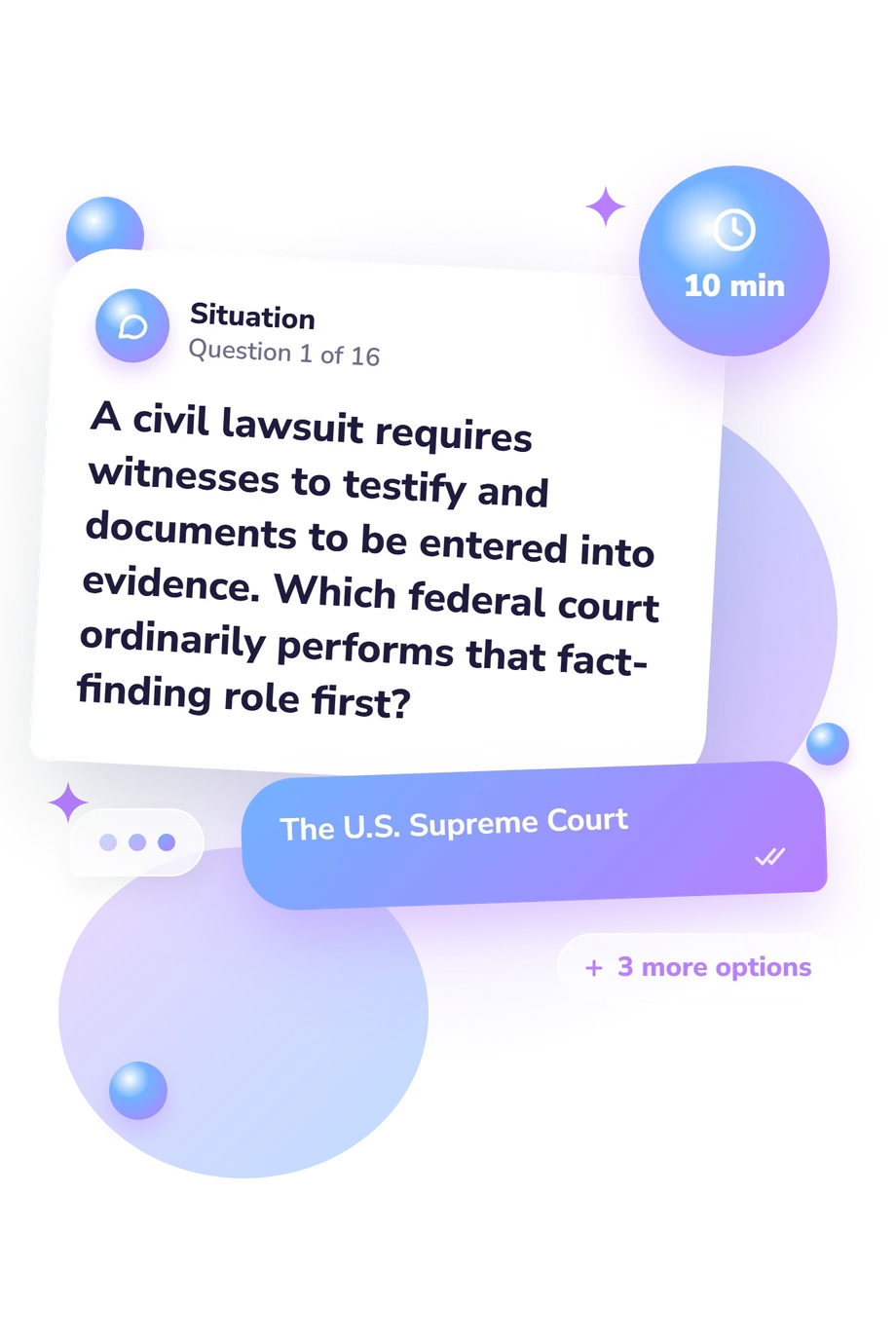
Example Questions From the Test
- Article III
- Article I
- Article IV
- Article VI
- The Supreme Court
- The United States government
- The alleged victim acting as the government
- The state legislature
- Conduct a completely new trial with a new jury
- Ask the executive branch to settle the case
- Rewrite the disputed statute before deciding the appeal
- Review the lower court’s proceedings for relevant legal error
Judicial Branch Quiz - Description and methodology of the test
For students, civics learners, and anyone reviewing how federal courts work, this judicial branch quiz offers a focused way to examine constitutional distinctions. It suits readers who want to distinguish trial and appellate functions, understand judicial independence, or revisit the Supreme Court’s place in the system. A review of this federal judicial-branch quiz can help learners compare those functions and roles before class or independent reading.
What This Assessment Explores
The questionnaire measures practical knowledge of the U.S. federal judicial branch, not attitudes or personality. Topics include Article III, federal-question jurisdiction, original and appellate jurisdiction, standing, judicial review, precedent, certiorari, appointments, impeachment, and the division of responsibility among courts. For a learner taking a federal courts quiz, the score indicates an overall knowledge band and supplies the broad review guidance attached to that band.
The displayed Judicial Branch Knowledge scale runs from 0-16 and is organized through the following bands:
- Foundations to build (0-6) indicates that core concepts such as constitutional authority, jurisdiction, and court procedure need review.
- Developing knowledge (7-12) indicates that many central ideas are understood, while some distinctions or applications remain uneven.
- Strong knowledge (13-16) indicates a well-developed grasp of federal courts and judicial checks.
These labels describe the educational meaning of the score and point toward topics for further study.
Methodology and Scientific Basis
Each item presents a short constitutional or federal-court situation with four answer choices. Selecting the best answer tests recognition and application of civic knowledge rather than free-form legal reasoning. The result summarizes performance across the full set; no additional scoring formula or weighting should be inferred from the displayed range.
The questionnaire is conceptually consistent with the Federal Judicial Center overview of court roles, jurisdiction, procedure, and judicial independence and with the authorities described below; it is not a direct administration or validated adaptation of any one of them. The constitutional logic is consistent with Marbury v. Madison, particularly judicial review. Hall and McGuire provide institutional context, while Gibson and Caldeira’s study addresses the challenge of measuring public knowledge about the Supreme Court.
As a judicial branch test, it is an online educational self-check. Its documented scoring presents an overall knowledge band; guessing, terminology familiarity, and current study context can affect answers. Use the result to guide review of constitutional authority, jurisdiction, court roles, and judicial checks, then confirm difficult points in authoritative legal and civics materials.
- Federal Judicial Center. Federal Courts and What They Do. 2006.
- Hall, Kermit L., and Kevin T. McGuire, eds. Institutions of American Democracy: The Judicial Branch. Oxford University Press, 2005.
- Gibson, James L., and Gregory A. Caldeira. "Knowing the Supreme Court? A Reconsideration of Public Ignorance of the High Court." The Journal of Politics 71, no. 2 (2009): 429-441. 10.1017/S0022381609090379.
- Marbury v. Madison, 5 U.S. (1 Cranch) 137 (1803).
Updated: