
What Bear Am I Quiz
How the Scales are Structured
Who Usually Takes This Test?
See How You Compare
Below is a preview of how scores are typically distributed across each scale.
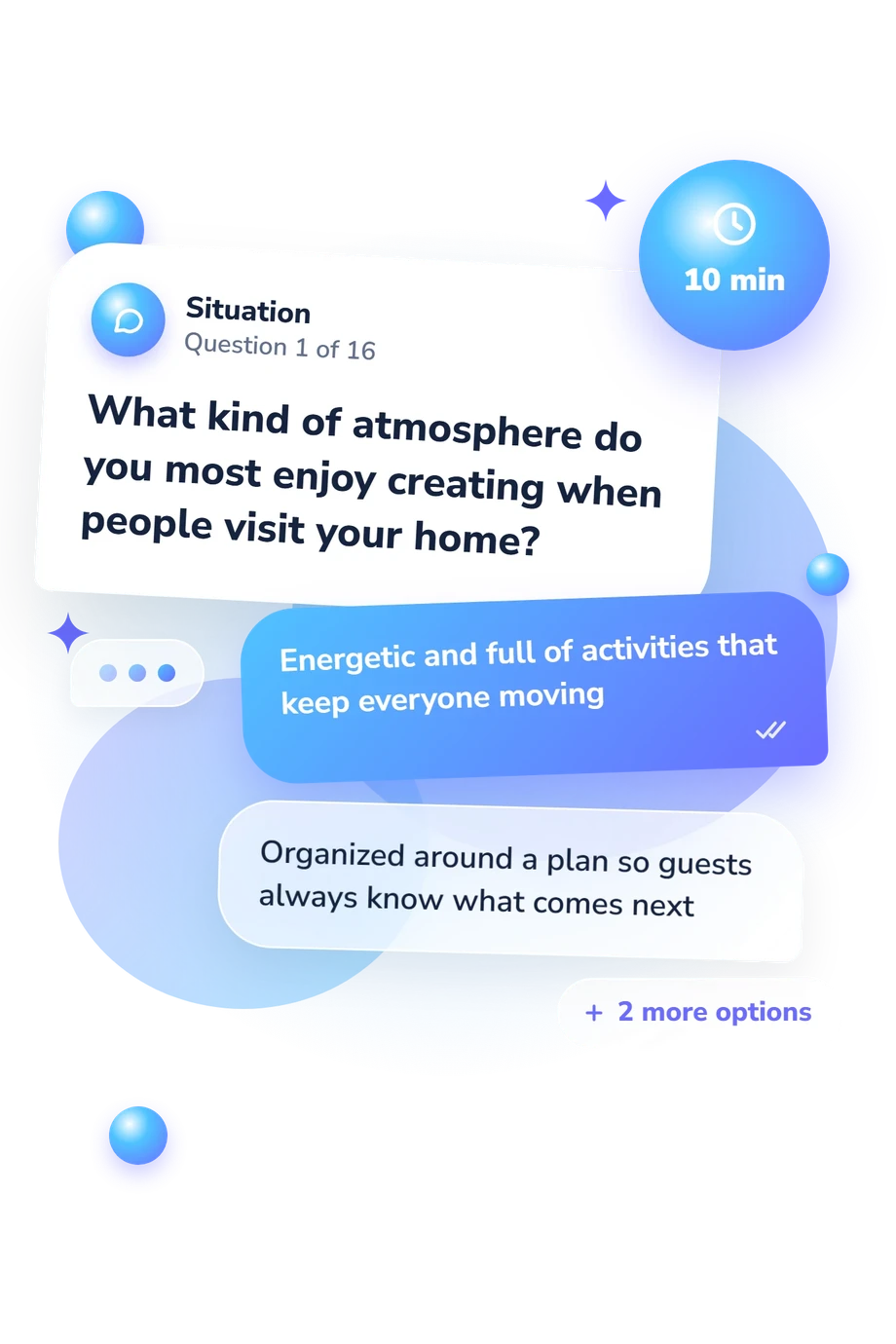
Example Questions From the Test
- Start an ambitious task while I have the extra opening
- Catch up on practical errands that have been waiting
- Mix one useful activity with something relaxing
- Settle into a favorite comfort and let the hours unfold slowly
- The chance to take on a fresh and demanding challenge
- Enough control to organize my priorities efficiently
- Open time to reconnect with people and interests I enjoy
- Small peaceful rituals that let me exist without rushing
- Encourage both to slow down, feel heard, and lower the tension
- Help them identify a compromise that each can accept
- Offer my honest view of which argument is more convincing
- Suggest they resolve it directly without placing me in the middle
What Bear Am I Quiz - Description and methodology of the test
People drawn to animal symbolism can use the What Bear Am I Quiz to reflect on how they approach decisions, relationships, challenge, change, and rest. It suits anyone curious about a playful personality profile, especially readers who want language for contrasting tendencies rather than a single label. As a bear personality quiz, it turns familiar choices into an easy-to-read pattern and highlights a leading affinity or possible blend.
What This Assessment Explores
This questionnaire groups everyday preferences into four bear affinities. Situations involving relationships, change, challenge, recovery, and curiosity show how these tendencies combine in your profile. As a bear personality test, it describes preferences rather than a fixed identity.
The result types are:
- Black Bear (0-12) reflects adaptability, practical curiosity, resourcefulness, and flexible social energy; Steady Specialist (0-4), Flexible Forager (5-8), and Black Bear Spirit (9-12) show increasing flexibility.
- Grizzly (0-12) reflects bold action, direct communication, independence, and protective leadership; Quiet Presence (0-4), Grounded Strength (5-8), and Grizzly Spirit (9-12) show increasing assertiveness.
- Panda (0-12) reflects gentleness, harmony, playful comfort, and an unhurried pace; Active Current (0-4), Easy Balance (5-8), and Panda Spirit (9-12) show increasing calm.
- Polar Bear (0-12) reflects composure, strategic thinking, endurance, and purposeful solitude; Shared Momentum (0-4), Measured Explorer (5-8), and Polar Bear Spirit (9-12) show increasing self-reliance.
Methodology and Evidence Base
Each prompt offers four situational choices, and you select the response closest to your usual reaction. Decisions, encounters, obstacles, routines, unfamiliar tools, and recovery keep the self-report concrete.
The displayed scale scores are compared across the four profiles. The highest displayed scale score indicates the strongest affinity; any other scale within one point of it contributes to a blended result. This comparison highlights the pattern most evident across your selected responses and shows when two affinities are close enough to read together.
Its conceptual framework is consistent with Zoomorphy (Sommer & Sommer, 2011), which treats animal metaphors as ways to describe human personality. Goldberg (1990) supplies a trait-oriented context, and Gosling (2001) connects animal research with personality thinking. The cited works do not validate these exact items or establish norms for these scores.
Answers are self-reported, so mood, recent experience, self-awareness, and socially desirable responding can influence the result. Explore which bear personality traits feel most familiar, reading the strongest score as a relative tendency and a near tie as a blended pattern whose expression may vary by situation.
- Sommer, Robert, and Barbara A. Sommer. "Zoomorphy: Animal Metaphors for Human Personality." Anthrozoös, vol. 24, no. 3, 2011, pp. 237-248. 10.2752/175303711X13045914865024
- Goldberg, Lewis R. "An Alternative Description of Personality: The Big-Five Factor Structure." Journal of Personality and Social Psychology, vol. 59, no. 6, 1990, pp. 1216-1229. 10.1037/0022-3514.59.6.1216
- Gosling, Samuel D. "From Mice to Men: What Can We Learn About Personality From Animal Research?" Psychological Bulletin, vol. 127, no. 1, 2001, pp. 45-86. 10.1037/0033-2909.127.1.45
Updated: