
Electrical Safety Quiz
How the Scales are Structured
Who Usually Takes This Test?
See How You Compare
Below is a preview of how scores are typically distributed across each scale.
Example Questions From the Test
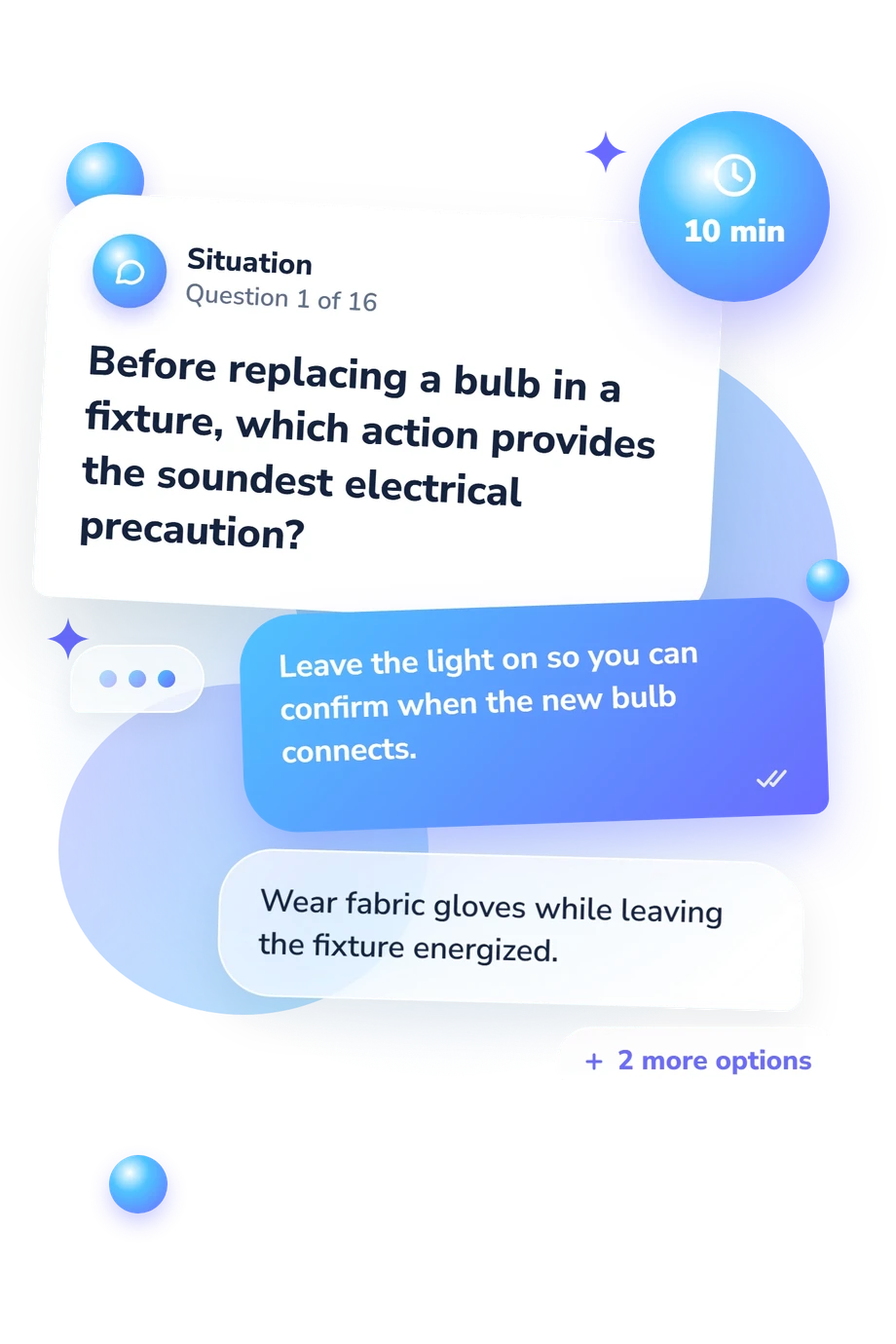
- Leave the light on so you can confirm when the new bulb connects.
- Wear fabric gloves while leaving the fixture energized.
- Disconnect or isolate the power using the appropriate control, ensure it cannot be restored unexpectedly, and let the bulb cool.
- Touch the metal fitting briefly to check whether current is present.
- The rug can reduce the voltage reaching the connected appliance.
- Heat and damage can go unnoticed, increasing the chance of insulation failure or fire.
- The rug can cause the electricity to flow into nearby furniture.
- The cord will automatically draw more current whenever it is covered.
- Pull the cord steadily while supporting it near the appliance.
- Twist the cord until the plug loosens from the outlet.
- Insert a thin object beside the plug to lever it out.
- Grip the plug body and pull it out without tugging the cord.
Electrical Safety Quiz - Description and methodology of the test
People who want to check their understanding of everyday electrical hazards can use this electrical safety quiz as a focused self-assessment. It is intended for anyone who handles household, workplace, or maintenance equipment and wants to recognize safer decisions before acting. The result highlights topics worth reviewing when a situation involves live energy, damaged equipment, or uncertain isolation. The electrical safety questions emphasize judgment in realistic situations.
What This Assessment Explores
Rather than measuring trade skill or certifying a worksite, the questionnaire checks whether a person can recognize safer decisions in common situations. It focuses on recognizing protective actions: isolating energy, avoiding contact, protecting equipment, and knowing when a fault requires qualified help.
Presented as a quiz with answers about electrical safety, it uses scenarios involving cords, breakers, grounding, water, power lines, shock response, and stored charge. The result reflects recognition of protective actions, not physical competence.
Electrical Safety Knowledge is reported on 0-16, with Foundations to build (0-6), Developing knowledge (7-12), and Strong knowledge (13-16). The result touches on:
- Isolation and lockout show whether the respondent recognizes the need to prevent unexpected energization before work.
- Overcurrent and equipment condition show whether overloads, faults, and damage are recognized.
- Emergency exposures test whether distance, warning, and safe reporting are chosen.
Methodology and Evidence Base
Each item presents a brief situation and four response options, asking the respondent to select the action that best controls the hazard. As an electrical safety test, it emphasizes applied recognition rather than calculations or personality traits.
The questionnaire produces the displayed total, while the point-by-point weighting of individual responses is unspecified. The result is an unvalidated educational indicator, not certification or proof that a setting is safe.
The content is conceptually consistent with the NIOSH Electrical Safety Manual (Fowler et al., 2009), particularly its treatment of isolation, grounding, overcurrent, shock, and stored energy. This questionnaire is not an adaptation of that manual.
Sokas et al. (2009) and McCann et al. (2003) provide background on electrical-safety training and injury mechanisms, not evidence that this online questionnaire is validated. They are relevant context for scenarios about isolation, overload, shock response, and stored energy, but they do not establish the score's measurement quality.
An electrical hazard quiz can reveal recognition gaps, but results depend on attention, current knowledge, and whether selected actions match behavior under pressure. An immediate hazard takes priority over any score.
- Fowler, Thaddeus W., Karen K. Miles, Michael McCann, and Carol M. Stephenson. Electrical Safety: Safety and Health for Electrical Trades - Student Manual (Revised Edition). Cincinnati, OH: National Institute for Occupational Safety and Health, 2009. 10.26616/NIOSHPUB2009113
- Sokas, Rosemary K., Emile Jorgensen, Leslie Nickels, Weihua Gao, and Janie L. Gittleman. An Intervention Effectiveness Study of Hazard Awareness Training in the Construction Building Trades. Public Health Reports, 124(Suppl 1), 161-168, 2009. 10.1177/00333549091244S118
- McCann, Michael, Katherine L. Hunting, Judith Murawski, Risana Chowdhury, and Laura Welch. Causes of Electrical Deaths and Injuries Among Construction Workers. American Journal of Industrial Medicine, 43(4), 398-406, 2003. 10.1002/ajim.10198
Updated: