
Similar Triangles Quiz
How the Scales are Structured
Who Usually Takes This Test?
See How You Compare
Below is a preview of how scores are typically distributed across each scale.
Example Questions From the Test
- 47°
- 68°
- 65°
- 115°
- 4
- 3
- 6
- 2
- AA similarity
- SSS similarity
- SAS similarity
- The Pythagorean theorem
Similar Triangles Quiz - Description and methodology of the test
Students and independent learners can use this similar triangles quiz to connect proportional-geometry rules with calculations. Reviewing answers from this quiz on similar triangles can help learners focus their review of triangle-similarity concepts. It examines similarity evidence, corresponding parts, scale factors, lengths, perimeters, shadows, and areas, giving a focused picture of current geometry knowledge.
What This Assessment Measures
Questions connect geometry with numerical consequences. Triangle similarity questions cover dilation, angle and side correspondence, AA, SAS, and SSS reasoning, parallel lines, and proportional calculations with lengths, shadows, perimeters, and areas. Together, they contribute to one broad result reflecting recognition and application of similar-triangle relationships, not separate group scores.
Results use Similar Triangles Knowledge (0-16). Foundations to Review (0-6) calls for reviewing correspondence, proportional sides, and basic criteria; Developing Knowledge (7-12) shows core understanding with practice needed for scale factors or valid evidence; Strong Knowledge (13-16) indicates consistent application across conceptual and calculation-based problems.
The question themes are:
- Correspondence shows whether you match angles, sides, and vertex order.
- Criteria reasoning shows whether you identify AA, SAS, and SSS evidence.
- Scale-factor work shows accuracy with lengths, perimeters, areas, and shadows.
- Applications show whether you transfer relationships to dilation and parallel-line setups.
Methodology and Evidence Base
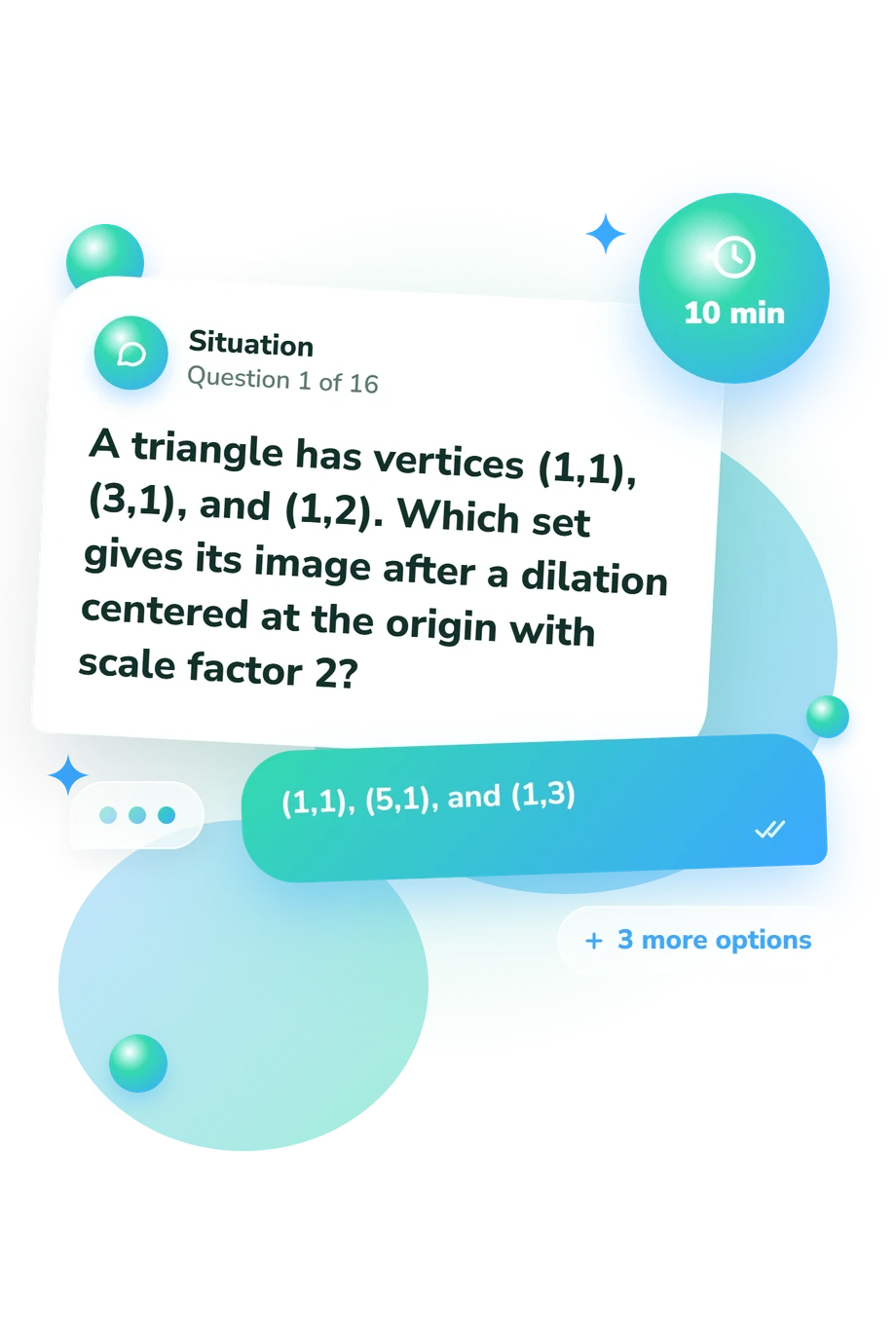
Each item presents a geometry prompt with four answer choices. You identify corresponding parts, select a similarity criterion, test side-ratio consistency, and apply scale factors to lengths, perimeters, and areas. Coordinate dilation and a shadow problem extend the set beyond definition recall.
The questionnaire reports one overall score. Its response-to-score rule and any normative comparison are not specified. The bands can guide similar triangles practice by indicating whether broad review or additional practice may be useful, but they do not identify particular weak topics or establish overall mathematical ability.
A study focused on triangle similarity examines correspondence, proportional reasoning, and difficulties with triangle-similarity problems, making its subject matter directly relevant to the themes here. Another study discusses educational context for learning these relationships through visual and dynamic representations. This questionnaire is conceptually consistent with those works, not an adaptation or restandardized version.
Prior instruction, concentration, guessing, and answer-selection habits can affect responses, so interpret the result alongside worked problem-solving and targeted review.
- Abdullah Cagri Biber. "Students' Difficulties in Similar Triangle Questions." Cypriot Journal of Educational Sciences, 15(5), 1146-1159, 2020. 10.18844/cjes.v15i5.5161
- Kin Keung Eric Poon and Kwan Lam Wong. "Pre-constructed dynamic geometry materials in the classroom: How do they facilitate the learning of 'Similar Triangles'?" International Journal of Mathematical Education in Science and Technology, 48(5), 735-755, 2017. 10.1080/0020739X.2016.1264636
Updated: