
Which Charmed Sister Are You Quiz
How the Scales are Structured
Who Usually Takes This Test?
See How You Compare
Below is a preview of how scores are typically distributed across each scale.
Example Questions From the Test
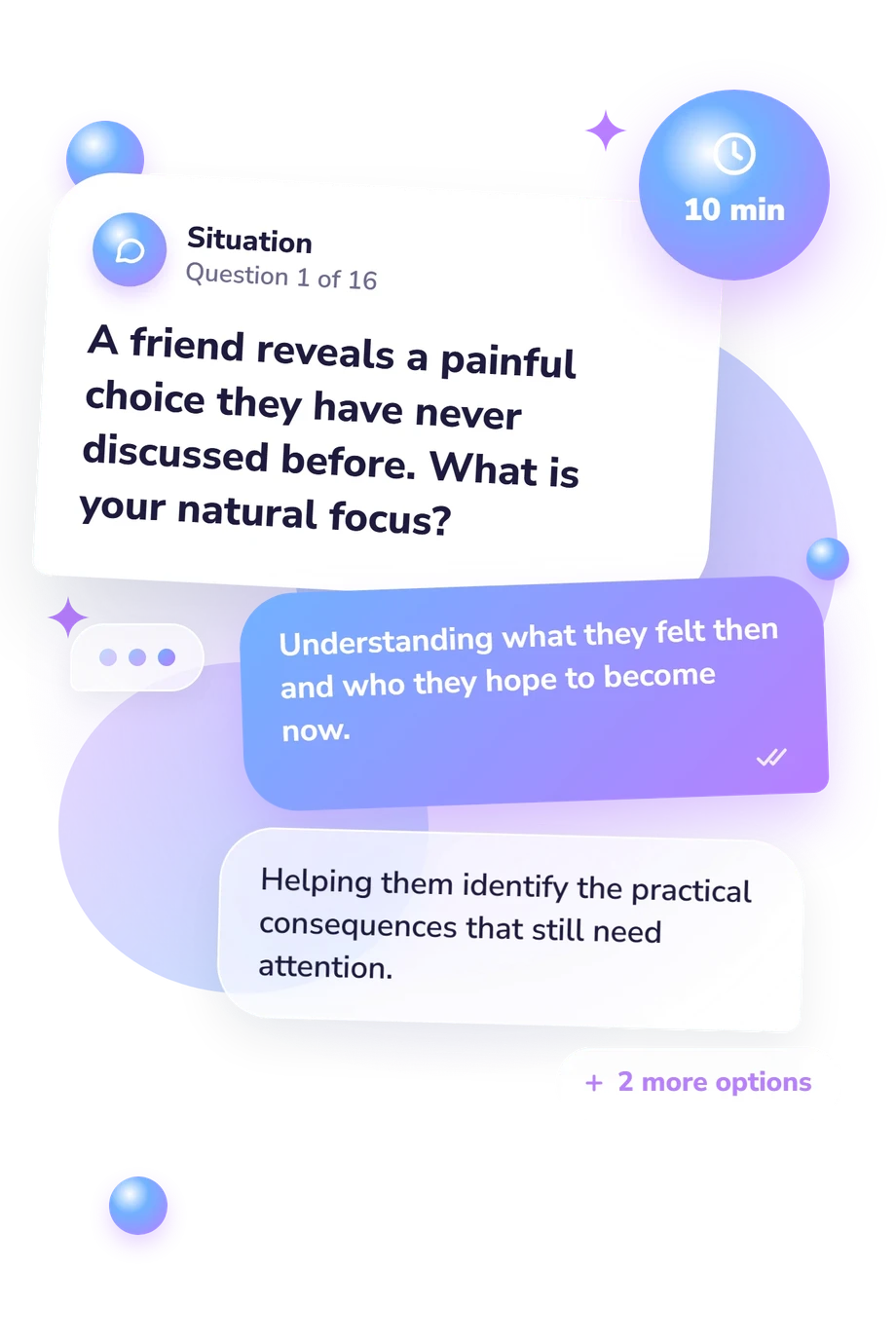
- Understanding what they felt then and who they hope to become now.
- Helping them identify the practical consequences that still need attention.
- Making the conversation feel steady, warm, and free of pressure.
- Deciding whether I need to step in and protect anyone affected.
- Follow whatever catches my attention and let the day unfold without a fixed plan.
- Choose one meaningful destination, then leave room for a little wandering.
- Research the main options and build an efficient route between them.
- Find a comfortable local spot and enjoy the atmosphere at an unhurried pace.
- Losing the chance to discover what the strange event might reveal.
- Having someone else dictate how I am supposed to respond.
- Watching people hesitate when immediate leadership is needed.
- Seeing hard-won normality disrupted yet again.
Which Charmed Sister Are You Quiz - Description and methodology of the test
For viewers drawn to the sisters’ contrasting approaches to relationships, responsibility, and independence, the Which Charmed Sister Are You Quiz turns those differences into situations you can compare with your own choices. Through personality-style scenarios, this Charmed sister personality test invites you to compare your approach with the sisters’ contrasting responses rather than recall plot details. The format gives viewers a way to examine why different approaches resonate in everyday situations.
What This Assessment Explores
Situations cover friendship, danger, authority, tradition, mistakes, group direction, intuition, and domestic disruption. Four response options make competing priorities visible, including emotional openness, practical steadiness, unconventional resourcefulness, and decisive protection. The Charmed personality quiz uses situational choices to emphasize self-recognition rather than trivia or plot recall.
These dimensions capture the four styles the questions contrast:
- Paige Matthews Affinity (0-12) measures unconventional resourcefulness and compassion: Different Center 0-4; Paige Notes 5-8; Strong Paige Affinity 9-12.
- Phoebe Halliwell Affinity (0-12) measures openness, intuition, empathy, and growth: Different Center 0-4; Phoebe Notes 5-8; Strong Phoebe Affinity 9-12.
- Piper Halliwell Affinity (0-12) measures warmth, steadiness, mediation, and family-centered resolve: Different Center 0-4; Piper Notes 5-8; Strong Piper Affinity 9-12.
- Prue Halliwell Affinity (0-12) measures decisive responsibility, ambition, and protective leadership: Different Center 0-4; Prue Notes 5-8; Strong Prue Affinity 9-12.
Methodology and Psychological Basis
Each item presents a short situation with four response options, each emphasizing a different way of handling it. Answers feed four character-affinity scores rather than one total. The highest score is the strongest affinity, and any other score within one point joins it in a blended result. The response pattern works as a which charmed character are you quiz, showing which Charmed character you most resemble rather than measuring right-or-wrong performance.
The 2008 edited volume by Beeler and Beeler provides context for the sisters’ contrasting identities and roles, making the questionnaire conceptually consistent with their characterization. Cohen (2001) and Rarity, Leitao, and Rutchick (2022) connect media-character identification with psychological connection and perceived sharing of character traits. The questionnaire is conceptually consistent with that identification theory, but no cited instrument was adapted and these sources do not validate its scoring.
Self-report can shift with current mood, self-image, familiarity with the series, and how each scenario is understood, especially when several approaches feel equally plausible. The displayed bands are descriptive affinity categories, so the result may vary with those influences.
- Beeler, Stan, and Karin Beeler, eds. Investigating Charmed: The Magic Power of TV. I.B. Tauris, 2008.
- Rarity, Erica C., Matthew R. Leitao, and Abraham M. Rutchick. "Identification With Characters in Parasocial Relationships Predicts Sharing Their Personality Traits." Psychology of Popular Media, 11(2), 111-116, 2022. 10.1037/ppm0000389
- Cohen, Jonathan. "Defining Identification: A Theoretical Look at the Identification of Audiences With Media Characters." Mass Communication and Society, 4(3), 245-264, 2001. 10.1207/S15327825MCS0403_01
Updated: