
Middle East and North Africa Capitals Quiz
How the Scales are Structured
Who Usually Takes This Test?
See How You Compare
Below is a preview of how scores are typically distributed across each scale.
Example Questions From the Test
- Nouakchott
- Bamako
- Rabat
- Dakar
- Tripoli
- Amman
- Beirut
- Damascus
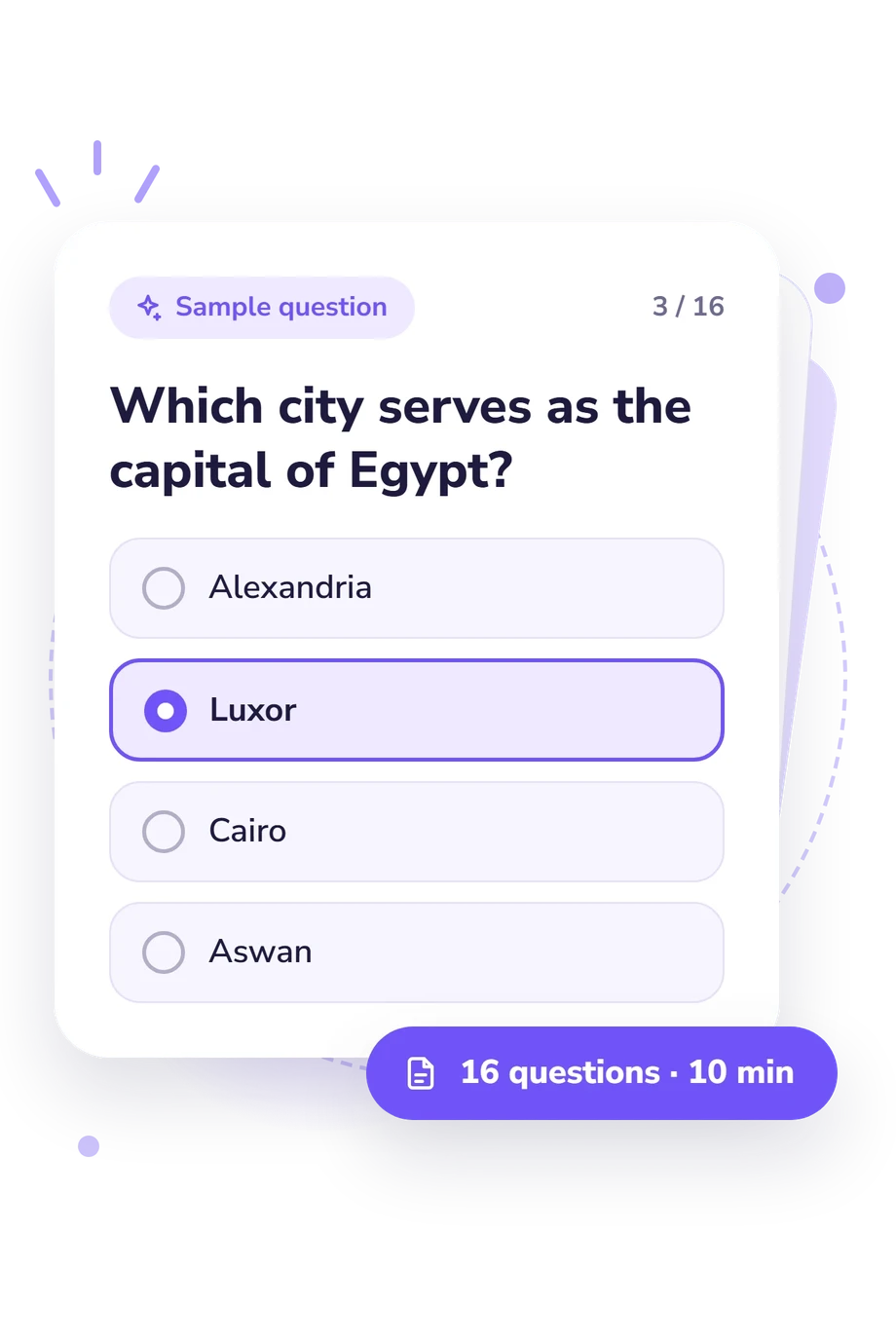
- Alexandria
- Luxor
- Cairo
- Aswan
Middle East and North Africa Capitals Quiz - Description and methodology of the test
People checking their regional geography can use this assessment to examine how securely they connect countries with their national capitals. The Middle East and North Africa Capitals Quiz turns familiar-looking city names into a focused recognition task using four answer choices for learners, travelers, students, and curious adults. Its situations include travel, news, conferences, and country-capital comparisons. As a regional capitals quiz, it checks regional knowledge.
What This Assessment Explores
This assessment measures recognition of national capitals across the Middle East and North Africa for learners, travelers, and curious adults. Each item presents alternatives, and the overall score from this country capitals quiz can guide regional study.
These groups show the distinctions tested:
- North African capitals show whether neighbors match cities.
- Levant capitals show whether you separate Beirut, Amman, and Damascus.
- Gulf capitals show whether cities match countries.
- Wider capitals show whether recognition extends beyond familiar alternatives.
The displayed scale is Middle East and North Africa Capitals Knowledge (0-16). Foundations to build (0-6) means you recognize some capitals but may mix up neighbors or major cities; Developing knowledge (7-12) means you know many capitals and can strengthen regional distinctions; Strong knowledge (13-16) means you identify capitals accurately across most of the region, including commonly confused city-country pairings.
Methodology and Evidence
Each item presents four answer choices. Some ask directly for a capital; others use brief travel, news, conference, or country-capital situations. Alternatives include neighboring capitals, major cities, and other familiar places.
Through presented choices, the capital city quiz measures recognition. Each correct response adds one point, and the raw total maps to the displayed band. It describes performance on these choices, not general geographic ability.
De Witte and colleagues’ study of factual learning in an immersive-learning context offers limited conceptual context. Hoffman and Crutch’s work concerns geographical knowledge and spatial processing, but these items do not measure spatial ability. A United Nations geographical-names reference supports the capital-country facts. None of these sources validates this questionnaire, and no spatial subscale is established.
Performance can vary with schooling, travel experience, language, revision, attention, and guessing. Use the raw score to guide further regional study while treating it as a snapshot under these task conditions.
- De Witte, Benjamin, Vincent Reynaert, Jerome Hutain, Danny Kieken, Joseph Jabbour, and Jalal Possik. “Immersive learning of factual knowledge while assessing the influence of cognitive load and spatial abilities.” Computers & Education: X Reality, vol. 5, 2024, article 100085. 10.1016/j.cexr.2024.100085.
- Hoffman, Paul, and Simon Crutch. “Knowing what and where: TMS evidence for the dual neural basis of geographical knowledge.” Cortex, vol. 75, 2016, pp. 151-159. 10.1016/j.cortex.2015.11.021.
- United Nations Group of Experts on Geographical Names. “List of country names and capitals: Summary.” Submitted by Cyprus, E/CONF.101/97/Add.1. New York: United Nations, 2012.
Updated: