
Egyptian Mythology Quiz
How the Scales are Structured
Who Usually Takes This Test?
See How You Compare
Below is a preview of how scores are typically distributed across each scale.
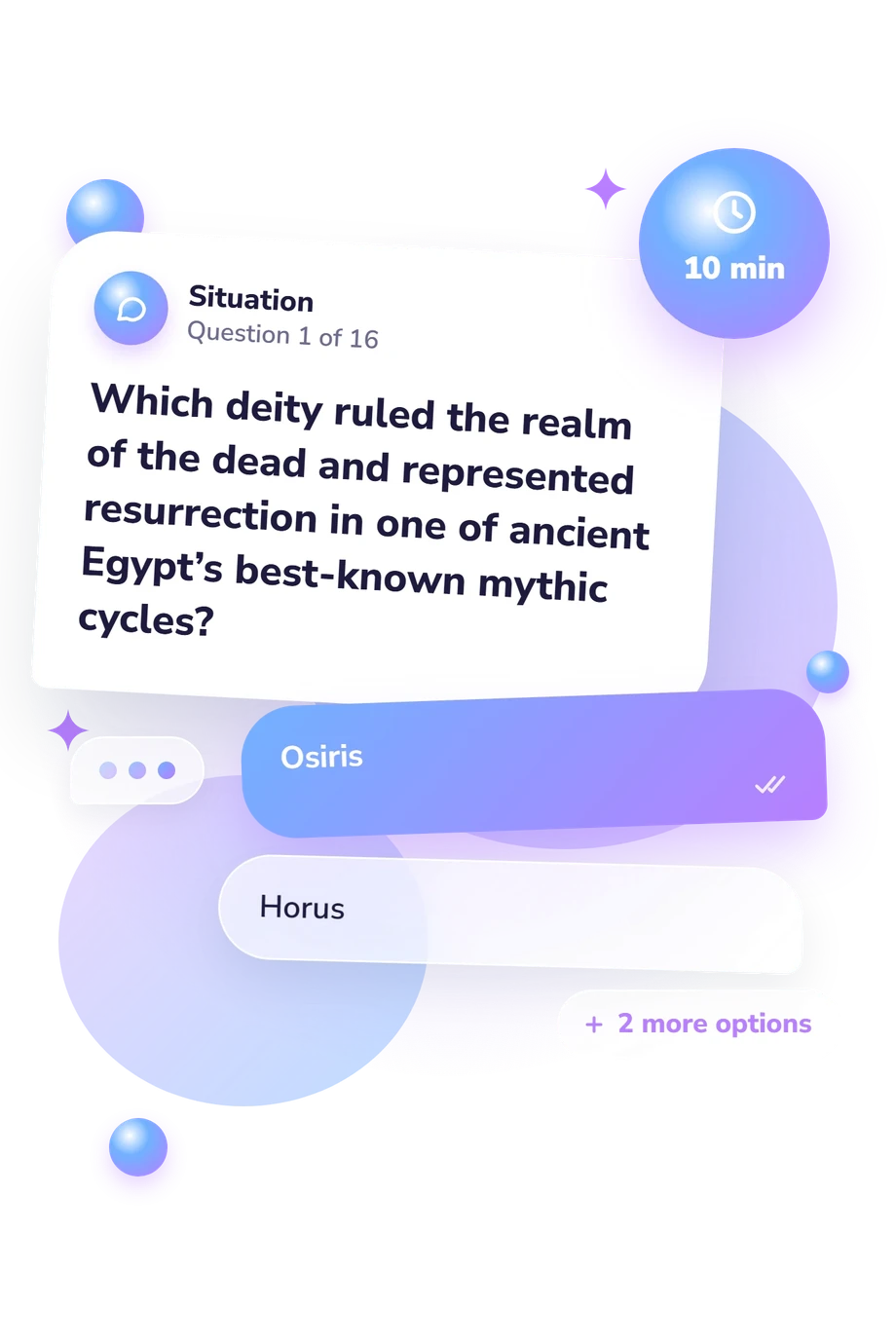
Example Questions From the Test
- Osiris
- Horus
- Aten
- Sobek
- Hathor
- Bastet
- Neith
- Isis
- Shu
- Montu
- Hapi
- Khonsu
Egyptian Mythology Quiz - Description and methodology of the test
Built for readers who want a clearer map of ancient Egyptian religion, the Egyptian Mythology Quiz tests recognition of deities, symbols, sacred texts, and beliefs about kingship and the afterlife. It suits curious learners, students, and anyone revisiting familiar names. The result can turn scattered facts into a useful guide for further reading about ancient Egyptian mythology.
What This Assessment Explores
Rather than measuring isolated names, the assessment samples parts of Egyptian religious culture. It covers deities, mythic episodes, symbols, sacred texts, funerary customs, and royal worship. Alongside its wider mythology coverage, the assessment functions as an Egyptian god quiz that links deity questions with broader traditions.
The main thematic areas are:
- Deities and roles show links among domains, relationships, symbols, and myths.
- Symbols and imagery test recognition of objects such as the Wedjat, djed, solar disk, and feather of Ma’at.
- Funerary beliefs cover judgment, resurrection, mummification, protected organs, and hopes for the afterlife.
- Texts and contexts test mortuary writings, temple traditions, and the Aten’s royal promotion.
These themes are sampled together, while a single total score summarizes performance across the full set.
Egyptian Mythology Knowledge (0-16) is reported as Foundations to Build (0-6), Developing Knowledge (7-12), or Strong Knowledge (13-16).
Methodology and Evidence Base
Each item presents a question with four answer choices. Some ask for direct recognition, such as identifying a deity from an animal-headed image; others require applied recall from a monument, hymn, amulet, or funerary scene. Egyptian mythology questions therefore test connections, not only memorized labels.
The score counts correct answers, and the result bands indicate increasing command of the sampled material. The displayed score describes performance on these 16 items; it should not be treated as a normed ability measure unless standardization evidence is documented. Results can vary with prior study, memory, and interpretation of wording.
Historical references support the quiz's content rather than its measurement validity. Pinch’s overview of Egyptian deities supplies context for their roles, symbols, traditions, and historical settings. Funerary references include Faulkner’s translation of the Book of the Dead and Allen’s edition of the Pyramid Texts. These works are contextual touchpoints, not source instruments adapted into the questionnaire. A strong result indicates familiarity with the selected themes; a lower result indicates less success across the sampled questions and may motivate review of the represented material.
- Pinch, Geraldine. Egyptian Mythology: A Guide to the Gods, Goddesses, and Traditions of Ancient Egypt. Oxford University Press, 2004. ISBN 9780195170245.
- Faulkner, Raymond O., Ogden Goelet, Carol A. R. Andrews, J. Daniel Gunther, and James Wasserman. The Egyptian Book of the Dead: The Book of Going Forth by Day: The Complete Papyrus of Ani. 20th Anniversary ed., Chronicle Books, 2015. ISBN 9781452144382.
- Allen, James P. The Ancient Egyptian Pyramid Texts. 2nd ed., Society of Biblical Literature, 2015. 10.2307/j.ctt14jxv34.
Updated: