
Boat Quiz
How the Scales are Structured
Who Usually Takes This Test?
See How You Compare
Below is a preview of how scores are typically distributed across each scale.
Example Questions From the Test
- Its stern
- Its starboard side
- Its port side
- Its bow directly head-on
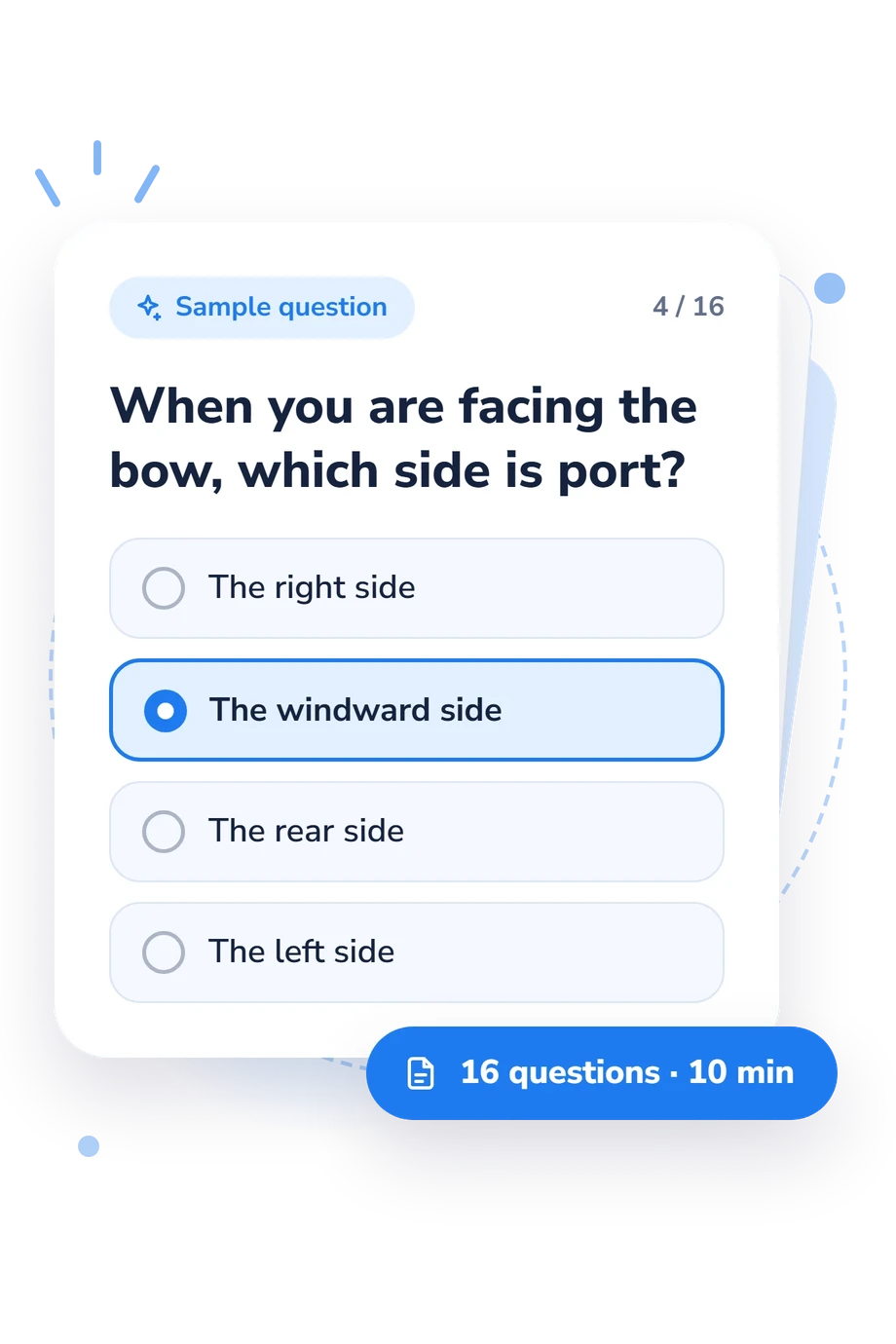
- The right side
- The windward side
- The rear side
- The left side
- The overtaking boat
- The boat being overtaken
- Whichever boat is traveling closer to shore
- Whichever boat has fewer people aboard
Boat Quiz - Description and methodology of the test
For anyone preparing to operate a recreational boat, the boat quiz offers a structured check of essential knowledge before time on the water. As a boat safety quiz, it suits learners, returning boaters, and people who want to identify gaps in basic safety awareness. The result gives one overall knowledge band rather than separate results for navigation, equipment, emergencies, or operating decisions.
What This Assessment Explores
Questions in this boating quiz address control, prevention, and response. Items cover storms, lights, right-of-way, draft, anchoring, carbon monoxide, flotation, and man-overboard action. The result describes practical knowledge, not boat-handling skill in real conditions.
These areas show what content contributes to the result:
- Navigation and collision awareness indicate recognition of lights, right-of-way, and safe course changes.
- Terminology and judgment show understanding of draft, scope, depth, and wake control.
- Emergency safety reflects familiarity with flotation, flooding, fumes, fueling, and recovery.
- Weather decisions indicate whether early action is recognized when conditions worsen.
Results appear on the Boat Knowledge scale, 0-16: Foundations to build (0-6) means core concepts need review; Developing knowledge (7-12) indicates many essentials with some gaps; Strong knowledge (13-16) indicates a solid grasp of covered principles, but this educational score is not certification or a safety guarantee.
Methodology and Evidence Base
The format is an online multiple-choice knowledge check: each item presents four answer options, and the respondent selects the safest or most accurate answer. Items move from terminology and navigation rules to hazards, prevention, and immediate response. The questionnaire reports one scale through the displayed bands; no separate item-level profile is presented.
As a boating knowledge test, it is conceptually consistent with Reichle's 1980 recreational-boating knowledge measure, a published measure of recreational boating safety knowledge. This questionnaire has its own item set and is not presented as an adaptation of that instrument. That relationship concerns shared subject matter and knowledge-check purpose, not identical items, scoring, or validation.
The displayed bands are educational categories and are best used to target review. A stronger result suggests broader recognition of covered principles, but it cannot establish practical competence across every vessel, waterway, weather condition, or crew. Guessing, current attention, and wording familiarity can affect scores; hands-on steering, lookout habits, equipment handling, and local rules require separate learning.
- Reichle, Marvin Noel. (1980). Development of an instrument to measure knowledge in recreational boating safety. Journal of Safety Research, 12(4), 157-162.
- Davis, Michael W., and Reichle, Marvin N. (1977). Boater Performance Course Resource Manual. Recreational Boating Institute, Inc., University of Tulsa.
- National Association of State Boating Law Administrators. (2016). ANSI/NASBLA 103-2016: Basic Boating Knowledge - Power. National Association of State Boating Law Administrators.
- Virk, Amanpreet, and Pikora, Terri J. (2011). Developing a tool to measure safe recreational boating practice. Accident Analysis and Prevention, 43(1), 447-450. 10.1016/j.aap.2010.09.016
Updated: