
Do I Hate My Boyfriend Quiz
How the Scales are Structured
Who Usually Takes This Test?
See How You Compare
Below is a preview of how scores are typically distributed across each scale.
Example Questions From the Test
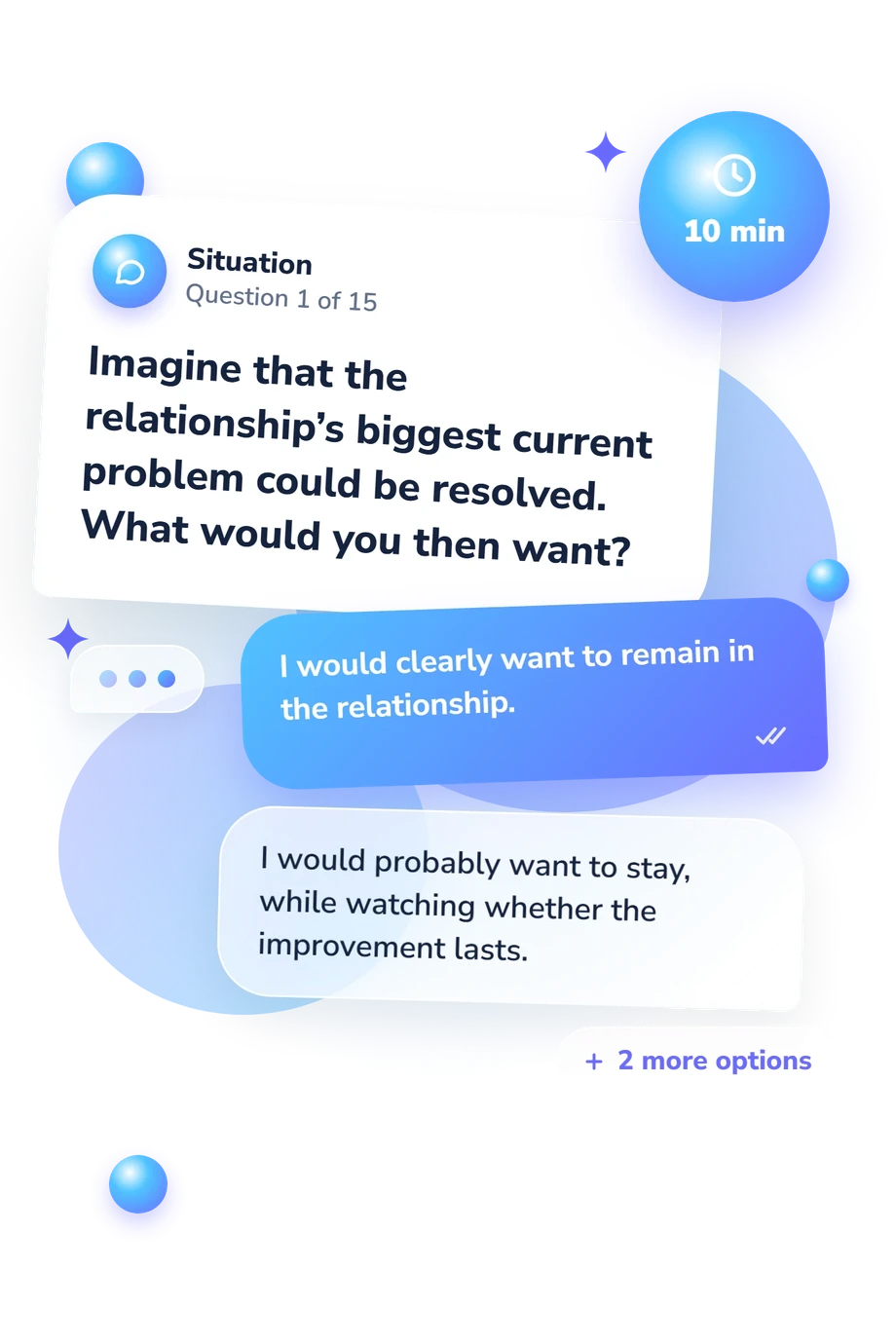
- I would clearly want to remain in the relationship.
- I would probably want to stay, while watching whether the improvement lasts.
- I would still be uncertain about whether the relationship fits me.
- I would still want the relationship to end.
- Affection usually feels natural and welcome.
- My response varies with mood, timing, and recent interactions.
- I often participate mainly because it seems expected.
- I regularly recoil, tense up, or look for a way to avoid the contact.
- I feel concern and want to understand what he is experiencing.
- I care, although my available attention depends on my own energy.
- I respond supportively on the surface but feel mostly detached inside.
- His need for support feels intrusive, and I resent being asked to engage.
Do I Hate My Boyfriend Quiz - Description and methodology of the test
If you are questioning your feelings toward a partner, the Do I Hate My Boyfriend Quiz helps you examine irritation, distance, and uncertainty. It is intended for people who want to reflect on recurring relationship patterns rather than rely on one intense moment. Your own reactions matter too, so the result can address the concern behind an am I annoying my boyfriend quiz while considering the wider dynamic.
What This Assessment Explores
These situations focus on how closeness and conflict feel from your side. They ask about affection, missing him after separation, sharing good news, tolerating disappointments, replaying arguments, imagining a future together, and willingness to repair.
Viewed in context, the result works as a boyfriend feelings quiz that separates passing annoyance from patterns involving resentment, doubt, or detachment. It describes your reported experience; it does not establish that you hate your boyfriend. The three displayed dimensions are:
- Accumulated Resentment (0-15) shows whether unresolved hurt colors present interactions: Limited buildup (0-5), Resentment accumulating (6-10), or Resentment dominating (11-15).
- Commitment and Repair Doubt (0-15) shows openness to continuing and repairing problems: Repair orientation (0-5), Genuine ambivalence (6-10), or Strong continuation doubt (11-15).
- Emotional Disconnection (0-15) shows whether warmth remains accessible: Connection available (0-5), Uneven connection (6-10), or Strong disconnection pattern (11-15).
Methodology and Scientific Basis
Each item presents a concrete relationship situation with four ordered response options. The choices move from welcome, concern, flexibility, or repair willingness toward irritation, avoidance, withdrawal, or desire to leave. This format captures immediate feelings and interpretations of repeated behavior without requiring a complete relationship history.
Scores are reported separately for the three dimensions. The answer-point formula is not stated, so read the numerical ranges through their displayed bands rather than reverse-engineering them. This relationship uncertainty quiz is an online self-report tool without documented standardization; its results support structured reflection, not clinical thresholds.
Its closest conceptual anchor is Resentment Rating Scale for Couples (Agbalog & Yukawa, 2019), particularly accumulated hurt and resentment in romantic relationships. Emotional distance is consistent with Barry, Lawrence, and Langer’s 2008 account of disengagement, while continuation doubts overlap with Niehuis and Bartell’s 2006 scale. These links describe shared constructs, not proof that this questionnaire is a validated adaptation.
Current stress, recent conflict, self-awareness, and the wish to justify staying or leaving can influence answers. Read the profile alongside patterns over time, boundaries, and whether discussion feels safe.
- Agbalog, F. C. M., & Yukawa, S. (2019). The Resentment Rating Scale for Couples (RRS-C): Development and Psychometric Properties of a Novel Scale for Measuring Resentment. International Journal of Psychiatry Research, 2(6), 1-12. 10.33425/2641-4317.1034
- Barry, R. A., Lawrence, E., & Langer, A. (2008). Conceptualization and assessment of disengagement in romantic relationships. Personal Relationships, 15(3), 297-315. 10.1111/j.1475-6811.2008.00200.x
- Niehuis, S., & Bartell, D. (2006). The Marital Disillusionment Scale: Development and psychometric properties. North American Journal of Psychology, 8(1), 69-84. 10.1037/t42162-000
Updated: