
Cause and Effect Quiz
How the Scales are Structured
Who Usually Takes This Test?
See How You Compare
Below is a preview of how scores are typically distributed across each scale.
Example Questions From the Test
- An event or condition that produces or contributes to a result
- The result that follows an event or condition
- A detail that describes when the result occurred
- A prediction made after the result is known
- Because the alarm failed, Nora arrived late.
- Strong winds caused several branches to fall.
- The heater stopped, so the room cooled.
- The room cooled because the heater stopped.
- The earliest event mentioned in a passage
- A condition that makes another event possible
- A word used to connect two unrelated details
- A result or change produced by a cause
Cause and Effect Quiz - Description and methodology of the test
People who want to examine how they reason about explanations, evidence, and everyday events can use this cause and effect quiz as a focused learning check. As a cause-and-effect quiz, it suits learners, educators, and curious adults who want to separate sequence from causation and recognize alternative explanations. The result points to current strengths and areas for further practice without reducing reasoning to a single label.
What This Assessment Explores
The assessment works as a causal reasoning quiz: it asks you to identify what produces an outcome, what follows it, and what evidence is needed before calling one event a cause. Scenarios include direct relationships, linked chains, common causes, competing explanations, and conditions that can alter an effect.
The question themes point to four abilities that shape the result:
- Cause and Effect Knowledge (0-16) summarizes performance: Foundation Building (0-6) indicates basic recognition; Developing (7-12) indicates growing control of causal chains and evidence; Strong (13-16) indicates consistent distinctions among causes, effects, correlations, and causal support.
- Immediate-cause recognition shows whether you can select the closest stated condition behind an outcome.
- Causal-chain tracking shows whether you can follow linked events without confusing an earlier cause with a later effect.
- Evidence evaluation shows whether you can notice confounding variables, supporting conditions, and stronger ways to test a claim.
Methodology and Evidence Base
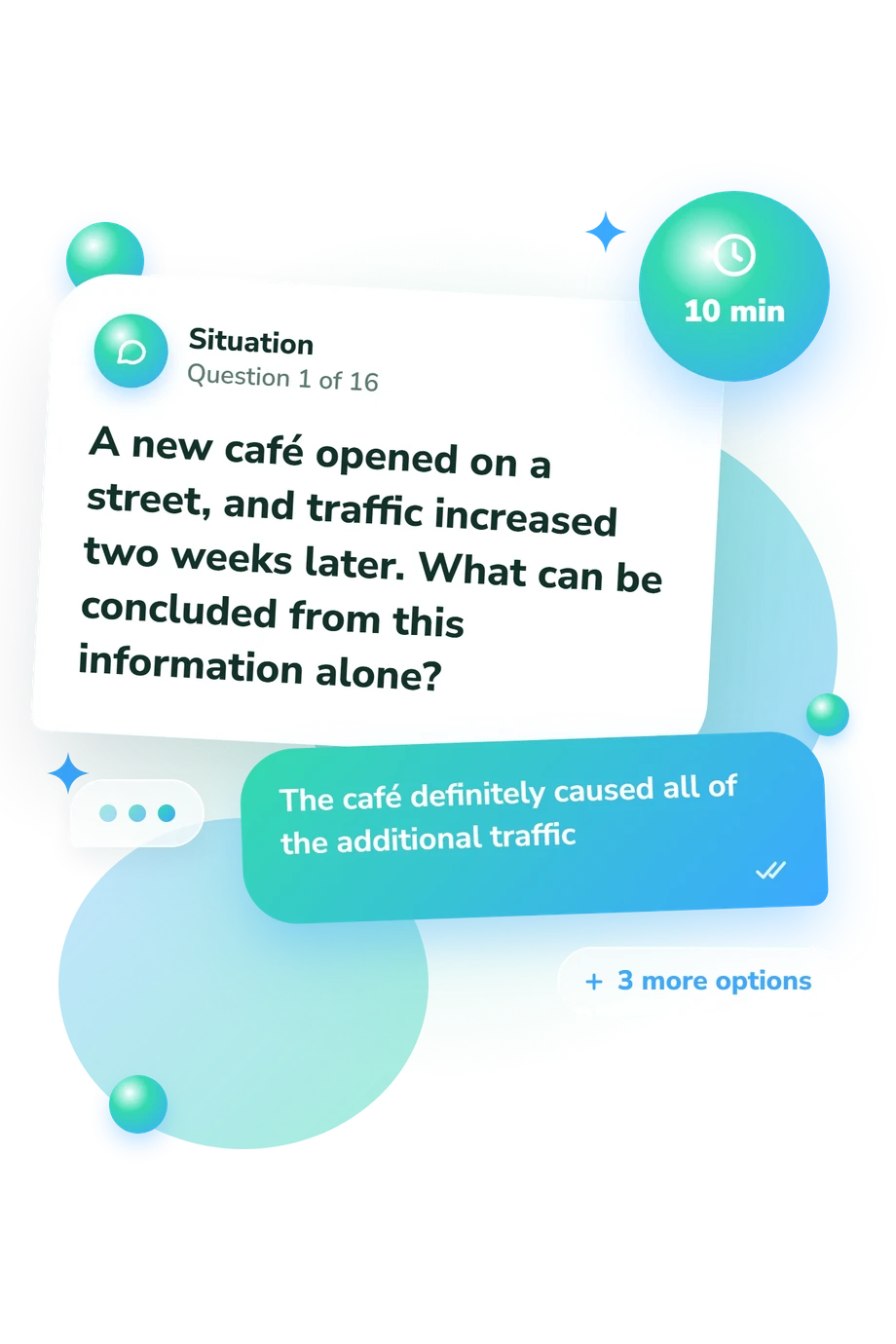
Each item presents a scenario, definition, or comparison with four answer choices. The prompts ask you to identify immediate causes or effects, follow a sequence, distinguish correlation from causation, recognize supporting conditions, or select evidence that would strengthen a causal claim. That structure makes the cause and effect test a multiple-choice reasoning exercise rather than a personality inventory.
Conceptually, the questionnaire is consistent with Shin and colleagues’ work on causal reasoning as an assessable ability; it is not presented as a direct adaptation or as sharing that study’s validation. Research by Shavlik and colleagues connects causal reasoning with early scientific literacy, while Pearl’s framework explains why temporal order alone does not establish causation and why alternative conditions matter.
The response-to-score rule is not specified, so no item weighting or point value should be inferred. The questionnaire also reports no norm group, reliability estimate, or clinical cutoff. Reading comprehension, attention, and familiarity with examples may affect performance, making the score a focused snapshot rather than a complete measure of analytical ability.
- Shin, Jongho, Hyunjoo Lee, Jung Ha Kim, Hyeyoung Hwang, Heekyung Kwon, and Jeong A Shim. (2008). A Study on Validating Causal Reasoning Ability Test for Children. Korean Journal of Educational Psychology, 22(2), 367-384.
- Shavlik, Margaret, Özgün Köksal, Brian F. French, Catherine A. Haden, Cristine H. Legare, and Amy E. Booth. (2022). Contributions of causal reasoning to early scientific literacy. Journal of Experimental Child Psychology, 224, 105509. 10.1016/j.jecp.2022.105509
- Pearl, Judea. (2009). Causality: Models, Reasoning, and Inference. 2nd ed. Cambridge University Press.
Updated: