
Career Interest Quiz for High School Students
How the Scales are Structured
Who Usually Takes This Test?
See How You Compare
Below is a preview of how scores are typically distributed across each scale.
Example Questions From the Test
- Invent the theme and develop its visual identity
- Handle room booking, supplies, and setup times
- Write announcements that turn the event into an appealing story
- Decorate the space using a theme the group has already selected
- Sort the source notes into factual categories
- Brainstorm several unusual angles before choosing one
- Adapt a successful format while adding some original details
- Build a straightforward outline around the required information
- Design and construct a working storage solution for a small space
- Create precise technical drawings for an existing product
- Study an economics case about how products are priced
- Develop and test several physical versions of a simple device
Career Interest Quiz for High School Students - Description and methodology of the test
Students weighing electives, activities, and possible work settings can use this career exploration quiz for students to compare the kinds of tasks that hold their attention. The career interest quiz for high school students produces a profile of current interests rather than a fixed career prediction. It can help a student notice promising directions, frame questions for further exploration, and choose experiences that test those preferences in practice.
What This Assessment Explores
School, project, volunteer, and community scenarios reveal preferences for evidence, expression, coordination, practical action, and helping others. This high school career quiz describes current interests, not intelligence, talent, or guaranteed career fit.
The result groups those preferences into five dimensions:
- Analytical Investigator (0-12) shows interest in evidence and research: Applied Observer (0-4), Curious Problem-Solver (5-8), or Evidence Explorer (9-12).
- Creative Communicator (0-12) shows interest in ideas and expression: Structured Contributor (0-4), Creative Adapter (5-8), or Imaginative Communicator (9-12).
- Enterprising Organizer (0-12) shows interest in goals and coordination: Focused Specialist (0-4), Project Contributor (5-8), or Initiative Driver (9-12).
- Practical Builder (0-12) shows interest in tools and tangible solutions: Concept-Oriented (0-4), Practical Explorer (5-8), or Hands-On Builder (9-12).
- Supportive Guide (0-12) shows interest in helping others: Independent Contributor (0-4), Responsive Helper (5-8), or People-Centered Guide (9-12).
Methodology and Scientific Basis
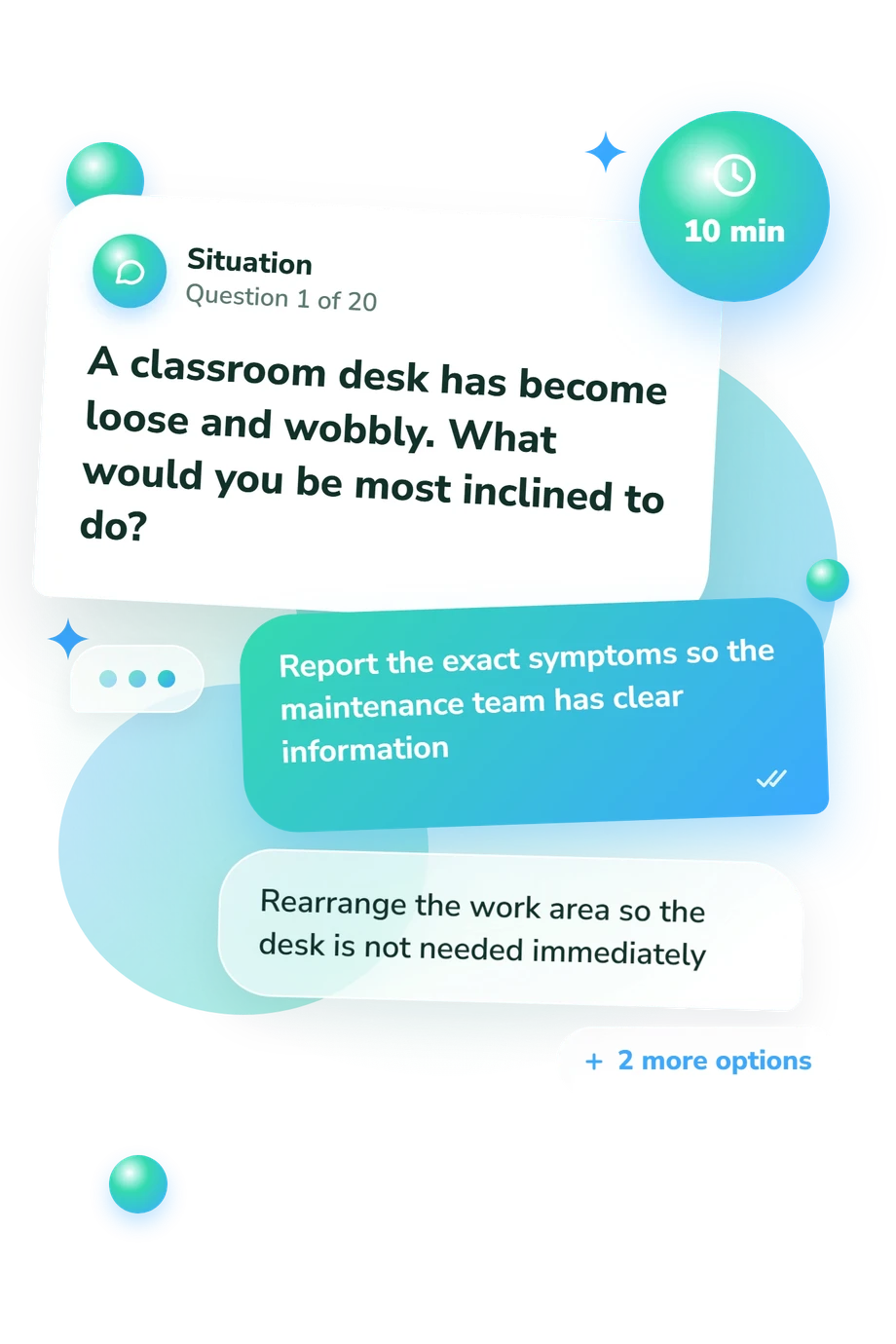
Each item presents a school, project, or community situation with four possible responses. The options contrast checking evidence, shaping a message, organizing a project, repairing an object, and helping someone learn. Choosing the most appealing response makes the format preference-based, not a knowledge test or a demand to name an occupation.
The scoring display groups responses into five interest dimensions and three bands. No point-by-point formula is stated, so results indicate current attraction rather than a percentile, ability estimate, or success prediction. Used as a student career interest test, this profile can suggest electives, clubs, volunteering, job shadowing, and other experiences worth trying.
This separate online questionnaire is not a standardized O*NET administration, but it is conceptually consistent with the O*NET Interest Profiler (Lewis & Rivkin, 1999) and Holland’s (1997) model. Rounds et al. (1999) examined the published O*NET tool; those findings do not automatically validate this questionnaire. Low et al. (2005) shows that vocational interests can change across development. Honest self-report, current circumstances, and limited self-awareness may shape the result, so compare it with persistence, skills, and real-world feedback.
- Lewis, P., & Rivkin, D. (1999). Development of the O*NET Interest Profiler. Raleigh, NC: National Center for O*NET Development.
- Rounds, J., Walker, C. M., Day, S. X., Hubert, L., Lewis, P., & Rivkin, D. (1999). O*NET Interest Profiler: Reliability, Validity, and Self-Scoring. Raleigh, NC: National Center for O*NET Development.
- Holland, J. L. (1997). Making Vocational Choices: A Theory of Vocational Personalities and Work Environments (3rd ed.). Psychological Assessment Resources.
- Low, K. S. D., Yoon, M., Roberts, B. W., & Rounds, J. (2005). The Stability of Vocational Interests from Early Adolescence to Middle Adulthood: A Quantitative Review of Longitudinal Studies. Psychological Bulletin, 131(5), 713-737. 10.1037/0033-2909.131.5.713
Updated: