
Is My Dog Spoiled Quiz
How the Scales are Structured
Who Usually Takes This Test?
See How You Compare
Below is a preview of how scores are typically distributed across each scale.
Example Questions From the Test
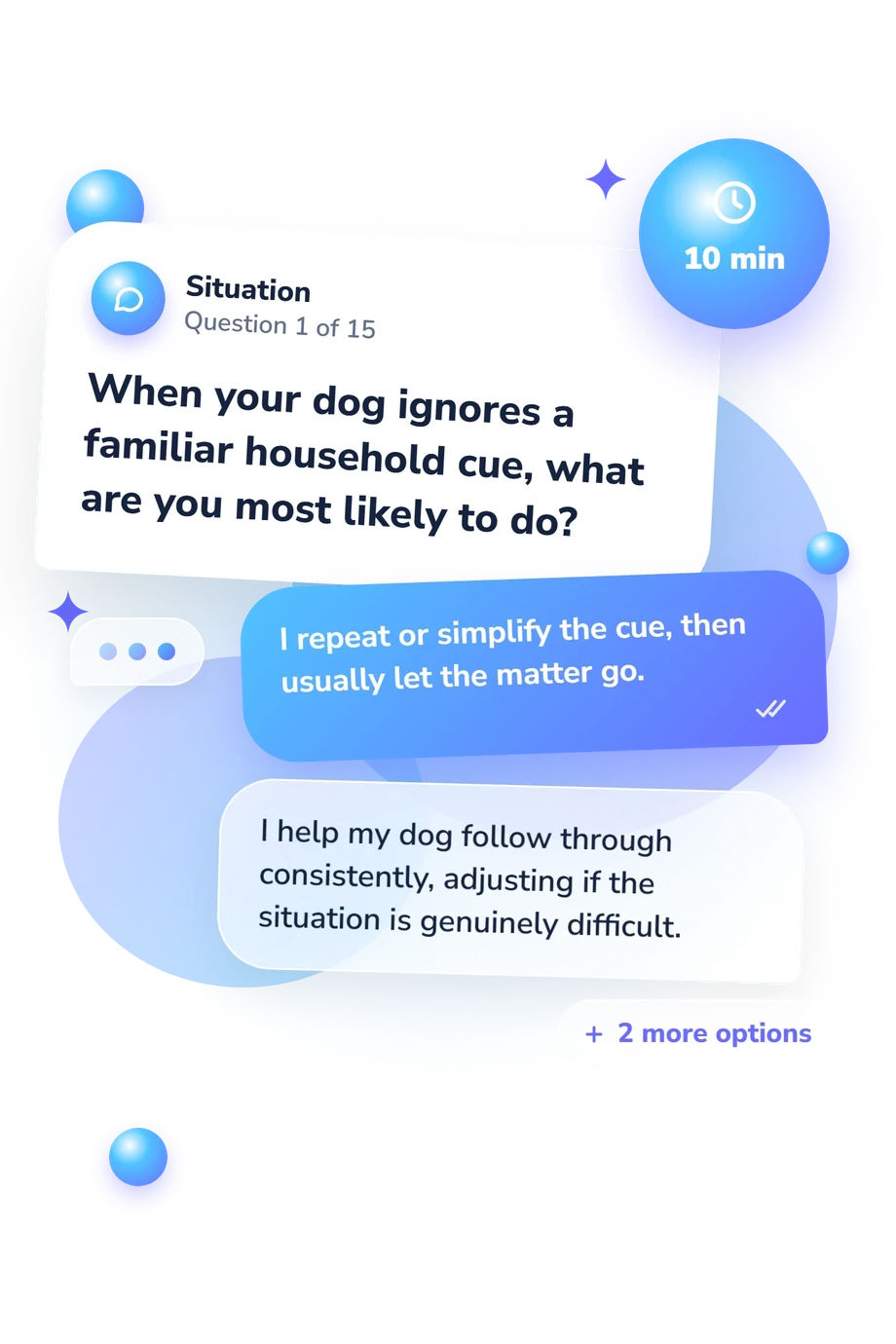
- I repeat or simplify the cue, then usually let the matter go.
- I help my dog follow through consistently, adjusting if the situation is genuinely difficult.
- I often decide the cue was not important after all.
- I usually follow through, though I make exceptions when I am rushed or tired.
- They are mostly planned around training, enrichment, or the dog’s overall food needs.
- They appear throughout the day whenever my dog looks expectant.
- I give several spontaneous treats, though I sometimes adjust meals to account for them.
- There are a few unplanned extras alongside generally measured portions.
- Whether it supports an identified need and suits my dog’s size, habits, and safety.
- Whether it will create an exciting reaction, even if a similar item is already available.
- A mix of usefulness and fun, with occasional purchases made mainly as a treat.
- Whether it feels luxurious or comforting, even when its practical value is limited.
Is My Dog Spoiled Quiz - Description and methodology of the test
People who wonder whether affection has become accommodation can use the Is My Dog Spoiled Quiz to examine everyday choices rather than judge the relationship. It is intended for dog owners who want a clearer picture of how attention, treats, routines, and limits are negotiated at home. As a spoiled dog test, it turns familiar moments into a structured reflection on consistency and wellbeing.
What This Assessment Explores
Questions cover petting, play, treats, food refusal, routine care, activity, greetings, furniture, and responses to household cues. They focus on what happens when persistence, comfort, or visible disappointment influences the owner’s next choice. Viewed as a practical how spoiled is my dog quiz, this assessment describes interaction patterns rather than assigning a fixed label.
The result separates three dimensions:
- Attention on Demand (0-15) shows whether persistence controls interaction: Balanced access (0-5), Responsive pattern (6-10), or Demand-led attention (11-15).
- Indulgence and Wellbeing Trade-offs (0-15) shows whether extras displace core care: Wellbeing-led treats (0-5), Frequent accommodation (6-10), or Indulgence-first pattern (11-15).
- Rules and Boundaries (0-15) shows how often limits bend: Steady structure (0-5), Selective flexibility (6-10), or Dog-shaped rules (11-15).
Methodology and Evidence Base
Each item presents a familiar situation with four response options. Choices distinguish between maintaining a need or boundary, making an accommodation, and letting repeated requests shape the outcome. Its dog behavior quiz format keeps attention on owner choices and observable routines.
Selections are combined into three thematic scores, and the displayed bands show how strongly each pattern appears. Higher values indicate more frequent demand-led attention, indulgence-over-needs decisions, or flexible rules; they do not measure love, bond quality, temperament, or training skill as a whole.
Conceptually, the questionnaire is consistent with Voith, Wright, and Danneman (1992), who examined spoiling activities alongside canine behavior problems, anthropomorphism, and obedience training. It also connects with van Herwijnen, van der Borg, Naguib, and Beerda (2018) on owner-dog parenting styles and Blackwell, Twells, Seawright, and Casey (2008) on training methods and reported behavior problems. These studies provide context, not validation of this online questionnaire.
Interpret results alongside current health, age, environment, and recent changes. Self-report depends on memory, mood, and self-awareness, and the bands are descriptive categories rather than population norms. Food refusal, pain, weight concerns, or sudden behavior changes require veterinary judgment rather than a score-based conclusion.
- Voith, V. L., Wright, J. C., & Danneman, P. J. (1992). Is there a relationship between canine behavior problems and spoiling activities, anthropomorphism, and obedience training? Applied Animal Behaviour Science, 34(3), 263-272. 10.1016/S0168-1591(05)80121-2
- van Herwijnen, I. R., van der Borg, J. A. M., Naguib, M., & Beerda, B. (2018). The existence of parenting styles in the owner-dog relationship. PLOS ONE, 13(2), e0193471. 10.1371/journal.pone.0193471
- Blackwell, E. J., Twells, C., Seawright, A., & Casey, R. A. (2008). The relationship between training methods and the occurrence of behavior problems, as reported by owners, in a population of domestic dogs. Journal of Veterinary Behavior, 3(5), 207-217. 10.1016/j.jveb.2007.10.008
Updated: