
What Song Should I Listen To Quiz
How the Scales are Structured
Who Usually Takes This Test?
See How You Compare
Below is a preview of how scores are typically distributed across each scale.
Example Questions From the Test
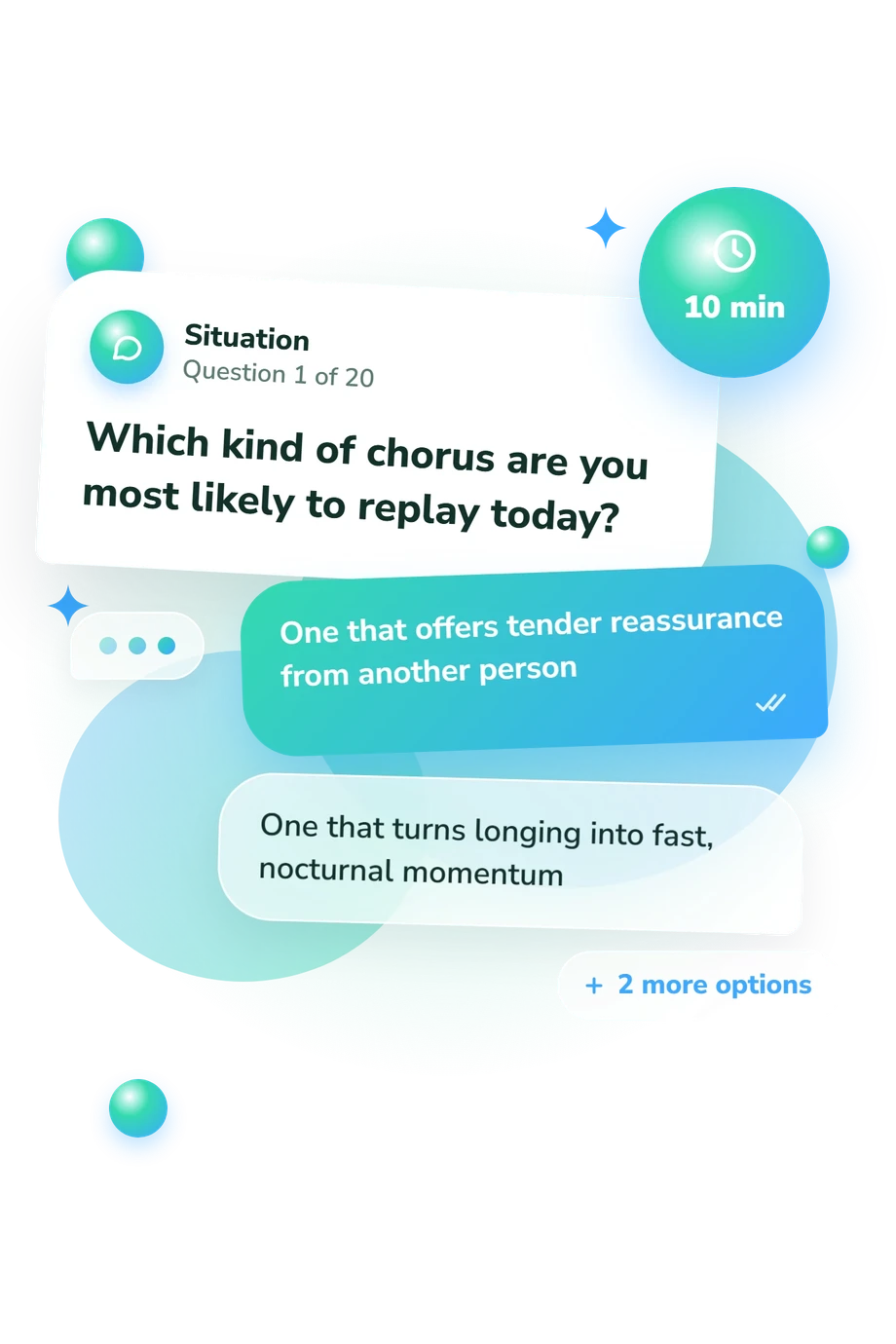
- One that offers tender reassurance from another person
- One that turns longing into fast, nocturnal momentum
- One that makes self-respect feel catchy and effortless
- One that bursts into theatrical, communal joy
- I can still make the evening enjoyable on my own terms
- I want permission to feel disappointed before moving ahead
- A fresh morning may put the situation in perspective
- I would rather outrun the feeling with pure adrenaline
- Tender, patient, and emotionally expansive
- Self-assured, breezy, and rhythmically relaxed
- Restless, glossy, and charged with nighttime tension
- Playful, extravagant, and joyfully over the top
What Song Should I Listen To Quiz - Description and methodology of the test
People choosing music for an emotional moment can use the What Song Should I Listen To Quiz as a self-reflection tool. It suits listeners deciding whether they need comfort, momentum, confidence, optimism, or celebration. Results compare recognizable musical profiles and turn an unclear mood into a practical listening direction. Listeners can use this music mood quiz to identify which track suits the present moment and shape today’s soundtrack with confidence.
What This Assessment Explores
Questions explore current affinity, not fixed personality. Scenarios about disappointment, night travel, recovery, fresh starts, and celebration link sound to emotional function. As a song mood quiz, it separates urgency, exuberance, comfort, self-reliance, and patient optimism.
Five song-affinity scales show how each track’s qualities fit now:
- Blinding Lights (0-12) captures synth-pop urgency and longing: 0-4 Different atmosphere; 5-8 Night-drive spark; 9-12 Neon momentum.
- Don’t Stop Me Now (0-12) captures rock speed and playful confidence: 0-4 Different energy; 5-8 Ready to lift off; 9-12 Unstoppable match.
- Fix You (0-12) captures tenderness, support, and catharsis: 0-4 Different route; 5-8 Reflective pull; 9-12 Cathartic match.
- Flowers (0-12) captures breezy confidence and self-reliance: 0-4 Different message; 5-8 Growing confidence; 9-12 Self-possessed match.
- Here Comes the Sun (0-12) captures acoustic optimism and renewal: 0-4 Different atmosphere; 5-8 Gentle possibility; 9-12 Sunrise match.
Methodology and Scientific Basis
Each prompt offers four options combining tempo, instrumentation, emotional tone, or situation. Self-report captures what feels relevant now, and choices are compared across five song profiles to produce an affinity score for each.
Scoring compares each song’s displayed score with the others; a result within one point of the highest belongs in the blended recommendation. Bands describe lower fit, partial resonance, or strong match; they do not establish universal cutoffs or fixed points per answer. It is a music recommendation quiz for a moment, not a lasting label.
Its interpretive framework is conceptually consistent with Shan et al. (2009), whose affinity-discovery approach links emotional characteristics with recommendation; this questionnaire is not an adaptation of that system. Zentner et al. (2008) describe recurring emotions evoked by music, while Saarikallio (2008) examines music’s role in mood regulation. These sources provide context rather than standardization; the questionnaire has no population norms or validated cutoffs, so scores are relative recommendations among five profiles. Current circumstances, fatigue, memory, self-awareness, and honest responding can shift self-report, making the result a timely snapshot.
- Shan, Man-Kwan, Fang-Fei Kuo, Meng-Fen Chiang, and Suh-Yin Lee. (2009). Emotion-based music recommendation by affinity discovery from film music. Expert Systems with Applications, 36(4), 7666-7674. 10.1016/j.eswa.2008.09.042
- Zentner, Marcel, Didier Grandjean, and Klaus R. Scherer. (2008). Emotions evoked by the sound of music: Characterization, classification, and measurement. Emotion, 8(4), 494-521. 10.1037/1528-3542.8.4.494
- Saarikallio, Suvi H. (2008). Music in Mood Regulation: Initial Scale Development. Musicae Scientiae, 12(2), 291-309. 10.1177/102986490801200206
Updated: