
What Massage Should I Get Quiz
How the Scales are Structured
Who Usually Takes This Test?
See How You Compare
Below is a preview of how scores are typically distributed across each scale.
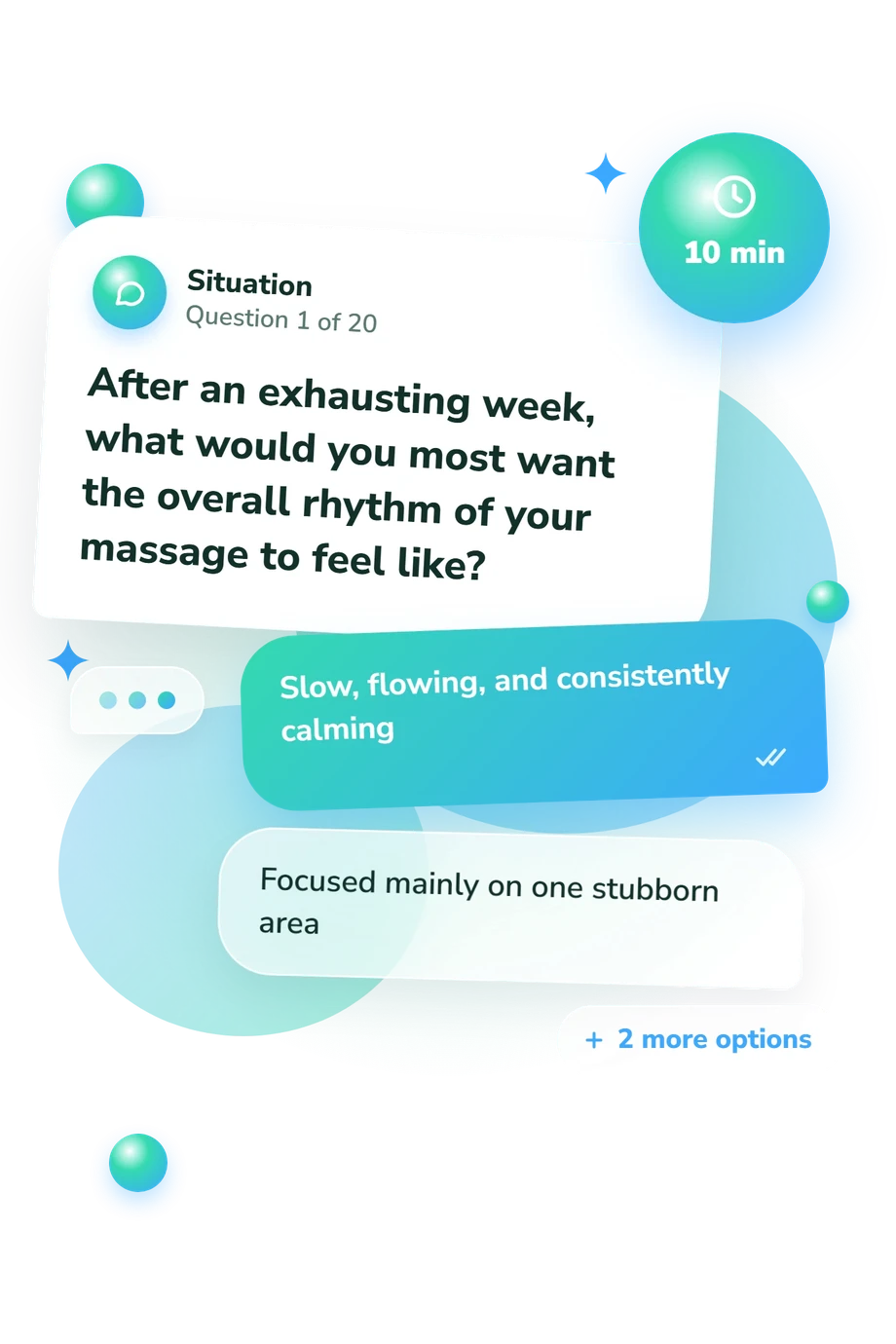
Example Questions From the Test
- Slow, flowing, and consistently calming
- Focused mainly on one stubborn area
- Active, with stretches and position changes
- Relaxing overall, with occasional firmer work
- Lying mostly still while oil-based strokes flow across the body
- A table massage that includes a few gentle stretches
- A clothed session with regular movement and assisted stretching
- A mixed session with compression and occasional position changes
- A massage table, because I want to remain still and fully relaxed
- A table, though I would welcome a little assisted stretching
- Either, provided the session includes meaningful movement
- A padded mat that allows broad stretches and varied positions
What Massage Should I Get Quiz - Description and methodology of the test
Choosing a massage is easier when you first identify the experience you want rather than relying on a familiar label. The What Massage Should I Get Quiz is intended for anyone comparing pressure, warmth, movement, and relaxation preferences. As a massage preference quiz, it turns those priorities into a profile that can guide a conversation with a practitioner.
What This Assessment Explores
The profiles describe preferred experiences rather than quality. A massage style quiz helps compare formats, while the result shows which dimensions best fit the intended session.
- Deep Tissue Massage (0-12) measures preference for slow, firm, targeted work: Other Priorities 0-4; Selective Match 5-8; Strong Affinity 9-12.
- Hot Stone Massage (0-12) measures preference for sustained warmth and stillness: Other priorities 0-4; Possible match 5-8; Strong affinity 9-12.
- Sports Massage (0-12) measures preference for activity-specific, goal-oriented work: Other Priorities 0-4; Situational Match 5-8; Strong Affinity 9-12.
- Swedish Massage (0-12) measures preference for flowing, relaxation-centered bodywork: Other Priorities 0-4; Possible Match 5-8; Strong Affinity 9-12.
- Thai Massage (0-12) measures preference for assisted stretching, compression, and movement: Other Priorities 0-4; Possible Match 5-8; Strong Affinity 9-12.
Methodology and Scientific Basis
Each item presents a concrete situation with four response choices. The options vary pressure, heat, pacing, table or mat, movement, focused attention, and activity-related goals. Respondents choose the closest preference rather than rating pain, injury, or clinical severity.
Answers are grouped into five profiles and converted into separate 0-12 scores. The highest score indicates strongest affinity, while scores within one point form a blend. This massage recommendation quiz organizes preferences rather than ranking massage quality.
Prasetyo et al. (2024) is the closest conceptual match because it examines how consumers weigh massage attributes when selecting services. The questionnaire is also conceptually consistent with Boulanger et al. (2012) on client expectations and Cowen et al. (2006) on Thai and Swedish massage. These sources support the distinctions, but this online questionnaire is not an adaptation or validation of them.
This is an unvalidated self-report with no stated norms, reliability estimates, or diagnostic cutoffs. Mood, expectations, self-awareness, and response style may shift the result, which should be used to clarify preferences rather than assess injury, exercise readiness, or medical symptoms.
- Yogi Tri Prasetyo, Maela Madel L. Cahigas, Abel Phillip Tan, Lilian Evangelista Kurniawan, Stevano Nyoto Prawiro, Reny Nadlifatin, Ma. Janice J. Gumasing, Irene Dyah Ayuwati. The Indonesian consumer perspective on the massage industry: A conjoint analysis approach. PLOS ONE. 2024;19(8):e0308098. 10.1371/journal.pone.0308098
- Karen T. Boulanger, Shelly Campo, Jennifer L. Glanville, John B. Lowe, Jingzhen Yang. The Development and Validation of the Client Expectations of Massage Scale. International Journal of Therapeutic Massage & Bodywork. 2012;5(3):3-15. 10.3822/ijtmb.v5i3.176
- Virginia S. Cowen, Lee Burkett, Joshua Bredimus, Daniel R. Evans, Sandra Lamey, Theresa Neuhauser, Lawdan Shojaee. A comparative study of Thai massage and Swedish massage relative to physiological and psychological measures. Journal of Bodywork and Movement Therapies. 2006;10(4):266-275. 10.1016/j.jbmt.2005.08.006
Updated: