
DnD Background Quiz
How the Scales are Structured
Who Usually Takes This Test?
See How You Compare
Below is a preview of how scores are typically distributed across each scale.
Example Questions From the Test
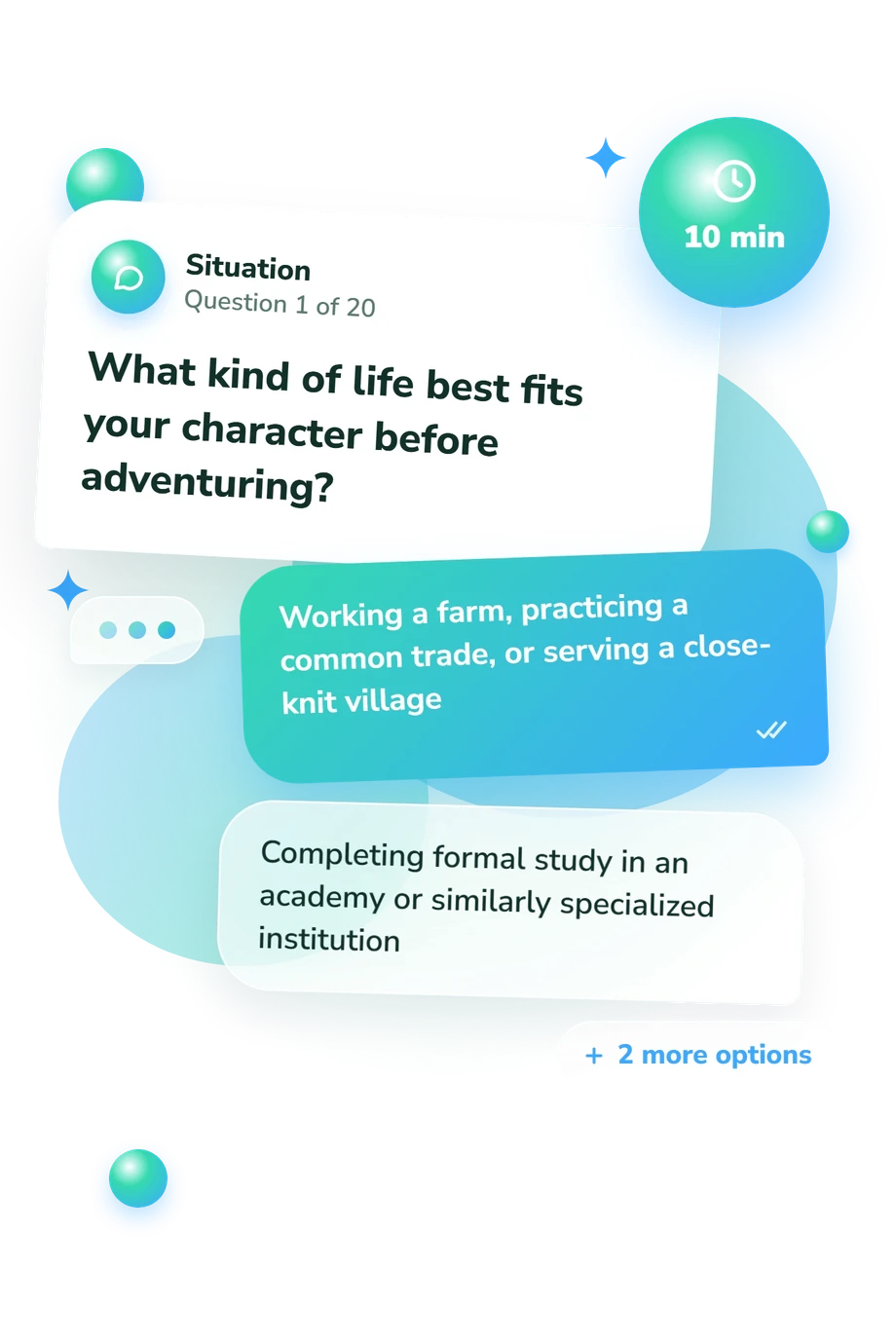
- Working a farm, practicing a common trade, or serving a close-knit village
- Completing formal study in an academy or similarly specialized institution
- Moving between communities and helping with seasonal work when needed
- Learning a practical occupation in a busy town with limited local ties
- Focus on a practical compromise without exploring the beliefs behind it
- Consult doctrine and recognized religious authorities for guidance
- Step back because religious disputes fall outside their experience
- Compare both traditions and look for values they share
- They remained outside illegal circles but learned to recognize their influence
- They knew people involved in illicit work without becoming deeply involved
- They occasionally transported, concealed, or sold something prohibited
- They regularly planned jobs, managed illicit contacts, or worked under an alias
DnD Background Quiz - Description and methodology of the test
For players shaping a character’s past, the DnD Background Quiz offers a structured way to compare possible origins. A D&D background test can clarify whether faith, secrecy, community, status, or study should anchor the backstory. The result then gives role-play a direction, helping the player choose motives, relationships, and history without dictating the character’s whole story.
What This Assessment Explores
The questions sample pre-adventure life through work, faith, privilege, community, learning, secrecy, and authority. As a character background quiz, they group those themes into five affinities:
- Acolyte (0-12) measures sacred affiliation: Secular Path (0-4), Values-Touched (5-8), Devoted Insider (9-12).
- Criminal (0-12) measures covert methods and illicit contacts: Open-Handed Route (0-4), Streetwise Edge (5-8), Underworld Insider (9-12).
- Folk Hero (0-12) measures local roots and service: Wider Horizon (0-4), Community Champion (5-8), Beloved Defender (9-12).
- Noble (0-12) measures lineage, status, etiquette, and duty: Self-Made Path (0-4), Courtly Connection (5-8), Privileged Heir (9-12).
- Sage (0-12) measures scholarship and discovery: Experiential Learner (0-4), Curious Investigator (5-8), Dedicated Scholar (9-12).
The strongest result identifies the most natural origin theme; close scores can support a blended backstory.
Methodology and Scientific Basis
Each item presents a character-history situation with four options covering work, faith, status, learning, community, secrecy, and information gathering. The respondent chooses what best fits the imagined character, not the player.
Scoring compares five affinity totals. The highest is the strongest fit, while totals within one point form a blend. The questionnaire therefore provides a comparative affinity profile with a highest-score/blended-score interpretation, but no item-level scoring formula or norm-referenced bands are supplied.
The D&D Player’s Handbook and the 2014 D&D Basic Rules provide narrative context for character backgrounds, including cues about contacts and motivations; they are not psychometric evidence for this questionnaire.
A 2026 study by Scholte Albers and de Wit examined how player-character similarity and personality design can relate to bleed during D&D play. Its findings concern character design and play dynamics, not the validity of these scores or prediction of player personality.
Self-report, current mood, and the imagined concept can influence choices, so campaign needs and the player’s preferred D&D character origin remain the final guide.
- Mearls, Mike, and Jeremy Crawford; writing by James Wyatt, Robert J. Schwalb, and Bruce R. Cordell. Dungeons & Dragons Player's Handbook. Wizards of the Coast, 2014. ISBN 978-0-7869-6560-1.
- Wizards of the Coast. D&D Basic Rules, Version 0.1. Wizards of the Coast, 2014.
- Scholte Albers, Maxime, and Jan de Wit. “Bleed in Dungeons & Dragons: A Study on the Impact of Personality Design and Character Similarity.” International Journal of Role-Playing, no. 17 (2026): 106-138. 10.33063/ijrp.vi17.648.
Updated: