
Regex Quiz
How the Scales are Structured
Who Usually Takes This Test?
See How You Compare
Below is a preview of how scores are typically distributed across each scale.
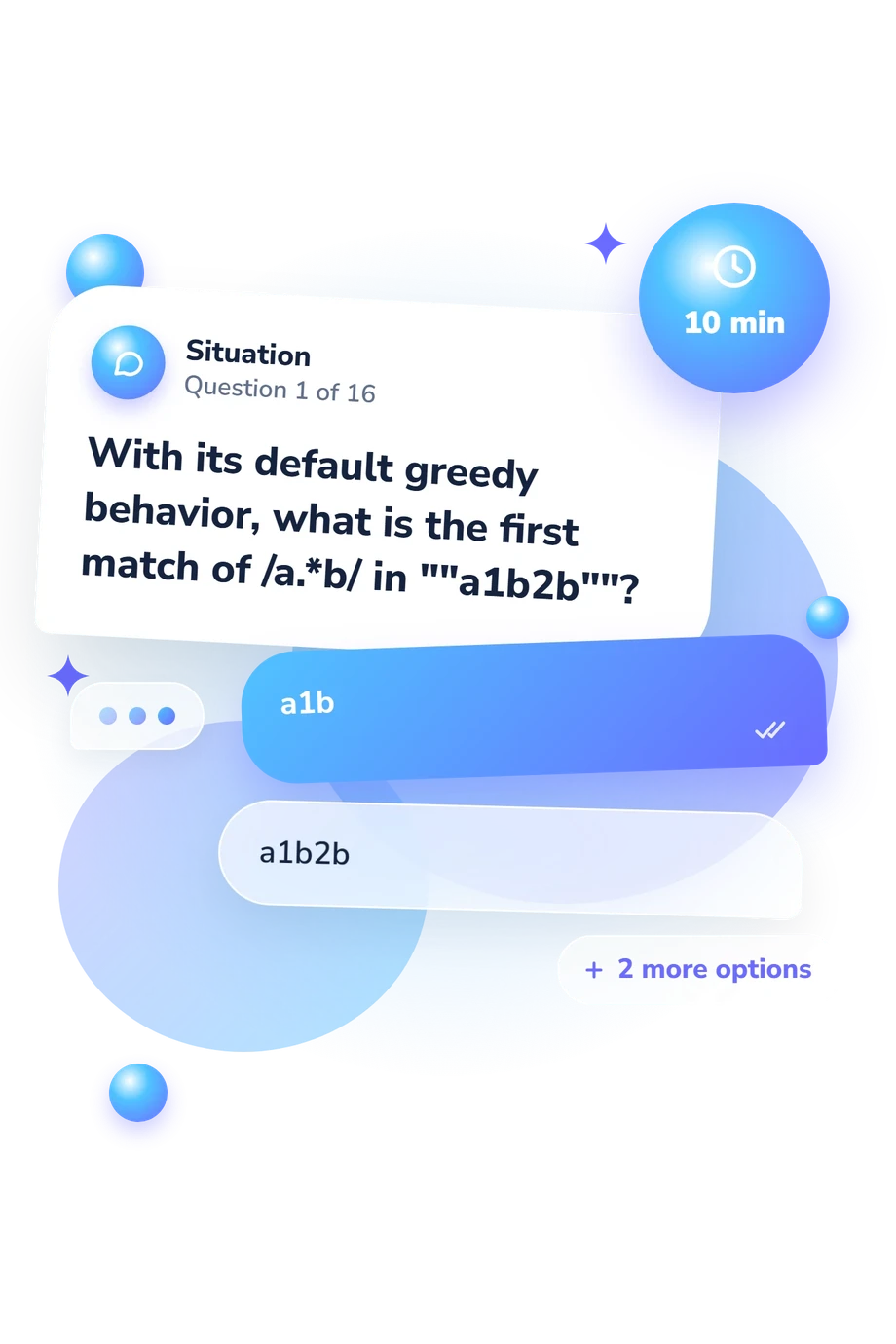
Example Questions From the Test
- a1b
- a1b2b
- 1b2b
- b2b
- Order
- 5
- 507
- Order 507
- The m flag lets ^ match at the start of a line
- The caret ignores all text before the letters H and i
- A pattern without a dot automatically skips the first line
- The m flag makes matching case-insensitive
Regex Quiz - Description and methodology of the test
For developers, students, and curious learners, this assessment checks whether you can follow the exact behavior of common pattern-matching rules rather than rely on memorized symbols. The regex quiz can show where your practical reasoning is secure and where a short review may help. Learners who take this regular expression quiz get a focused snapshot of JavaScript-style regex understanding.
What This Assessment Explores
The questions test whether you can predict what a JavaScript-style pattern will match, reject, capture, or leave untouched. They cover anchors, line boundaries, greedy and lazy quantifiers, character classes, word boundaries, alternation, optional characters, escaped punctuation, capture groups, flags, and positive lookahead. The mix checks both symbol recognition and step-by-step reasoning against a string.
The result is reported through the following scale:
- Regex Knowledge, 0-16, counts correct answers and places the result in Foundations (0-6), Developing (7-12), or Strong (13-16). Foundations points to core-rule review, Developing shows useful command with some precision gaps, and Strong reflects confident reasoning across varied common tasks.
This profile can help learners choose study priorities and programmers check whether their intuition matches engine behavior. For learners moving from simple searches to boundaries, captures, and lookarounds, this JavaScript regex test provides a focused check.
Methodology and Scientific Basis
Each item presents a regex and a short string or rule, followed by four answer choices. This is a fixed-choice knowledge assessment: the respondent selects the option that best describes the match, captured text, flag, boundary, or character class involved. The score is the number of correct responses; the bands describe performance levels, not proficiency beyond these tasks.
The ECMAScript RegExp specification supplies the behavioral reference for JavaScript-style syntax, including anchors, flags, captures, quantifiers, and lookahead. Practical explanations by Jan Goyvaerts and Steven Levithan clarify greedy and lazy matching, escaping, grouping, and character classes. Watson and Watson add a computational perspective on pattern matching, reinforcing why formal engine behavior matters more than intuition. These sources provide the syntax and pattern-matching reference; they do not establish validation of this online questionnaire.
Results from this regex practice test can guide review, but they are sensitive to prior exposure, attention, and compact technical wording. This online knowledge check has no stated population norms, reliability estimates, or clinical cutoffs, so use the bands to target practice rather than generalize about overall programming skill.
- Ecma International. ECMAScript 2025 Language Specification. 16th ed. Geneva: Ecma International, 2025.
- Goyvaerts, Jan, and Steven Levithan. Regular Expressions Cookbook. 2nd ed. Sebastopol, CA: O'Reilly Media, 2012. ISBN 978-1-4493-1943-4.
- Watson, Bruce W., and Richard E. Watson. A Boyer-Moore-style algorithm for regular expression pattern matching. Information Processing Letters 48, nos. 2-3 (2003): 99-117. 10.1016/S0167-6423(03)00013-3
Updated: