
Swedish Quiz
How the Scales are Structured
Who Usually Takes This Test?
See How You Compare
Below is a preview of how scores are typically distributed across each scale.
Example Questions From the Test
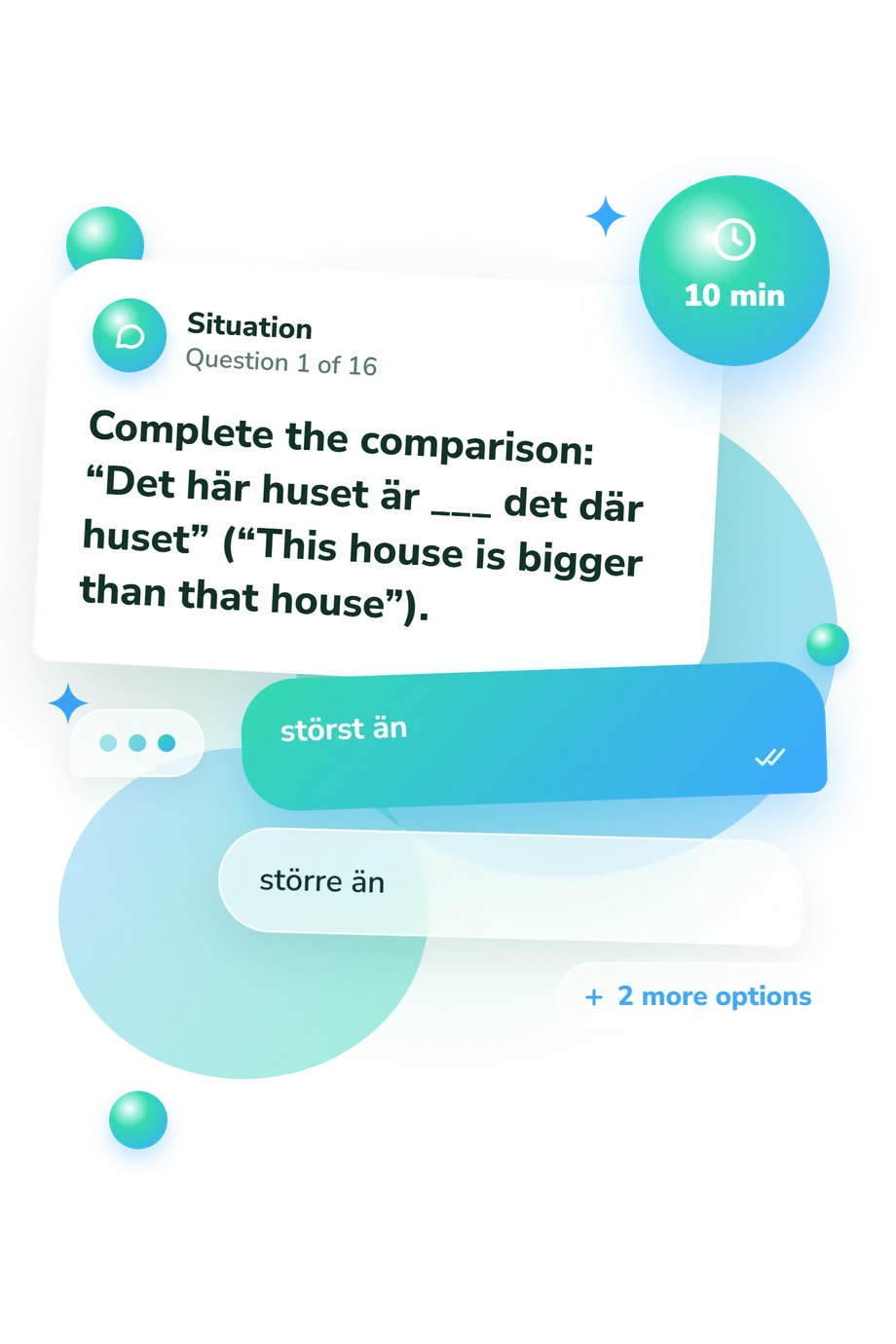
- störst än
- större än
- stor som
- mer stor än
- I live with Sofia
- I am looking for Sofia
- I know Sofia
- My name is Sofia
- Goodbye
- Hello
- Please
- Excuse me
Swedish Quiz - Description and methodology of the test
For learners who want a recognition-based snapshot of sampled Swedish knowledge, the swedish quiz offers a focused way to decide what to study next. It suits students, travelers, and curious readers who want to recognize everyday language without writing extended responses. This Swedish language assessment highlights vocabulary, grammar, common phrases, and short reading situations, giving you a clear starting point for more deliberate practice.
What This Assessment Explores
At its core, the assessment checks Swedish language knowledge used in everyday exchanges and short texts. The items ask you to recognize meanings, select forms, and interpret sentences rather than produce extended Swedish. The recognition-based format shows which foundations deserve practice.
It covers three connected areas:
- Everyday vocabulary and phrases show whether you recognize greetings, thanks, requests, times, and meanings.
- Grammar and forms show how you handle comparison, gender, plurals, tense, possessives, negation, and subordinate-clause order.
- Reading in context shows whether you understand weather, travel, shopping, and daily sentences.
The result gives Swedish Knowledge (0-16): Foundation Building (0-6), Developing Knowledge (7-12), or Strong Knowledge (13-16). The bands move from essential vocabulary and grammar needing practice, through familiar forms with gaps in tense, agreement, or subordinate clauses, to solid command of sampled concepts for more complex reading and conversation.
Methodology and Evidence Base
Methodologically, selected-response items present a Swedish word, phrase, sentence, or short notice with four alternatives. You choose the option that best completes or interprets it. The test's Swedish grammar quiz format samples form and meaning efficiently, but it does not directly measure pronunciation, spontaneous speaking, listening, or extended writing.
The displayed result is one 0-16 learning snapshot rather than separate subscores. The score is interpreted through descriptive catalogue bands; it is not a CEFR proficiency level or formal certification. Their wording concerns the knowledge sampled here, not complete Swedish ability.
Vocabulary content parallels SVALex (François et al., 2016), which organizes Swedish lexical knowledge by learner level. Warnby, Malmström, and Bardel (2022) provide a related vocabulary-assessment perspective; the CEFR framework (Council of Europe, 2020) is a broader language reference. These sources offer conceptual reference only, not validation, authorship, or provenance for this questionnaire, and do not establish its grammar or reading items.
Guessing, prior exposure, attention, and current familiarity with sampled Swedish can affect the result. Treat it as a study snapshot and compare performance across reading, listening, speaking, and writing.
- François, T., Volodina, E., Pilán, I., & Tack, A. (2016). SVALex: A CEFR-graded lexical resource for Swedish foreign and second language learners. In Proceedings of the Tenth International Conference on Language Resources and Evaluation (LREC'16), 213-219. European Language Resources Association.
- Warnby, M., Malmström, H., & Bardel, C. (2022). A Swedish academic vocabulary test: Revision, validation, and suggestions for further development. Nordic Journal of Literacy Research, 8(1), 106-127. 10.23865/njlr.v8.3282
- Council of Europe. (2020). Common European Framework of Reference for Languages: Learning, Teaching, Assessment-Companion Volume. Council of Europe. ISBN 978-92-871-8645-4.
Updated: