
Is My Boss a Micromanager Quiz
How the Scales are Structured
Who Usually Takes This Test?
See How You Compare
Below is a preview of how scores are typically distributed across each scale.
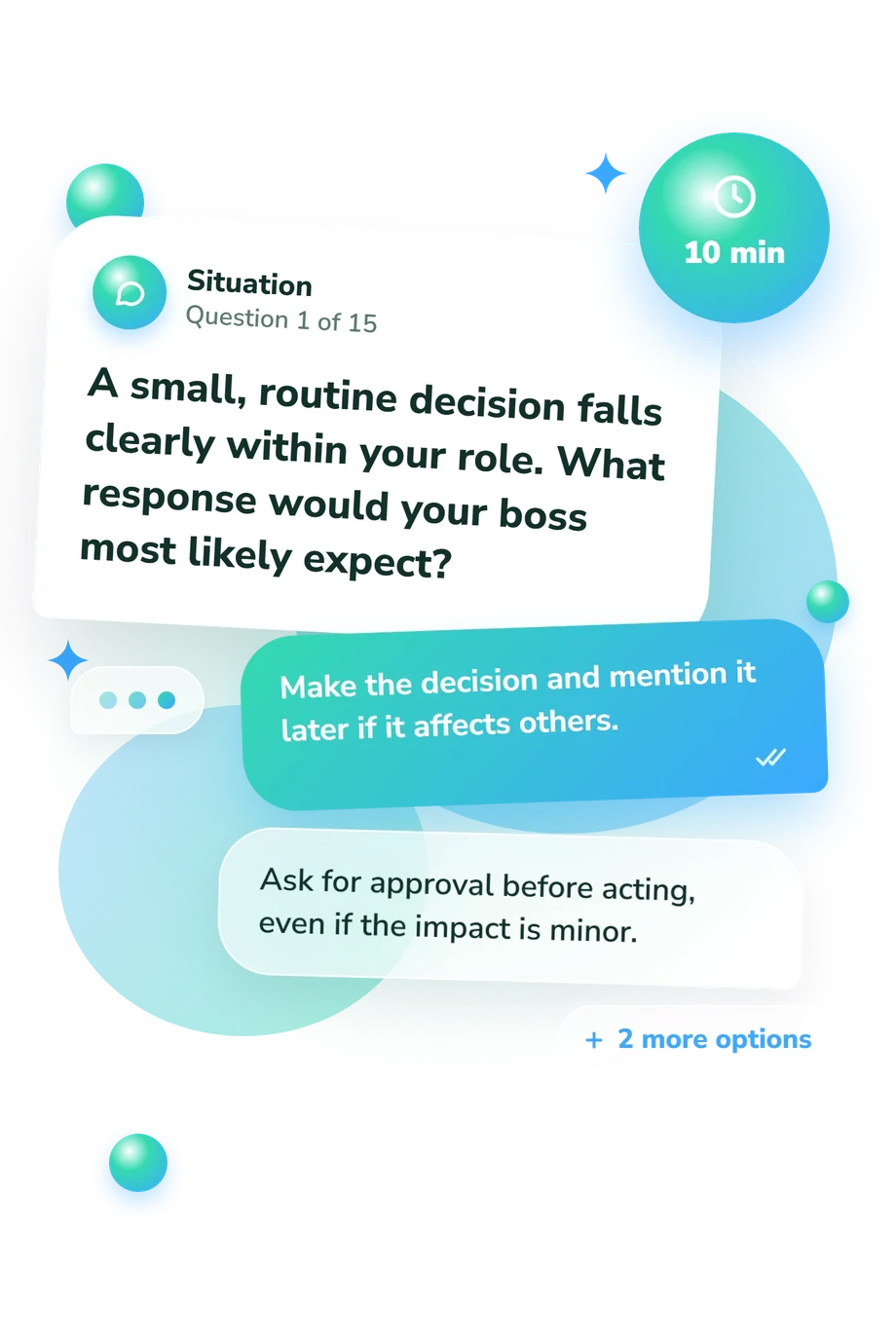
Example Questions From the Test
- Make the decision and mention it later if it affects others.
- Ask for approval before acting, even if the impact is minor.
- Use my judgment without checking in unless circumstances change.
- Consult them first when the choice could have a noticeable consequence.
- Ask for revisions so it matches their preferred style throughout.
- Use it as delivered if the differences do not affect the result.
- Redo it personally before allowing it to be used.
- Mention a preference to consider on future work.
- They choose the solution and tell me exactly how to carry it out.
- They discuss the trade-offs and let me make the final choice.
- They recommend one option but leave the decision with me.
- They make the final choice after hearing my analysis.
Is My Boss a Micromanager Quiz - Description and methodology of the test
Employees who want to understand whether close supervision is helping coordination or narrowing their room to work can use the Is My Boss a Micromanager Quiz as a structured reflection. It focuses on recurring interactions around decisions, revisions, communication, and progress updates. The profile can also help someone describe micromanagement at work more precisely by showing where control seems concentrated and which expectations may need clarification.
What This Assessment Explores
Rather than treating every check-in as excessive, the assessment examines situations where a manager limits judgment, controls execution, or demands unusually close visibility. It suits employees reflecting on recurring patterns, not a single tense exchange.
To distinguish ordinary management from overcontrol, this am i being micromanaged quiz examines more than check-in frequency and covers three dimensions:
- Autonomy and Decision Space (0-15) measures freedom to choose methods and make role-appropriate decisions: Room to operate (0-5), Conditional autonomy (6-10), Tightly directed (11-15).
- Intervention and Work Ownership (0-15) measures how much ownership you retain over revisions, recovery from mistakes, communication, and finished work: Ownership retained (0-5), Ownership shared (6-10), Ownership displaced (11-15).
- Monitoring and Visibility Demands (0-15) measures how intensely your boss seeks updates, tracks availability, and observes work in progress: Purposeful visibility (0-5), Frequent oversight (6-10), Constant visibility pressure (11-15).
Methodology and Evidence Base
Each item presents a workplace scenario with four response options. The choices contrast personal discretion with directive control and milestone visibility with continuous checking. Topics include decisions, delegation, revisions, mistakes, communication, meetings, dashboards, availability, and unscheduled updates, so you rate a manager’s likely behavior in context rather than an abstract personality trait.
Responses are grouped into three dimension scores and displayed in their corresponding bands. The profile shows where control is concentrated rather than producing a single verdict.
The evidence is conceptually consistent with MMS-9 (Deen et al., 2025), a published micromanagement measure, and a micromanagement questionnaire developed by Sulphey and Upadhyay (2019). This assessment is not presented as an adaptation of either instrument. Vu’s 2025 review supports treating micromanagement as multidimensional, matching its separation of discretion, ownership, and visibility.
Because it is a self-report tool, workload, recall, self-awareness, onboarding, deadlines, remote-work expectations, crises, and compliance requirements can shape responses. The result has no reported normative standardization, and a high score does not by itself prove harmful intent. Use the profile to compare examples and clarify review or reporting rhythms.
- Catherine Midel Deen, Christian Kiewitz, Jun-Yeob Kim, Simon Lloyd D. Restubog, Ying-Yi Chih, and Robert L. Tang (2025). Helicopter Bosses: Development and Validation of the Micromanagement Scale. Journal of Management, advance online publication. 10.1177/01492063251378092
- M. M. Sulphey and Yogesh K. Upadhyay (2019). Construction and validation of micromanagement questionnaire. International Journal of Environment, Workplace and Employment, 5(3), 193-205. 10.1504/IJEWE.2019.103378
- Thuy Thi Vu (2025). Micromanagement: A Systematic Literature Review and Future Research Agenda. SAGE Open, 15(4), 1-20. 10.1177/21582440251383211
Updated: