
Linking Verbs Quiz
How the Scales are Structured
Who Usually Takes This Test?
See How You Compare
Below is a preview of how scores are typically distributed across each scale.
Example Questions From the Test
- after
- quiet
- grew
- bell
- carried and opened
- seemed and became
- built and repaired
- asked and answered
- Leo was running toward the finish line.
- Leo was the winner of the contest.
- Leo was chosen by the judges.
- Leo was being watched by the crowd.
Linking Verbs Quiz - Description and methodology of the test
Learners who want to write more precise sentences can take the linking verbs quiz to examine how they distinguish grammatical functions in context. It suits students, teachers, and independent English learners seeking a clearer grasp of verb classification. Contrasting sentences in this linking and action verb quiz show how the same verb can function differently in context, while the result points to review of complements, auxiliary constructions, or context-sensitive meanings.
What This Assessment Explores
At the center is the difference between verbs that connect subjects with descriptions or identities and verbs that express action. Items include be, grow, look, taste, seem, and turn because context changes function.
Questions test subject complements and distinguish linking from helping uses of be. As a linking verb test, this questionnaire suits learners who hesitate when one word works differently across sentences.
The questions examine these related skills as part of one reported knowledge result:
- Verb-function recognition concerns accurate identification of linking, action, and helping uses.
- Subject-complement analysis connects subjects with descriptions or identities.
- Context-sensitive interpretation covers flexible verbs in different sentences.
- Linking Verbs Knowledge (0-16) reports Building Foundations (0-6) when core patterns need review, Developing Knowledge (7-12) when main rules work but flexible verbs still cause confusion, and Strong Knowledge (13-16) when identification and analysis are consistent.
Methodology and Evidence Base
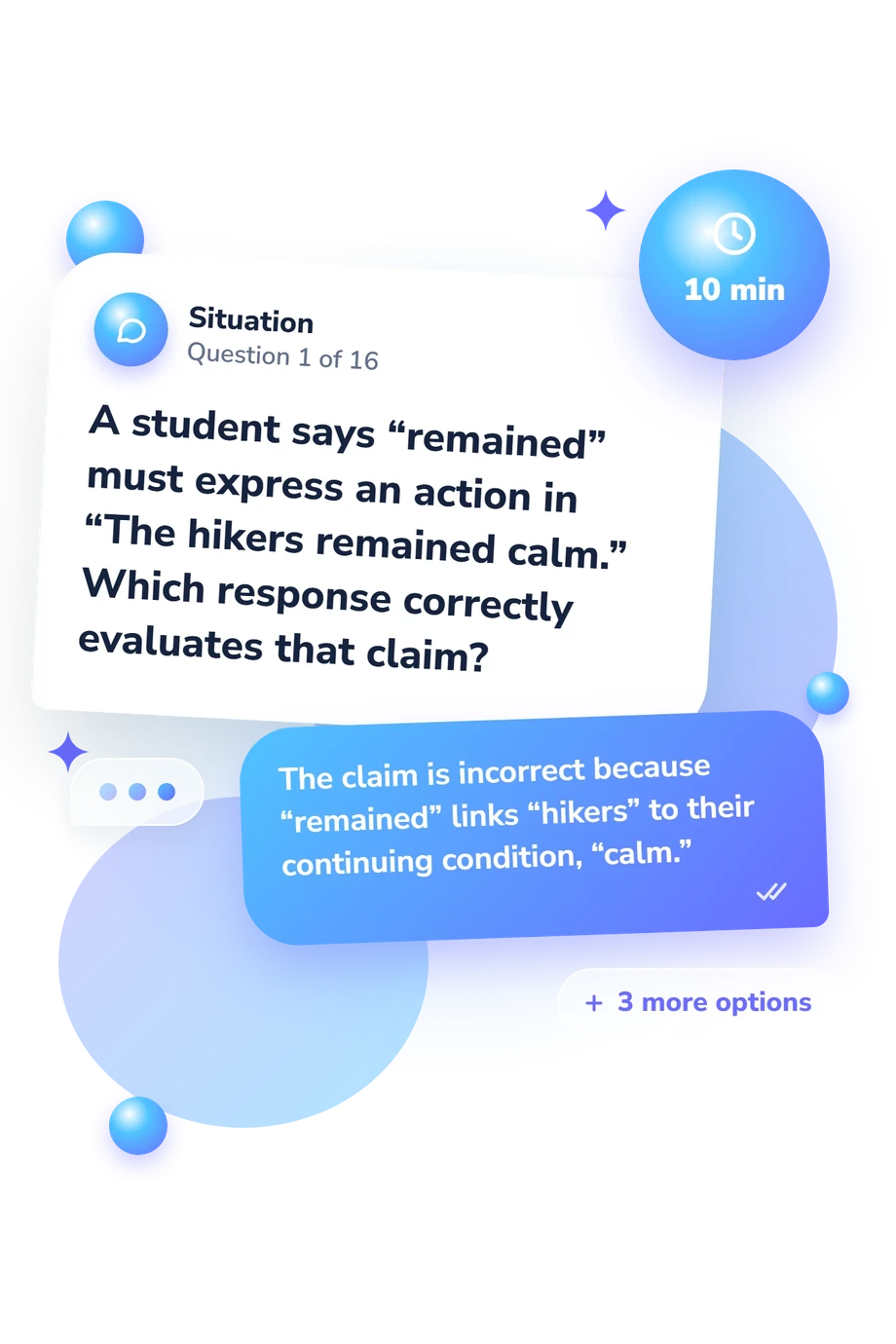
Each item presents a sentence or claim with four answer choices. You select the analysis that fits the grammatical function, not the word’s appearance alone. Contrasts between sentences such as "Maya tasted the soup" and "The soup tasted salty" test whether meaning and structure are considered together.
The assessment uses a rule-based self-test format. Responses are judged by distinctions among linking, action, and helping verbs, including complements and the be-substitution test. The questionnaire reports one knowledge score rather than separate subscores, so interpretation focuses on overall performance across these distinctions.
Altenberg and Vago (2010) and Huddleston and Pullum provide grammatical reference points for distinctions used here, including action and linking verbs, verb phrases, and complementation. Their books offer terminology and descriptive guidance rather than validation data for this questionnaire; they do not establish that it is a standardized adaptation of either book.
For improvement, this quiz offers linking verb practice that can guide review. Because performance may vary with attention, terminology, and sentence context, interpret the result as a snapshot of current grammatical knowledge and use missed distinctions to guide examples.
- Altenberg, Evelyn P., and Robert M. Vago. English Grammar: Understanding the Basics. Cambridge University Press, 2010, pp. 27-34. 10.1017/CBO9780511794803.
- Huddleston, Rodney D., and Geoffrey K. Pullum. The Cambridge Grammar of the English Language. Cambridge University Press, 2002. 10.1017/9781316423530.
Updated: