
Sexless Marriage Quiz
How the Scales are Structured
Who Usually Takes This Test?
See How You Compare
Below is a preview of how scores are typically distributed across each scale.
Example Questions From the Test
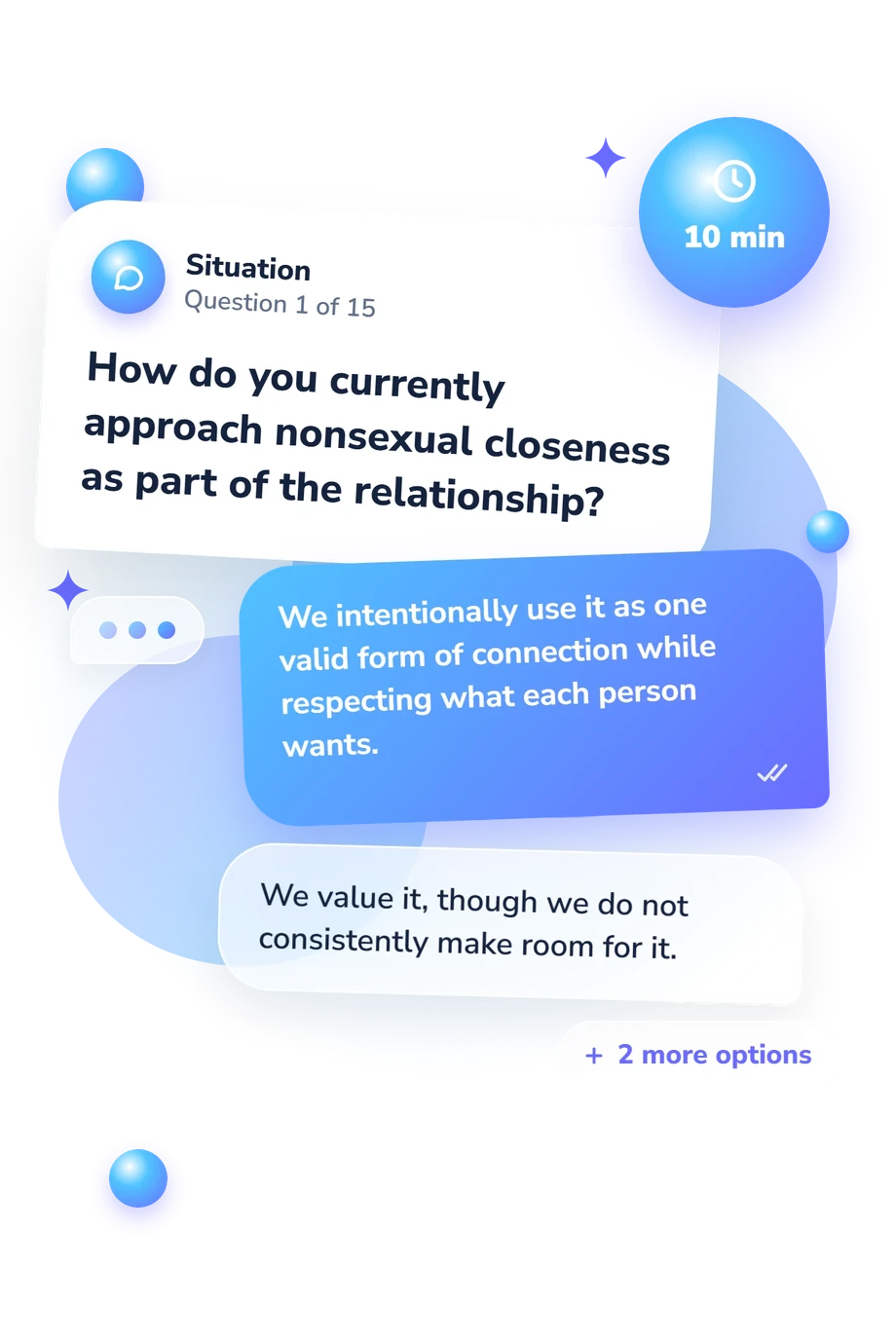
- We intentionally use it as one valid form of connection while respecting what each person wants.
- We value it, though we do not consistently make room for it.
- It happens naturally at times, but we rarely discuss its role.
- We are currently giving one another more space rather than focusing on closeness.
- Disappointment may remain briefly, but it usually settles without changing the relationship atmosphere.
- The refusal tends to feed lasting resentment, dread, or emotional distance.
- We generally recover without treating the refusal as a judgment of either person.
- Insecurity or frustration often carries into later interactions.
- It might improve somewhat, but a recurring mismatch would probably remain.
- It would likely return fairly easily because the disruption feels situational.
- Little would change because the disconnection now seems to have its own momentum.
- Our current level would probably remain satisfactory for me.
Sexless Marriage Quiz - Description and methodology of the test
People examining a marriage with little or no sexual connection can use this assessment to organize differences, pressures, and patterns between partners. The sexless marriage quiz is intended for individual reflection or a shared conversation when partners want clearer language for what is happening. It can also serve as a sexless marriage assessment when someone is considering whether the pattern feels situational or established before opening that conversation.
What This Assessment Explores
Items separate a temporary reduction linked to workload, health, caregiving, or another life phase from a persistent pattern affecting affection and expectations. They also address refusal, nonsexual touch, boundaries, and difficult conversations.
The result from this sexless marriage test describes emotional strain, desired-versus-experienced connection, and shared capacity for next steps. It does not assume that more sex is the required goal.
The displayed dimensions are:
- Communication and Emotional Strain (0-15) measures discussion difficulty and emotional impact: Manageable load (0-5), Sensitive and consequential (6-10), or Entrenched strain (11-15).
- Pattern and Mismatch (0-15) measures the persistence of the connection gap: Limited or situational gap (0-5), Recurring mismatch (6-10), or Established disconnection (11-15).
- Shared Agency and Next Steps (0-15) measures capacity for mutual choices: Individual/Paused (0-5), Emerging Shared Agency (6-10), or Strong Shared Agency (11-15).
Methodology and Evidence Base
Each relationship situation appears as four statements. The respondent chooses the one that best fits the current pattern, covering desire differences, missed intimacy, nonsexual closeness, refusal, conversations, and negotiation. This marriage intimacy questionnaire captures a self-described pattern, not a frequency count or clinical interview.
Results show three displayed totals, each from 0 to 15, with reflective bands for strain, mismatch, or shared agency. These bands are reflective categories, not clinical cutoffs or predictions; they describe the profile shown.
Sexual and Relationship Distress Scale (SaRDS; Frost & Donovan, 2018) is a close conceptual reference for distress around sexual and relationship experience. The Sexual Communication Discrepancy Index (Machette, Morrissey & Cionea, 2022) matches its focus on communication gaps and mismatched expectations. Dewitte and colleagues’ 2020 position statement treats desire differences as relationally negotiated, not proof that either partner is defective. This questionnaire is conceptually consistent with these works, not an adaptation of them.
Mutual choice and consent take priority over relationship goals; coercion, threats, injury, or fear are independent of the score and warrant safety-focused support.
- Frost, Rebecca, and Caroline Donovan. "The Development and Validation of the Sexual and Relationship Distress Scale." Journal of Sexual Medicine 15, no. 8 (2018): 1167-1179. 10.1016/j.jsxm.2018.06.004
- Machette, Anthony T., Brittney S. Morrissey, and Ioana A. Cionea. "The Sexual Communication Discrepancy Index: A Multidimensional Self-Report Instrument for the Assessment of Sexual Communication Discrepancies." Journal of Sex & Marital Therapy 48, no. 4 (2022): 376-391. 10.1080/0092623X.2021.1998272
- Dewitte, Marieke, Joana Carvalho, Giovanni Corona, Erika Limoncin, Patricia Pascoal, Yacov Reisman, and Aleksandar Stulhofer. "Sexual Desire Discrepancy: A Position Statement of the European Society for Sexual Medicine." Sexual Medicine 8, no. 2 (2020): 121-131. 10.1016/j.esxm.2020.02.008
Updated: