
Mushroom Quiz
How the Scales are Structured
Who Usually Takes This Test?
See How You Compare
Below is a preview of how scores are typically distributed across each scale.
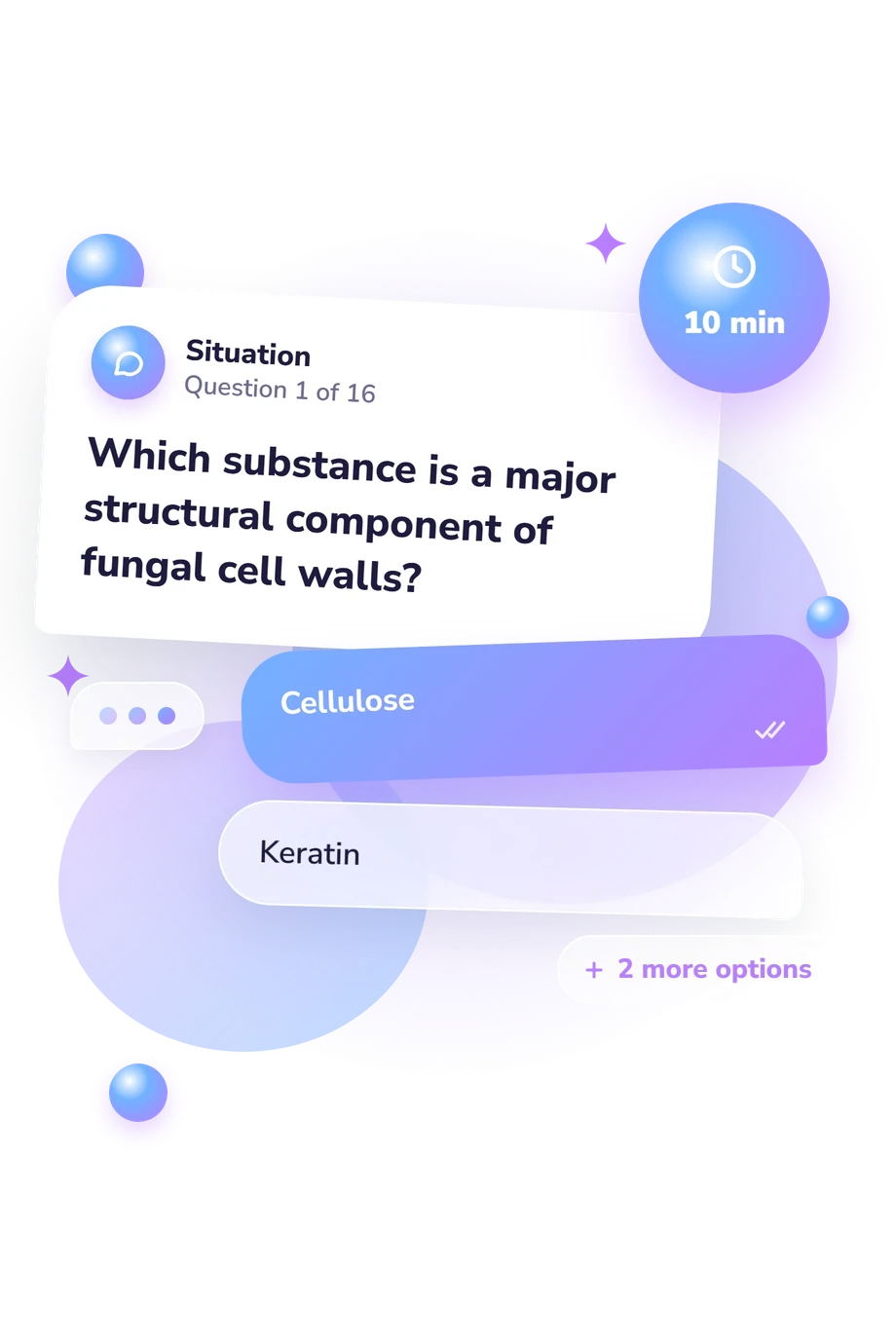
Example Questions From the Test
- Cellulose
- Keratin
- Starch
- Chitin
- Pores under the cap and a hollow stem
- A spore print and droplets on the gills
- Branching mycelium and plant roots around the stem
- A cup or sac at the stem base and patches on the cap
- A spore-producing fruiting body made by a fungus
- The fungus's entire underground root system
- A seed-bearing plant structure without chlorophyll
- A bacterial colony growing above the soil
Mushroom Quiz - Description and methodology of the test
People who want to understand mushrooms beyond memorized names can use this mushroom quiz to connect fungal biology with identification and safety. Learners, curious foragers, and anyone reviewing basic mycology can use this fungal biology quiz to revisit responsible identification before spending time outdoors. The result indicates an overall educational level reflected by the answers.
What the Questionnaire Measures
Questions link fungal facts with practical reasoning about structure, identification clues, ecology, and safety.
Rather than treating this mushroom identification quiz as picture matching, the test asks learners to combine cap, stem, gill or pore, veil, bruising, habitat, spore-print, and microscopic evidence. It suits general learners and curious foragers.
The result reflects fungal biology and responsible identification through these areas:
- Fungal biology explains how structures such as hyphae and fruiting bodies function.
- Identification evidence shows why appearance and habitat need supporting clues.
- Ecology connects decomposition, mycorrhizae, lichens, and growth patterns with fungal roles.
- Safety reasoning tests whether the respondent rejects tasting and appearance-only judgments.
Mushroom Knowledge runs from 0-16: Foundations to Build (0-6), Developing Knowledge (7-12), and Strong Knowledge (13-16). Higher bands indicate broader understanding, while lower bands identify foundations to review.
Methodology and Scientific Basis
Each item presents a question with four answer choices. The format tests recall, comparison, ecological reasoning, and responses to safety scenarios rather than open-ended field identification.
The responses are summarised as one total score with educational bands. The mushroom knowledge test produces an unvalidated educational score: its bands indicate broad learning levels reflected by the answers and cannot establish that a wild mushroom is edible. Suspected ingestion with vomiting or confusion calls for urgent professional help.
The content is conceptually consistent with the mycology work of Huffman and colleagues and with Kendrick's treatment of fungal structures, life processes, habitats, and relationships. Safety items also reflect Diaz's work on responding seriously to suspected mushroom poisoning. It functions as an online educational self-reflection questionnaire that brings these concepts into a concise question set.
Interpretation depends on attention, prior study, terminology, and guessing. A strong result indicates that the respondent handled more of the educational content successfully, while a lower result may simply show limited exposure or unfamiliar terminology.
- Donald M. Huffman, Lois H. Tiffany, George Knaphus, and Rosanne A. Healy. Mushrooms and Other Fungi of the Midcontinental United States. 2nd ed. University of Iowa Press, 2008. 10.2307/j.ctt20ks0sv.
- Bryce Kendrick. The Fifth Kingdom: An Introduction to Mycology. 4th ed. Focus, 2017.
- James H. Diaz. Syndromic diagnosis and management of confirmed mushroom poisonings. Critical Care Medicine, 2005, 33(2), 427-436. 10.1097/01.ccm.0000153531.69448.49.
Updated: