
Guess the Gun Quiz
How the Scales are Structured
Who Usually Takes This Test?
See How You Compare
Below is a preview of how scores are typically distributed across each scale.
Example Questions From the Test
- AK-47
- SKS
- AK-74
- AKM
- Sterling L2A3
- MAC-10
- MP40
- Uzi
- SIG Sauer P320
- Heckler & Koch VP9
- Smith & Wesson M&P9
- Glock 19
Guess the Gun Quiz - Description and methodology of the test
To understand which kinds of firearm clues you distinguish readily and which require further study, museum visitors, students, and collectors can use Guess the Gun Quiz. It also suits anyone revisiting reference material. As a firearm identification quiz, it tests recognition of well-known firearms through design, history, and terminology.
What This Assessment Measures
Recognition means matching defining clues to the likely model, not identifying an object through hands-on operation. This firearm knowledge quiz suits readers learning through museums, history, or reading. Readers learning to name firearms can use the exercise to compare related designs.
The questions fall into these subject areas:
- Pistols show how frame materials, safeties, action types, and adoption history narrow a model.
- Military rifles and submachine guns show how cartridges, receivers, layouts, magazines, and operating systems distinguish families.
- Shotguns and specialized firearms show how extraction, recoil, muzzle brakes, and mechanisms provide decisive clues.
Modern Firearm Identification Knowledge runs from 0-16. Foundation (0-6) reflects broad recognition with confusion between similar designs; Developing (7-12) reflects several connected clues while close alternatives remain difficult; Strong (13-16) reflects consistent identification from multiple defining clues. It measures recognition, not handling skill, safety competence, or legal knowledge.
Methodology and Evidence Base
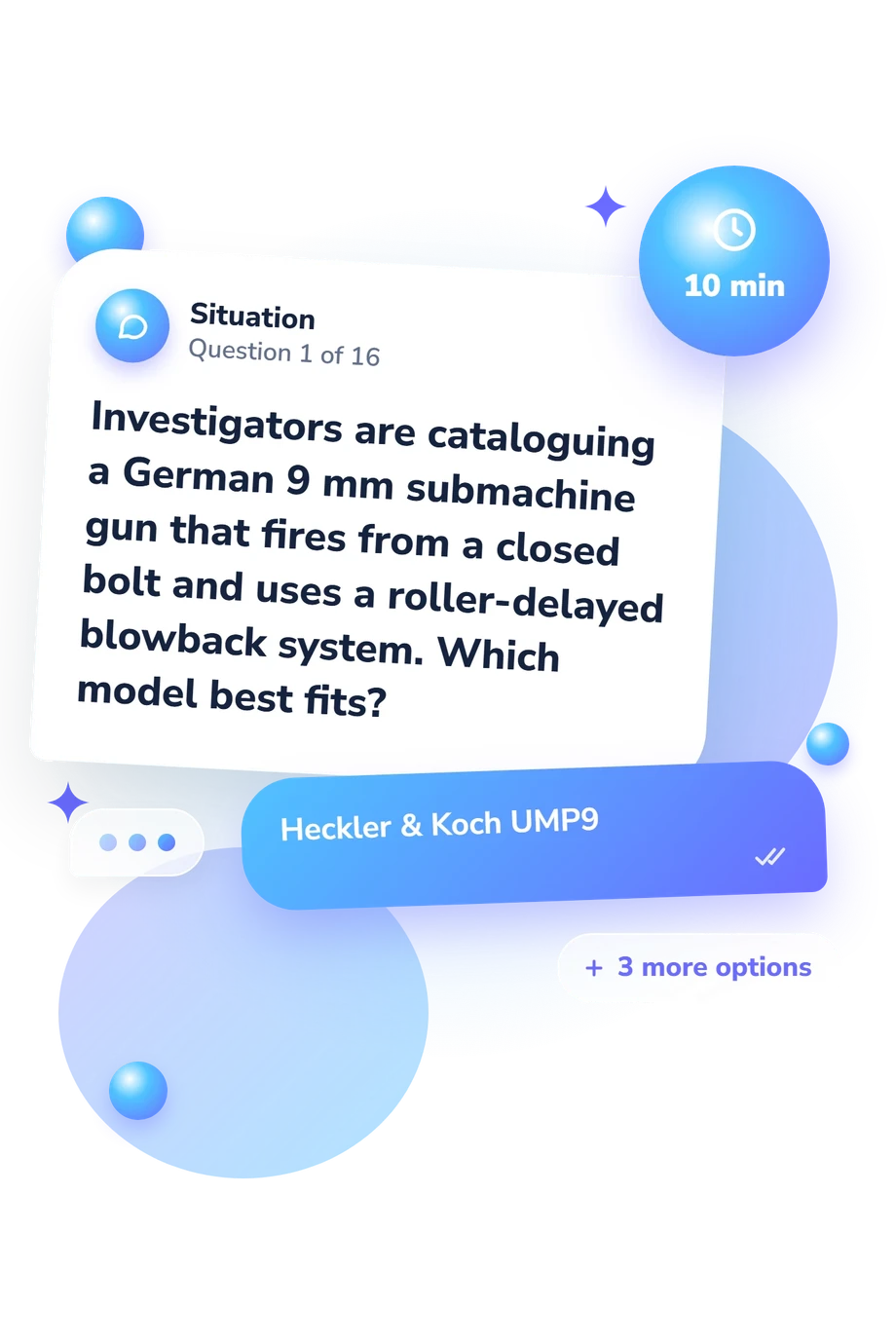
Each item gives a short identification scenario and four answer choices. Clues may involve cartridge, action, receiver, safety, magazine placement, operating system, layout, or historical adoption. Selecting the best-fitting model makes this a structured recognition task rather than a test of hands-on operation.
As a modern firearm quiz, the responses produce a displayed total that is placed in the displayed bands. The three bands organize performance by the level of recognition shown in the answer set, while the result remains tied to these particular identification scenarios.
Jones and White (2008) provide relevant descriptions of firearm models and terminology. The questionnaire is conceptually consistent with that guide, not adapted from it. Jenzen and Schroeder (2018) provide a structured framework for identifying small arms and associated ammunition. The questionnaire is conceptually consistent with that framework as well, not adapted from it. Chaikovsky and colleagues (2023) support systematic attention to visual firearm features but do not validate this questionnaire's scoring.
Previous exposure and familiarity with technical vocabulary can shape the result, so it is most useful for choosing topics for further study.
- Jones, Richard D., and Andrew White. 2008. Jane's Guns Recognition Guide. 5th ed. New York: Collins. ISBN 978-0-06-137408-1.
- Jenzen-Jones, N.R., and Matt Schroeder, eds. 2018. An Introductory Guide to the Identification of Small Arms, Light Weapons, and Associated Ammunition. Geneva: Small Arms Survey, Graduate Institute of International and Development Studies. ISBN 978-2-940548-55-2.
- Chaikovsky, Alan, Zohar Pasternak, Nir Finkelstein, Netta Lev Tov Chattah, Alexander Silchenko, Ophir Levy, and Amit Cohen. 2023. Form follows function: Applying photographic content analysis to forensic firearm identification. Journal of Forensic Sciences 68(6): 2153-2162. 10.1111/1556-4029.15363.
Updated: