
Basic Computer Technology Terms Quiz
How the Scales are Structured
Who Usually Takes This Test?
See How You Compare
Below is a preview of how scores are typically distributed across each scale.
Example Questions From the Test
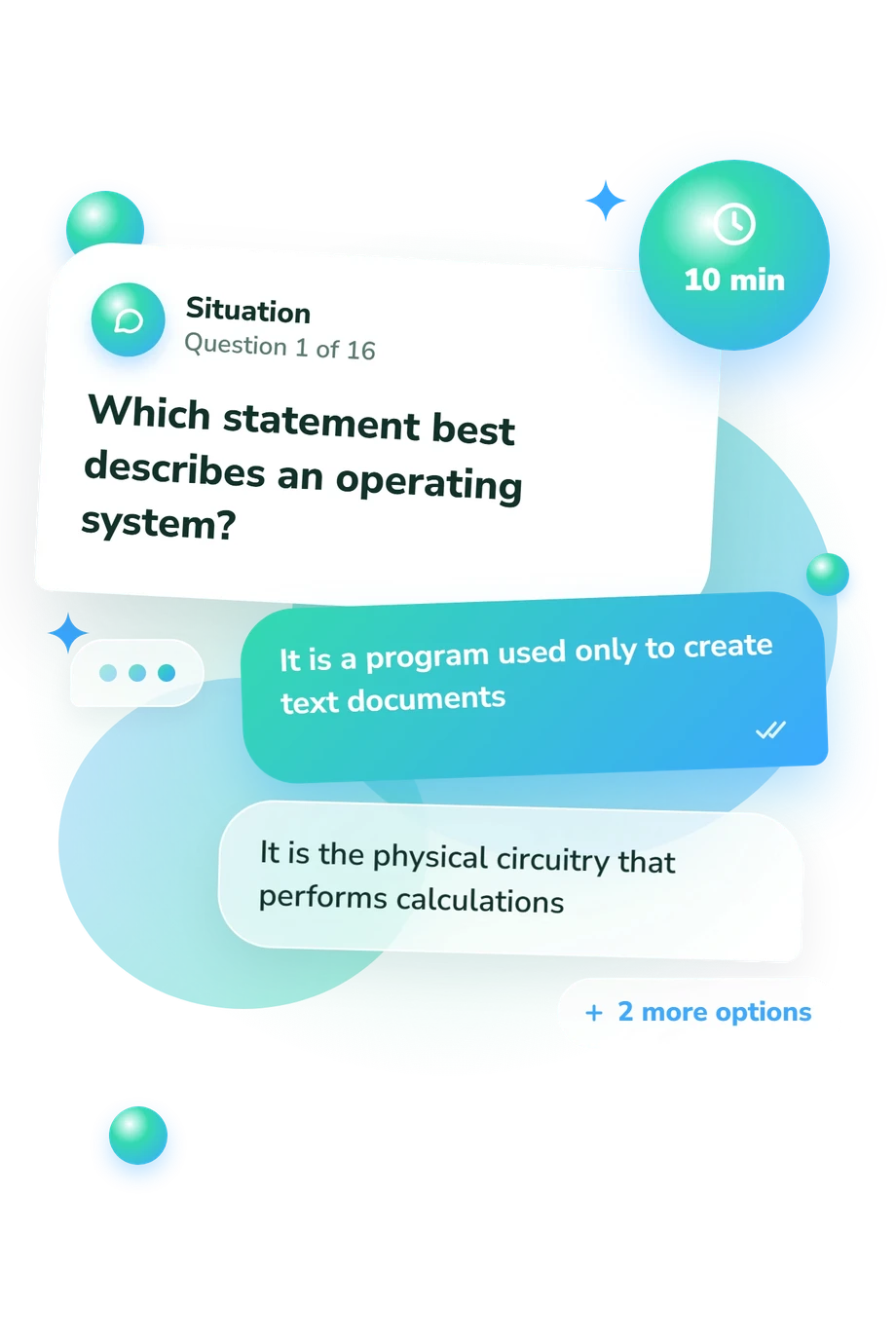
- It is a program used only to create text documents
- It is the physical circuitry that performs calculations
- It is an online service that finds web pages by keyword
- It manages the computer's hardware and supports applications
- A computer mouse
- A solid-state drive
- A photo-editing application
- A network cable
- A file compression utility
- A spreadsheet application
- A search engine's indexing system
- A web browser such as Firefox, Edge, or Safari
Basic Computer Technology Terms Quiz - Description and methodology of the test
People who want a clearer grasp of everyday digital language can use this assessment to check whether common terms make sense in practical situations. The basic computer technology terms quiz is intended for learners, workers, or anyone building confidence with computers rather than for measuring advanced technical expertise. As a computer terminology quiz, it focuses on usable vocabulary that supports independent problem-solving.
What This Assessment Explores
This assessment targets practical vocabulary rather than advanced coding or repair skills. Items cover hardware, software, processing, memory, files, networks, web use, cloud storage, and security, with some using familiar situations and others asking directly about a term or function.
That focus makes a computer basics test useful for learners building confidence and for experienced users checking gaps in everyday language. The result points to topics worth reviewing, not to technical job performance.
The result is organized into three bands on the Basic Computer Technology Terms Knowledge scale (0-16):
- Foundation to build (0-6) indicates that several common computer concepts may still be mixed up and deserve review.
- Developing knowledge (7-12) shows understanding of many everyday terms, with some practical distinctions to reinforce.
- Strong foundation (13-16) reflects accurate recognition and application of most terms covered by the questionnaire.
Methodology and Scientific Basis
Each item presents four answer choices and asks for the best term or description. It tests distinctions such as browser versus search engine, folder versus file format, and uploading versus downloading. A computer skills quiz in this form is an online multiple-choice knowledge assessment that emphasizes usable vocabulary, not speed or hands-on performance.
Scoring is direct: each correct answer adds one point, and the total is read through the questionnaire's descriptive bands. Displayed bands describe performance on this questionnaire rather than established population norms; the result reflects basic terminology knowledge, not advanced technical performance. Prior exposure, guessing, and the wording of an item can affect the total, so it works best as a review snapshot.
Bradlow et al. (2002) describe a related measure of basic computer proficiency. This questionnaire is conceptually consistent with that work, not a reproduction or adaptation. Fraillon et al. (2019) supplies a computer and information literacy framework, while Potosky (2007) presents an internet-knowledge measure. Together, these sources provide conceptual context, not validation or evidence of the same psychometric properties.
- Bradlow, E. T., Hoch, S. J., & Hutchinson, J. W. (2002). An Assessment of Basic Computer Proficiency Among Active Internet Users: Test Construction, Calibration, Antecedents and Consequences. Journal of Educational and Behavioral Statistics, 27(3), 237-253. 10.3102/10769986027003237
- Fraillon, J., Ainley, J., Schulz, W., Duckworth, D., & Friedman, T. (2019). IEA International Computer and Information Literacy Study 2018 Assessment Framework. Springer, Cham. 10.1007/978-3-030-19389-8
- Potosky, D. (2007). The Internet Knowledge (iKnow) Measure. Computers in Human Behavior, 23(6), 2760-2777. 10.1016/j.chb.2006.05.003
Updated: