
Naming Acids Quiz
How the Scales are Structured
Who Usually Takes This Test?
See How You Compare
Below is a preview of how scores are typically distributed across each scale.
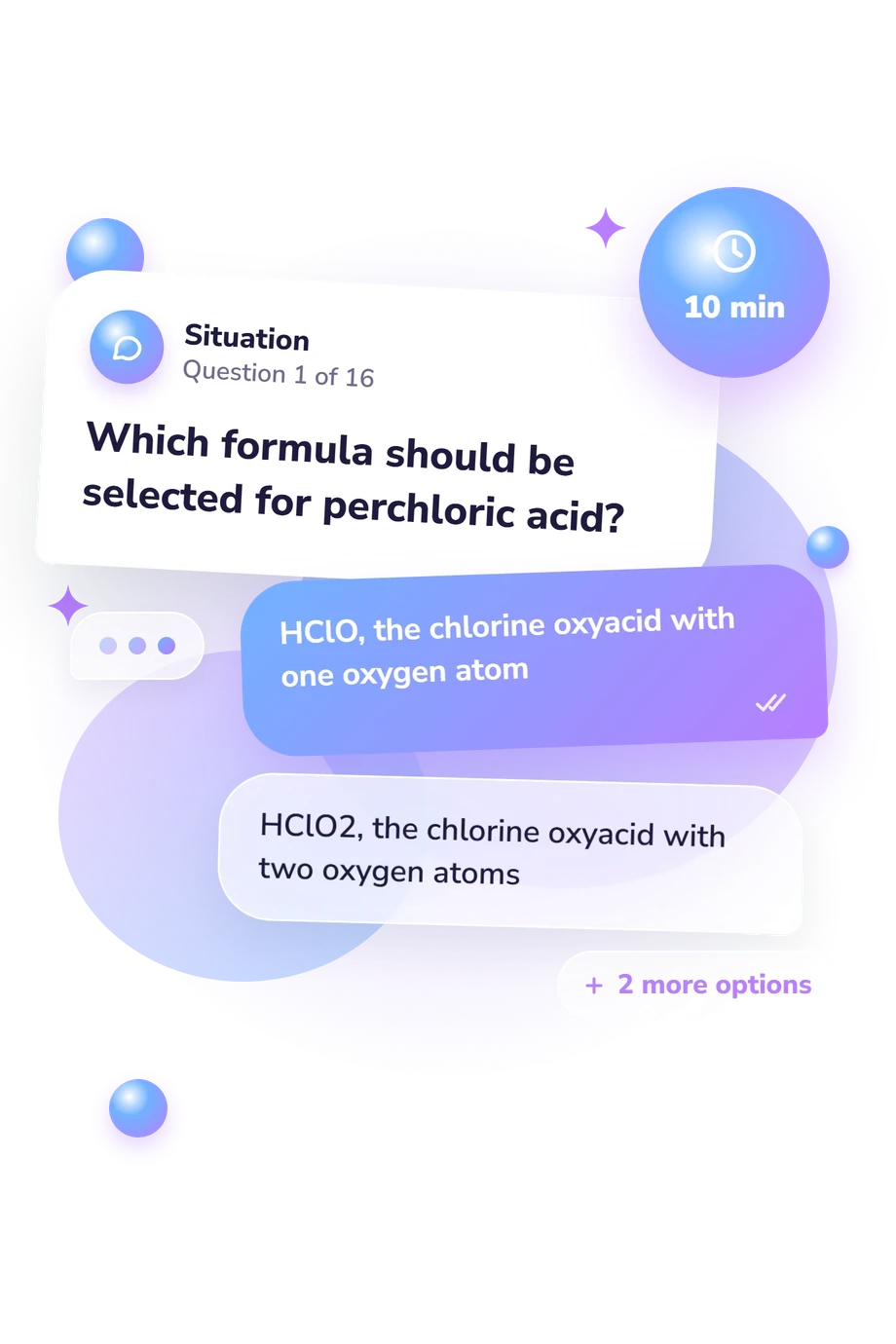
Example Questions From the Test
- HClO, the chlorine oxyacid with one oxygen atom
- HClO2, the chlorine oxyacid with two oxygen atoms
- HClO3, the chlorine oxyacid with three oxygen atoms
- HClO4, the chlorine oxyacid with four oxygen atoms
- Hydrobromic acid
- Bromic acid
- Bromous acid
- Hypobromous acid
- HNO2, with one fewer oxygen atom than nitrate
- HNO3, with one hydrogen bonded to the nitrate-derived group
- H2NO3, with two hydrogen atoms for a −1 ion
- H2N2O3, with two nitrogen atoms instead of one
Naming Acids Quiz - Description and methodology of the test
Students, teachers, and independent learners who want to check their command of introductory acid nomenclature can use Naming Acids Quiz to identify useful revision targets. Before a chemistry lesson or revision session, its acid naming quiz questions let learners check applied conventions and choose where to revise. The result indicates which areas need targeted practice and where naming accuracy is already consistent.
What This Assessment Explores
The questions examine two-way naming work: recognizing an acid from its formula and selecting a formula from an acid name. They cover binary acids and oxyacids, including hydrogen halides, HCN, H2S, and acids linked to nitrate, sulfate, sulfite, chlorate, carbonate, phosphite, and acetate ions. Learners can use the acid nomenclature quiz questions to locate rules needing focused review.
Four result themes are represented in the assessment:
- Binary-acid naming shows whether you apply hydro-…-ic acid to binary acids in aqueous solution.
- Oxyacid naming shows whether you match -ate/-ite ions with -ic/-ous endings.
- Formula construction shows whether you choose the hydrogen and oxygen pattern needed for a neutral acid.
- Naming Acids Knowledge (0-16) gives one point per correct answer: Foundations to review (0-6) signals rules to revisit, Developing knowledge (7-12) marks mostly correct application with some confusion, and Strong knowledge (13-16) indicates consistent use of standard school-level conventions.
Methodology and Scientific Basis
Each item presents a formula, an ion, or a laboratory situation with four answer choices. The respondent selects the option that follows the convention. Scoring is direct: each correct answer contributes one point, and the total is then read through the result bands. Learners move between chemical symbols and names in the acid formula naming test items, applying the convention.
Conceptually, the rules align with the 1987 study by Rodgers, State, and Bivens on relationships between oxyacid names and salts. The 2005 IUPAC recommendations provide the formal nomenclature framework, while the 2006 work by Wirtz, Kaufmann, and Hawley discusses rule discovery in student learning. This questionnaire is conceptually consistent with these nomenclature sources but is not an adaptation of any of them.
Interpret the result as a focused study profile rather than a measure of chemistry ability. Recall, attention, wording, and prior exposure can affect performance, and the score covers only the tested school-level conventions rather than estimating overall chemistry ability. Use the result to target practice with unfamiliar formulas and names, not to infer mastery beyond the tested conventions.
- Rodgers, Glen E.; State, Harold M.; Bivens, L. "Making sense of the nomenclature of the oxyacids and their salts." Journal of Chemical Education 1987, 64(5), 409. 10.1021/ed064p409
- International Union of Pure and Applied Chemistry. Nomenclature of Inorganic Chemistry: IUPAC Recommendations 2005. Prepared for publication by Neil G. Connelly, Ture Damhus, Richard M. Hartshorn, and Alan T. Hutton. RSC Publishing, 2005. ISBN 0-85404-438-8
- Wirtz, Michael C.; Kaufmann, Joan; Hawley, Gary. "Nomenclature Made Practical: Student Discovery of the Nomenclature Rules." Journal of Chemical Education 2006, 83(4), 595-598. 10.1021/ed083p595
Updated: