
Am I Overtraining Quiz
How the Scales are Structured
Who Usually Takes This Test?
See How You Compare
Below is a preview of how scores are typically distributed across each scale.
Example Questions From the Test
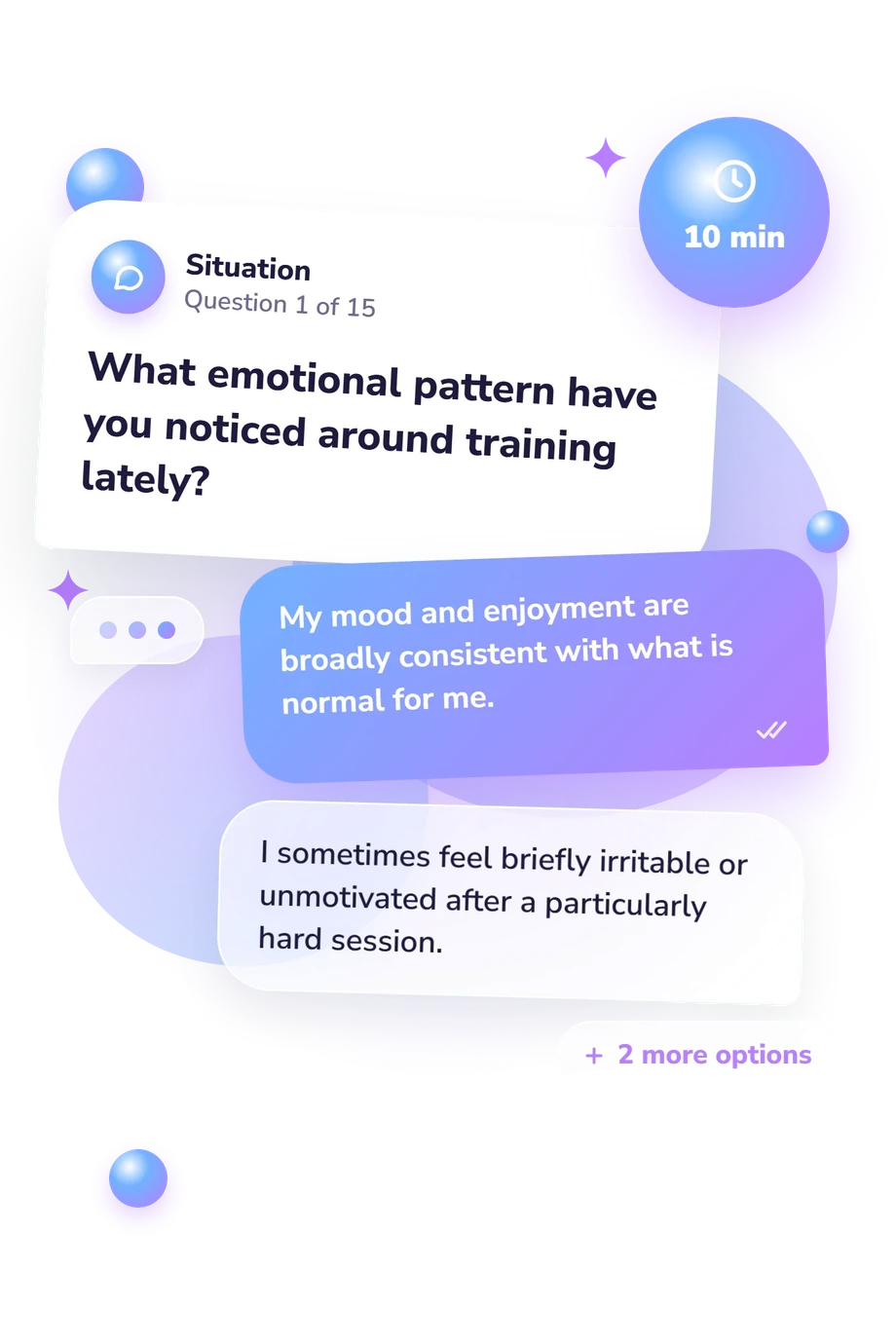
- My mood and enjoyment are broadly consistent with what is normal for me.
- I sometimes feel briefly irritable or unmotivated after a particularly hard session.
- I have recurring irritability, anxiety, low mood, or loss of enjoyment linked with the training period.
- I am experiencing an intense mood change, hopelessness, or a sense that I cannot cope.
- I have had no unusual illness pattern and return only after recovering normally.
- I had one minor illness and gave myself time to recover fully.
- I have had repeated minor illnesses or seem to recover unusually slowly.
- I am training through fever or significant illness symptoms, or those symptoms are getting worse.
- I follow it closely enough to let accumulated fatigue settle.
- I sometimes do a little more than planned when I feel energetic.
- I routinely skip or shorten it because reducing training makes me anxious about progress.
- I feel unable to reduce training even with an injury, significant illness, or professional advice to stop.
Am I Overtraining Quiz - Description and methodology of the test
People who feel persistently tired, under-recovered, or less capable in familiar workouts can use this Am I Overtraining Quiz to organize what has been happening around training. It is intended for active people who want structured self-reflection about effort, recovery, and functioning. An overtraining assessment can clarify which patterns deserve closer tracking, reduced load, or a conversation with a qualified professional.
What This Assessment Measures
For active people, this am i exercising too much quiz organizes changes in performance, recovery, mood, sleep, fueling, illness, pain, and daily functioning. It suits active people whose usual capacity has changed. Together, the dimensions show where concerns appear, while any concerning response should be considered independently of the total.
The displayed dimensions are:
- Performance and Daily Function (0-15) shows effects on ability and responsibilities: No disruption noted (0), Signal to notice (1-2), Action warranted (3-15).
- Physical and Emotional Warning Signs (0-15) shows selected warning experiences: No item endorsed (0), Signal to notice (1-2), Action warranted (3-15).
- Training Load and Recovery Balance (0-15) shows demand-recovery mismatch: No signal (0), Signal to notice (1-2), Action warranted (3-15).
Methodology and Scientific Basis
Each prompt presents a recent training situation with four ordered responses, moving from an expected experience through increasing disruption to a severe or potentially urgent one. Selecting the closest response makes this a structured self-report.
Scores are shown separately for the three dimensions. The questionnaire gives no item-by-item point rule, so totals should not be reverse-engineered. The bands are unvalidated and non-diagnostic: a zero does not prove safety, and a concerning answer matters independently of the total. Chest pain, fainting, severe breathing difficulty, or confusion requires urgent help.
Conceptually, the content is consistent with the SFMS Overtraining Questionnaire described by Maso, Lac, and Brun (2005), which examines overtraining symptoms. Meeusen and colleagues’ 2013 European consensus statement frames overtraining through load, recovery, performance, and health. Davis, Orzeck, and Keelan (2007) provide a related stress-recovery framework. Unvalidated bands are not clinical cutoffs; this questionnaire is not a standardized adaptation of those instruments and summarizes load-recovery patterns.
Current context, recall, self-awareness, and pressure to minimize or exaggerate symptoms can affect self-report, so use the pattern to guide rest, monitoring, and professional assessment.
- Freddy Maso, Gérard Lac, and Jean-Frédéric Brun. Analysis and Interpretation of the French Society of Sports Medicine Questionnaire for the Detection of Early Signs of Overtraining: A Multicenter Study. Science & Sports. 2005;20(1):12-20. 10.1016/j.scispo.2004.05.013
- Romain Meeusen, Martine Duclos, Carl Foster, Andrew Fry, Michael Gleeson, David Nieman, John Raglin, Gerard Rietjens, Jürgen Steinacker, and Axel Urhausen. Prevention, Diagnosis, and Treatment of the Overtraining Syndrome: Joint Consensus Statement of the European College of Sport Science and the American College of Sports Medicine. Medicine & Science in Sports & Exercise. 2013;45(1):186-205. 10.1249/MSS.0b013e318279a10a
- Henry Davis IV, Tricia Orzeck, and Patrick Keelan. Psychometric Item Evaluations of the Recovery-Stress Questionnaire for Athletes. Psychology of Sport and Exercise. 2007;8(6):917-938. 10.1016/j.psychsport.2006.10.003
Updated: