
Tax Quiz
How the Scales are Structured
Who Usually Takes This Test?
See How You Compare
Below is a preview of how scores are typically distributed across each scale.
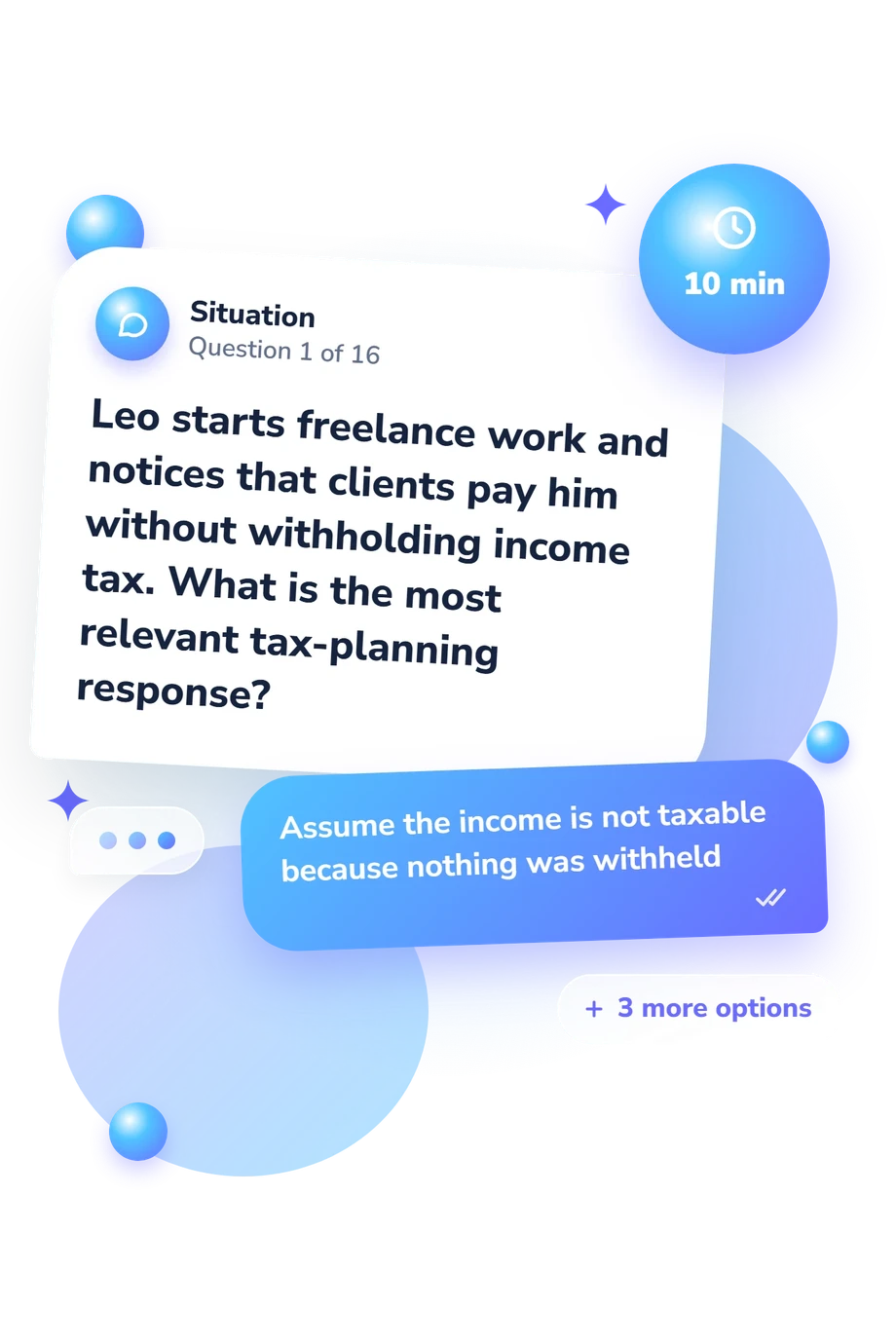
Example Questions From the Test
- The rate applied to the next portion of taxable income
- The average rate applied to every dollar of gross income
- The percentage of income withheld by an employer
- The highest rate listed anywhere in the tax system
- Determine the employee's final taxable income for the year
- Replace the need to calculate an annual tax liability
- Guarantee that the employee will receive a refund
- Prepay part of the employee's expected income tax during the year
- Knowingly concealing reportable income to reduce tax
- Claiming a deduction that the applicable rules expressly allow
- Contributing to a tax-advantaged account within the rules
- Comparing permitted filing methods before submitting a return
Tax Quiz - Description and methodology of the test
For readers who want to check their understanding before dealing with a return, this tax quiz offers a focused way to review everyday personal-tax principles. It also works as a tax knowledge test for learners who want to identify gaps without working through a full filing exercise. The result indicates a level of general tax knowledge and points to areas for further study.
What This Assessment Measures
The assessment asks whether a respondent can apply general personal income-tax concepts to familiar filing and payment situations. Quiz questions about personal taxation cover freelance income, withholding, notices, taxable income, deductions, credits, gains, marginal and effective rates, refunds, records, tax deferral, and lawful planning versus evasion.
Together, these themes test whether related terms can be distinguished and whether a sensible next step can be recognized. The displayed scale is Personal Income Tax Knowledge (0-16), with the result grouped as follows:
- Foundations to build (0-6) means key ideas or calculations may still need review.
- Developing knowledge (7-12) means core principles are understood but applying them in filing situations can improve.
- Strong knowledge (13-16) means the respondent shows solid command of general personal income tax concepts.
Methodology and Evidence Base
Each item uses a multiple-choice format with four alternatives and asks for the best general answer. Scenarios distinguish deductions from credits, marginal from effective rates, and withholding from final liability. The displayed result reports the knowledge score in one of three interpretive bands; the point allocation for answer choices is not specified. It supports structured review as a personal tax assessment.
The questionnaire is a separate online educational questionnaire conceptually consistent with Lyon and Catlin (2020), whose survey work highlights misunderstandings of ordinary tax rules. It also aligns with the educational focus of Eriksen and Fallan’s quasi-experimental work on tax knowledge and attitudes, while Callaway, McBride, Chen, and Pastrone provide recent US context for taxpayer knowledge gaps. Together, these studies support the questionnaire’s tax-knowledge focus but do not make it an adaptation of those studies; it has no stated norms or standardization.
Results can be affected by prior filing experience, familiarity with local terminology, attention, and the accuracy of selected answers. Laws and filing duties vary by jurisdiction, so the score cannot determine a specific obligation.
- Lyon, Elizabeth, and Jesse R. Catlin. “Consumer Misconceptions about Tax Laws: Results from a Survey in the United States.” Journal of Consumer Policy, vol. 43, no. 4, 2020, pp. 807-828. DOI 10.1007/s10603-020-09460-2.
- Eriksen, Knut, and Lars Fallan. “Tax Knowledge and Attitudes towards Taxation; A Report on a Quasi-Experiment.” Journal of Economic Psychology, vol. 17, no. 3, 1996, pp. 387-402. DOI 10.1016/0167-4870(96)00015-3.
- Callaway, Zoe, William McBride, Yihan Chen, and Nicolo Pastrone. “National Tax Literacy Poll: Assessing Taxpayer Knowledge and Perceptions of the US Tax System.” Tax Foundation, 2024.
Updated: