
Gymnastics Level Quiz
How the Scales are Structured
Who Usually Takes This Test?
See How You Compare
Below is a preview of how scores are typically distributed across each scale.
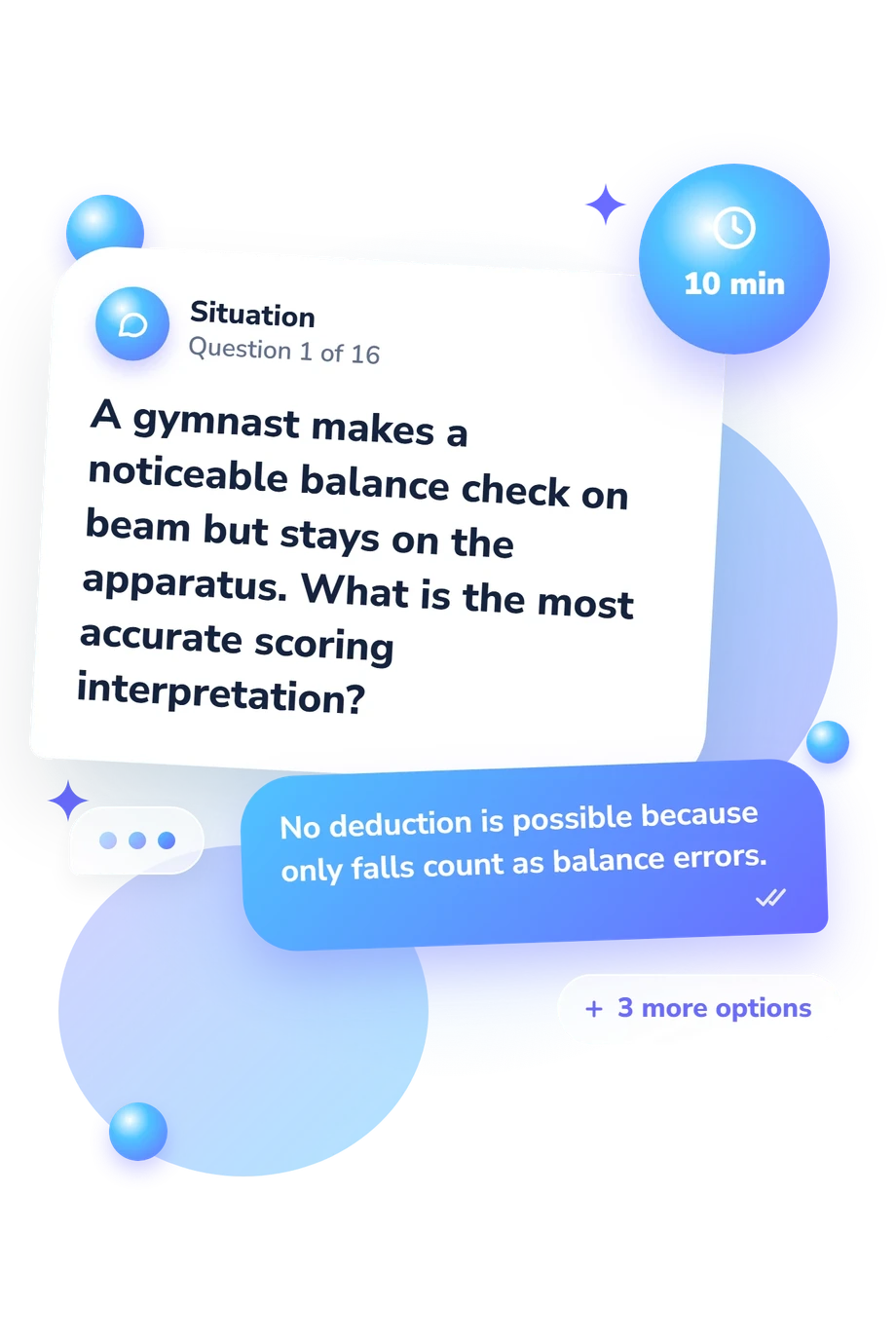
Example Questions From the Test
- As difficulty credit added to the routine
- As a neutral deduction applied according to the rules
- As an artistry bonus awarded by the event judge
- As an automatic replacement of the entire execution score
- Vault, uneven bars, balance beam, and floor exercise
- Uneven bars, pommel horse, vault, and floor exercise
- Vault, rings, balance beam, and floor exercise
- Balance beam, parallel bars, vault, and trampoline
- Gymnast A by 0.30
- They tie at 36.80
- Gymnast B by 0.50
- Gymnast B by 0.30
Gymnastics Level Quiz - Description and methodology of the test
Anyone who wants to understand gymnastics levels, scoring, and routine requirements can use this assessment to see how routines, events, scoring, and progression rules fit together. The gymnastics level quiz focuses on applying concepts to short situations, not on estimating athletic ability from a single skill. For someone wondering about the What Level Gymnast Am I Quiz, this assessment works as a rule-knowledge check rather than a placement measure.
What This Assessment Explores
Rather than placing an athlete in a competitive category, the assessment checks knowledge of how women’s artistic gymnastics is organized and scored. It suits learners, gymnasts, parents, and anyone preparing for a coaching conversation who wants a clearer picture of rule knowledge. A strong result reflects understanding of concepts, not physical ability, safe routine execution, or readiness to advance.
Viewed as a gymnastics scoring quiz, its questions cover events, start value, deductions, routine types, all-around totals, and progression rules. The displayed scale is Gymnastics Level Knowledge (0-16), with these result bands:
- Foundations to build (0-6) indicates that reviewing routine types, events, and basic scoring may strengthen your understanding.
- Developing knowledge (7-12) shows that you understand many core ideas while retaining some gaps in scoring or progression rules.
- Strong knowledge (13-16) reflects a well-rounded command of the concepts covered, without establishing athlete level or coaching qualification.
Methodology and Scientific Basis
Each question presents four answer choices, with one intended as the most accurate response. Items ask the respondent to apply a rule, compare scores, identify an event, or interpret a routine description. The questionnaire reports a 0-16 knowledge score with the displayed bands; the range alone does not establish how individual answers are weighted.
The content is conceptually consistent with USA Gymnastics’ 2022 optional-routine rules, its 2021 compulsory-exercise materials, and Chapter 8 of its Development Program rules from 2024. These sources provide context for optional and compulsory routines, event structure, start values, deductions, and progression.
Cuk, Fink, and Leskosek (2012) offer additional context for the relationship between difficulty, execution, and final score, but their study does not validate this questionnaire. As a gymnastics progression quiz, the result can identify rules to review before a coaching conversation and help organize questions about requirements, scoring, and safe progression. The educational score does not establish an athlete’s level or coaching qualification; actual placement requires evaluation by a qualified coach and the applicable program rules.
- USA Gymnastics; Cheryl Hamilton and Tom Koll, contributors. (2022). Women’s Artistic Gymnastics Development Program Optional Code of Points, 2022-2026. USA Gymnastics Publications.
- USA Gymnastics. (2021). USA Gymnastics Development Program Compulsory Exercises: Women’s Artistic, 2021-2029. USA Gymnastics.
- USA Gymnastics. (2024). Women’s Program Rules & Policies, Chapter 8: Development Program. USA Gymnastics.
- Cuk, Ivan, Hardy Fink, and Bojan Leskosek. (2012). Modeling the final score in artistic gymnastics by different weights of difficulty and execution. Science of Gymnastics Journal, 4(1), 73-82. 10.52165/sgj.4.1.73-82
Updated: