
Am I French Quiz
How the Scales are Structured
Who Usually Takes This Test?
See How You Compare
Below is a preview of how scores are typically distributed across each scale.
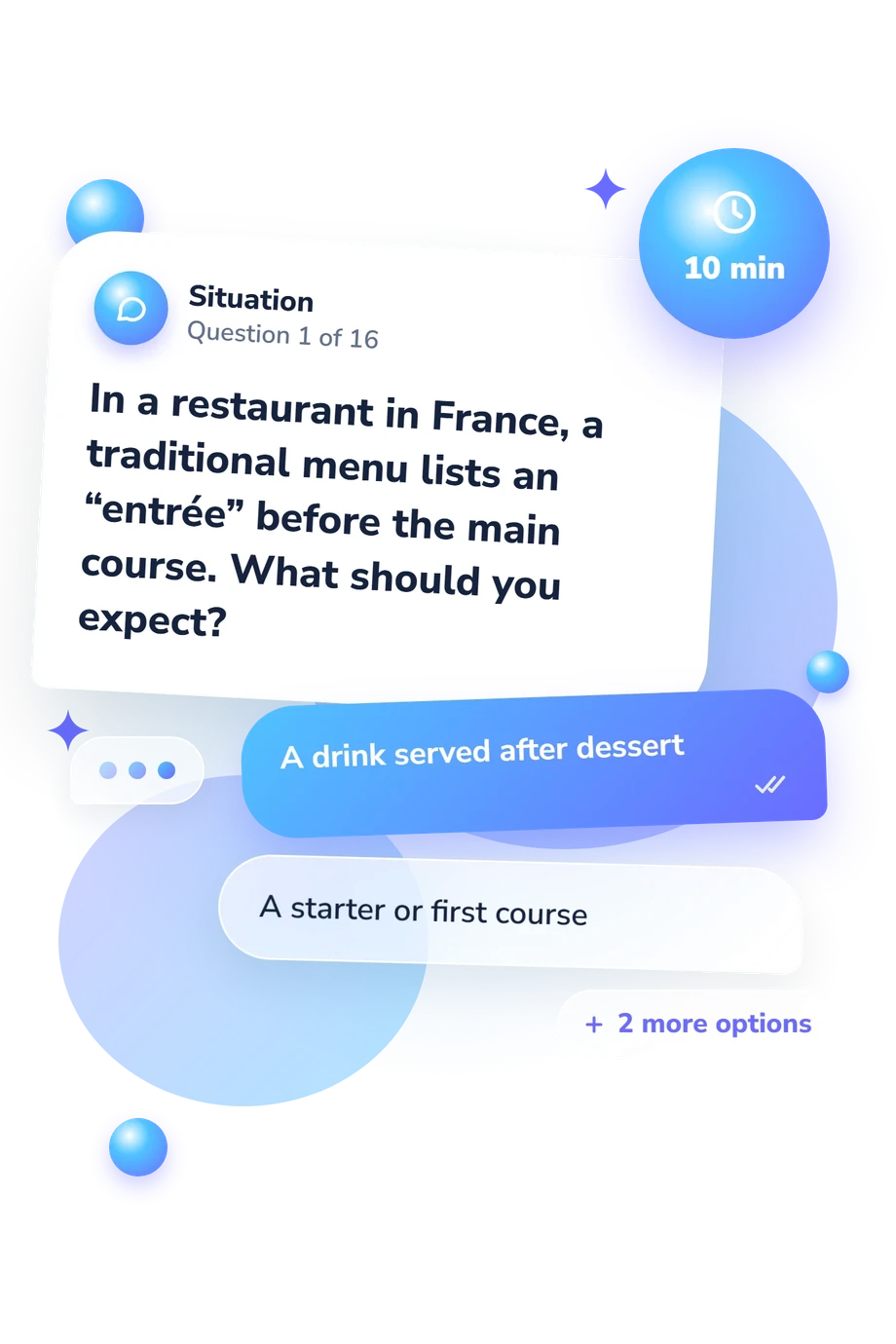
Example Questions From the Test
- A drink served after dessert
- A starter or first course
- The largest dish of the meal
- The bill and service charge
- Bouillabaisse
- Quiche lorraine
- Salade niçoise
- Crêpes and buckwheat galettes
- 1 May
- 14 July
- 11 November
- 8 May
Am I French Quiz - Description and methodology of the test
Readers who want to understand French and Francophone references can use the Am I French Quiz as a focused cultural self-check. It suits curious travelers, learners, and anyone building familiarity with language, history, institutions, geography, food, literature, and art. Someone approaching it as a how French are you quiz should read the result as a guide to cultural knowledge, not as a statement about identity.
What This Assessment Explores
It samples cultural knowledge rather than asking whether someone is French. As a French culture quiz, it covers language and etiquette, institutions, national symbols, geography, regional food, literature, art, and the wider Francophone world. The score reflects recognition of the topics represented by the items.
The displayed French and Francophone Culture Knowledge scale (0-16) summarizes performance across the full quiz. The result is shown in three bands:
- Starting Point (0-6) indicates recognition of some cultural touchstones, with plenty left to explore.
- Developing Familiarity (7-12) indicates a useful foundation across several aspects of French and Francophone culture.
- Strong Cultural Knowledge (13-16) indicates broad, accurate familiarity with the sampled topics.
This result concerns cultural knowledge, not nationality, citizenship, ancestry, or personal identity. It can point learners toward areas for further reading, travel preparation, or conversation.
Methodology and Evidence Base
Each item presents a cultural scenario or fact question with four answer choices. The format tests recognition of the best response rather than written explanation, covering language, public life, geography, food, literature, art, and Francophone contexts. The total is interpreted through the displayed band; no separate weighting system or population norm is specified.
The content is conceptually consistent with the domains discussed by Kelly and Atack (2001), which supplies cultural context rather than authorship for this online questionnaire. Items about laïcité, national principles, and overseas departments can be read alongside Articles 1-2 and 72-3 of the French Constitution. References to French-speaking communities align with the OIF’s account of La Francophonie. These sources support the subject matter, not a claim that the quiz is a standardized adaptation of one instrument.
Gonthier, Grégoire, and Besançon (2021) is relevant to interpreting a French cultural knowledge test: performance on culturally specific material should not be treated as intelligence measurement. Education, travel, language exposure, memory, and attention may affect results. The score is therefore best read as a focused snapshot that can guide further exploration.
- Kelly, Michael, and Margaret Atack, editors. French Culture and Society: The Essentials. London: Arnold, 2001.
- Gonthier, Corentin, Jacques Grégoire, and Maud Besançon. No negative Flynn effect in France: Why variations of intelligence should not be assessed using tests based on cultural knowledge. Intelligence 84 (2021): 101512. 10.1016/j.intell.2020.101512.
- French Republic. Constitution of 4 October 1958, Articles 1-2 and 72-3. 1958.
- International Organisation of La Francophonie. The Francophonie in Brief. n.d.
Updated: