
Am I Ready for College Quiz
How the Scales are Structured
Who Usually Takes This Test?
See How You Compare
Below is a preview of how scores are typically distributed across each scale.
Example Questions From the Test
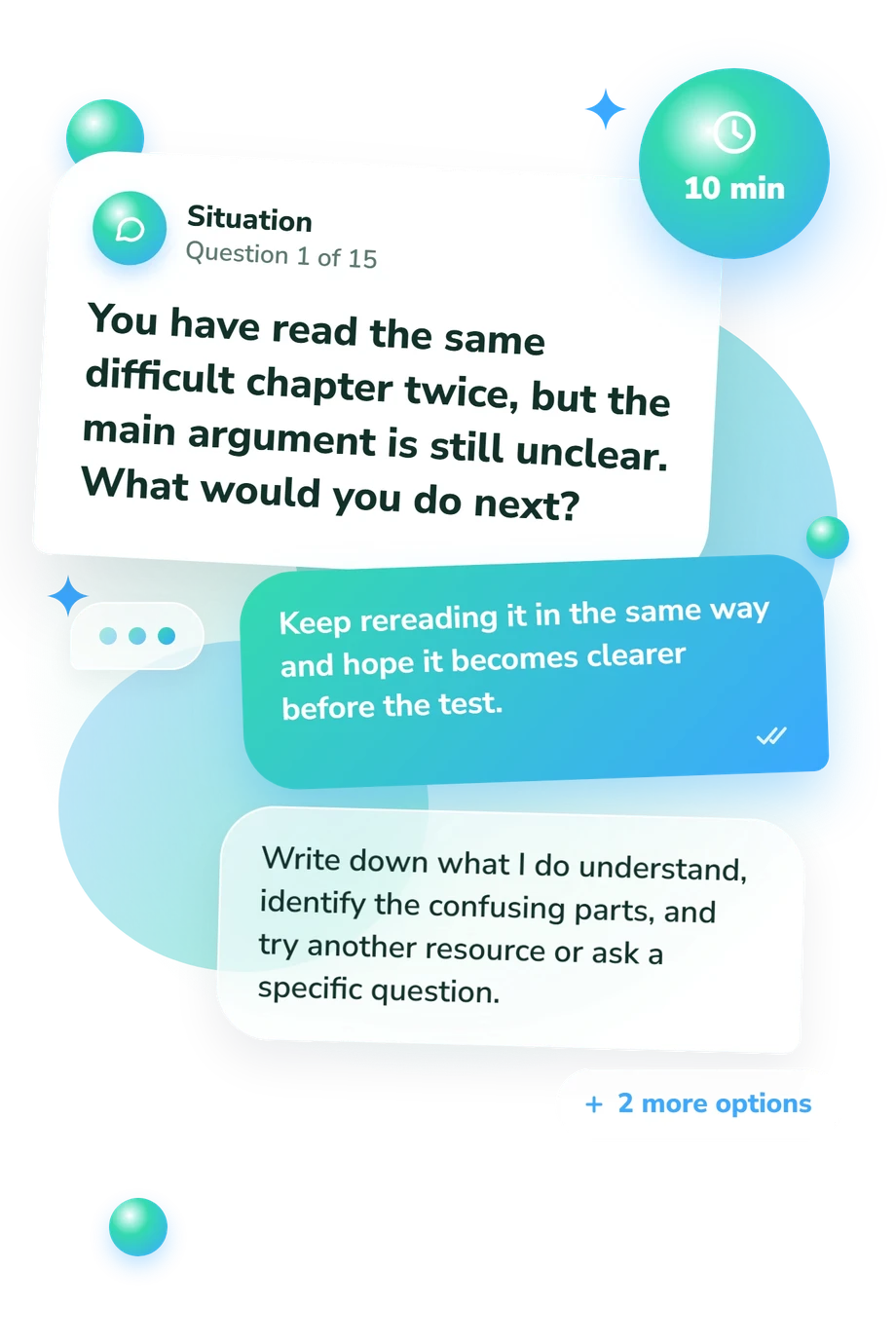
- Keep rereading it in the same way and hope it becomes clearer before the test.
- Write down what I do understand, identify the confusing parts, and try another resource or ask a specific question.
- Look at a short summary and move on, even if some of the reasoning remains unclear.
- Try a different approach, such as outlining the chapter or discussing it with a classmate.
- Keep my original plan and hope I can fit the new requirement in somewhere.
- Recheck my priorities, revise the week, and communicate early if the change creates a genuine conflict.
- Adjust the most urgent part of my plan but leave the rest unchanged for now.
- Put the planning aside until the new deadline is close enough to force a decision.
- Keep the feelings to myself and wait for them to disappear before changing anything.
- Stay connected with people from home while also adding one manageable activity or routine where I am.
- Contact familiar people often but avoid new activities until I feel completely comfortable.
- Talk with someone I trust and experiment with one way to feel more settled.
Am I Ready for College Quiz - Description and methodology of the test
Students preparing to leave home, begin independent study, or manage unfamiliar responsibilities can use the Am I Ready for College Quiz to examine practical readiness rather than predict academic success. It gives prospective students and supportive adults a concrete starting point for discussing strengths, pressure points, and skills to practise. Parents and supportive adults can use this profile to begin a calm planning conversation with a student about college preparation.
What This Assessment Explores
Readiness for college is broader than grades: it includes directing effort, responding to change, finding support, and managing ordinary responsibilities. These scenarios show how a respondent approaches difficult coursework, competing deadlines, unfamiliar settings, money, forms, meals, sleep, and household tasks. Together, they create a practical profile to guide college readiness planning before enrollment.
The result is organized into three dimensions:
- Academic Self-Management (0-15) reflects how consistently you plan, begin, monitor, and adjust academic work; Foundation to build (0-5), Developing system (6-10), and Established habits (11-15) mark increasing self-direction.
- Adaptation and Support Navigation (0-15) reflects responses to change, connection, and help-seeking; Foundation to Build (0-5), Developing Flexibility (6-10), and Resourceful Adjustment (11-15) mark increasing flexibility.
- Everyday Independence (0-15) reflects management of routines, money, household tasks, and administrative obligations; Foundation to build (0-5), Growing independence (6-10), and Functional routines (11-15) mark increasing consistency.
Methodology and Scientific Basis
Each scenario presents a transition problem with four options reflecting different approaches to planning, adjustment, help-seeking, and follow-through. Choosing the closest response makes the format a structured self-report exercise, not a test of factual knowledge. The items sample planning, persistence, adaptation, communication, help-seeking, and daily organization.
Responses produce separate profile totals. The point-contribution formula and normative reference values are not specified for these displayed bands, so these categories should not be reverse-engineered into a scoring rule. Its value as a college readiness assessment lies in identifying routines that appear established and areas where deliberate practice may help, rather than assigning one overall pass-or-fail result.
Conceptually, the questionnaire is consistent with Conley's college-readiness framework (2008), Baker and Siryk's (1984) work on adjustment to college, Credé and Niehorster's (2012) quantitative review, and Zimmerman's (2002) account of self-regulated learning. It is not presented as an adaptation of those published instruments.
The online questionnaire has no stated standardization for score interpretation. Stress, self-awareness, and impression management can influence self-report, so interpret the result as a snapshot for reflection and planning rather than a diagnosis.
- Conley, David T. (2008). Rethinking college readiness. New Directions for Higher Education, 2008(144), 3-13. 10.1002/he.321
- Baker, Robert W., & Siryk, Bohdan. (1984). Measuring adjustment to college. Journal of Counseling Psychology, 31(2), 179-189. 10.1037/0022-0167.31.2.179
- Credé, Marcus, & Niehorster, Sarah. (2012). Adjustment to College as Measured by the Student Adaptation to College Questionnaire: A Quantitative Review of Its Structure and Relationships with Correlates and Consequences. Educational Psychology Review, 24(1), 133-165. 10.1007/s10648-011-9184-5
- Zimmerman, Barry J. (2002). Becoming a Self-Regulated Learner: An Overview. Theory Into Practice, 41(2), 64-70. 10.1207/S15430421TIP4102_2
Updated: