
Medical Surgical Immune and Infectious Quiz
How the Scales are Structured
Who Usually Takes This Test?
See How You Compare
Below is a preview of how scores are typically distributed across each scale.
Example Questions From the Test
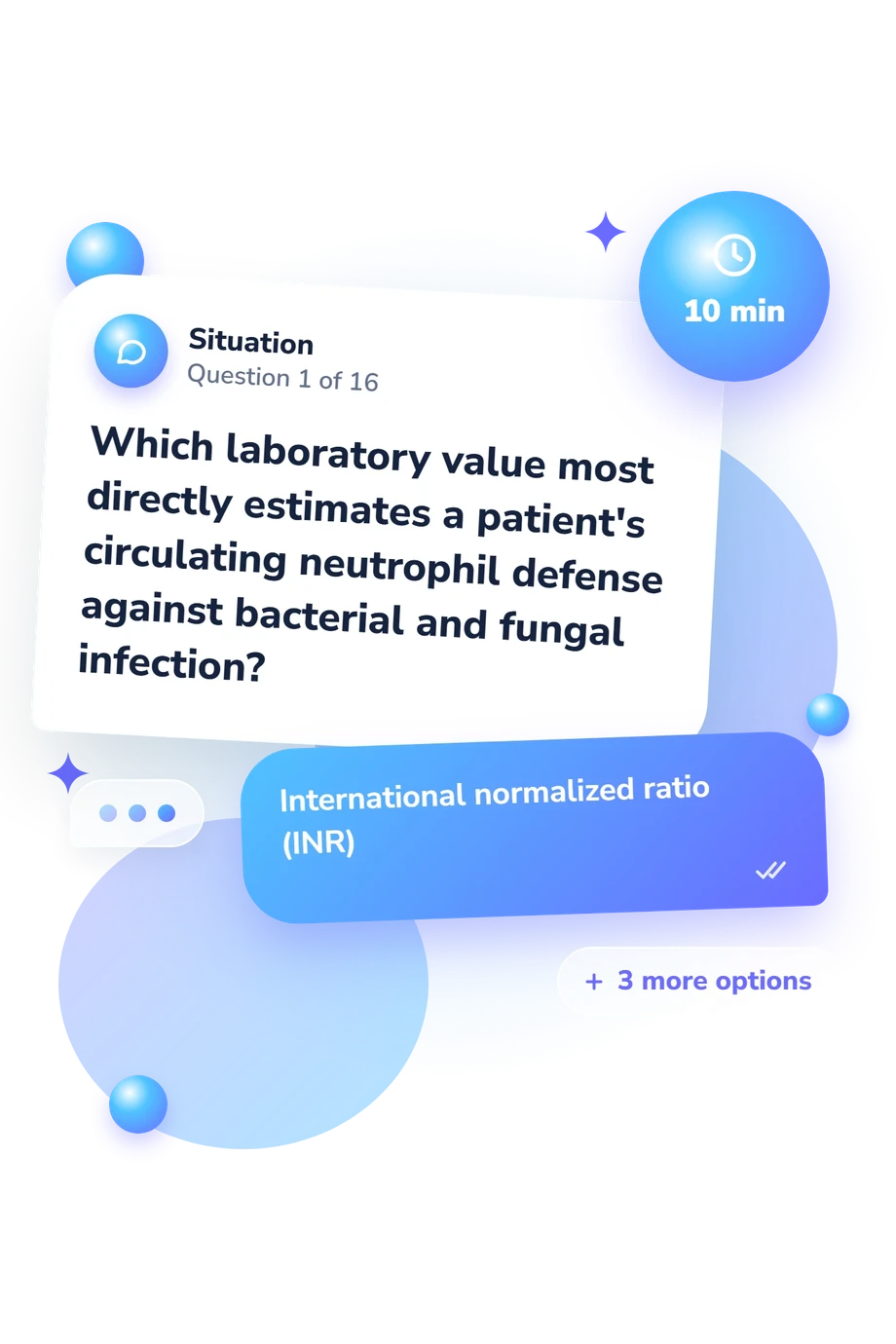
- International normalized ratio (INR)
- Hemoglobin concentration
- Serum albumin level
- Absolute neutrophil count (ANC)
- Natural passive immunity
- Artificial active immunity
- Innate immunity
- Artificial passive immunity
- CD4 T lymphocytes
- Erythrocytes
- Platelets
- Neutrophils
Medical Surgical Immune and Infectious Quiz - Description and methodology of the test
For nursing learners, the medical surgical immune and infectious practice quiz offers a focused way to connect classroom knowledge with decisions made in medical-surgical care. It suits readers reviewing infection prevention, immune responses, postoperative deterioration, and treatment priorities. The immune and infectious practice quiz can show which concepts feel secure and where deliberate revision may improve confidence before clinical placement, coursework, or an examination.
What This Assessment Explores
The clinical situations make this a medical-surgical immune and infectious quiz that tests recognition and prioritization. Its themes include infection prevention, immune mechanisms, acute deterioration, and treatment decisions, with examples involving isolation, allergy, vaccination, HIV, postoperative inflammation, and sepsis.
The questions cover four thematic groups:
- Infection prevention and transmission control shows whether you can choose precautions and interrupt equipment-related spread.
- Immune mechanisms and reactions connect cells, antibodies, hypersensitivity, graft responses, and immune memory with clinical findings.
- Assessment and escalation reflects recognition of patterns such as fever, confusion, tachypnea, and hypotension.
- Treatment and nursing priorities cover choices involving cultures, antibiotics, epinephrine, aseptic technique, and basic care priorities.
Medical-Surgical Immune and Infectious Knowledge is scored from 0-16, with Foundation to build (0-6), Developing knowledge (7-12), and Strong knowledge (13-16). The bands describe the concepts sampled, not complete bedside performance.
Methodology and Evidence Base
The items combine brief clinical scenarios with direct knowledge questions, all using four response choices. The result provides an educational score for the sampled questions, with no defined item weighting or population norms, so it summarizes performance on these questions rather than a population percentile. For an immune and infectious nursing review, this format links knowledge with prioritization.
Content is conceptually consistent with Harding et al. (2023), especially its links among assessment, infection, immune function, and nursing management. Isolation choices align with Siegel et al. (2007), updated September 2024, and hand-hygiene decisions with Boyce et al. (2002). Recognition of systemic deterioration follows the clinical logic of Singer et al. (2016). These sources support the subject matter; they do not make this questionnaire an adaptation or validated version of their work.
Because it is an unvalidated educational score, it is not a diagnosis or proof of clinical competency; current knowledge, recent study, familiarity with guidance, and interpretation of brief clinical scenarios can affect performance. Missed items can guide review against local protocols and supervised teaching.
- Harding MM, Kwong J, Hagler D, Reinisch C. Lewis's Medical-Surgical Nursing: Assessment and Management of Clinical Problems. 12th ed. Elsevier; 2023.
- Siegel JD, Rhinehart E, Jackson M, Chiarello L, Healthcare Infection Control Practices Advisory Committee. Guideline for Isolation Precautions: Preventing Transmission of Infectious Agents in Healthcare Settings. Centers for Disease Control and Prevention; 2007. Updated September 2024.
- Boyce JM, Pittet D, Healthcare Infection Control Practices Advisory Committee, HICPAC/SHEA/APIC/IDSA Hand Hygiene Task Force. Guideline for Hand Hygiene in Health-Care Settings: Recommendations of the Healthcare Infection Control Practices Advisory Committee and the HICPAC/SHEA/APIC/IDSA Hand Hygiene Task Force. MMWR Recomm Rep. 2002;51(RR-16):1-44.
- Singer M, Deutschman CS, Seymour CW, et al. The Third International Consensus Definitions for Sepsis and Septic Shock (Sepsis-3). JAMA. 2016;315(8):801-810. 10.1001/jama.2016.0287
Updated: