
Animal Farm Chapter 1 Quiz
How the Scales are Structured
Who Usually Takes This Test?
See How You Compare
Below is a preview of how scores are typically distributed across each scale.
Example Questions From the Test
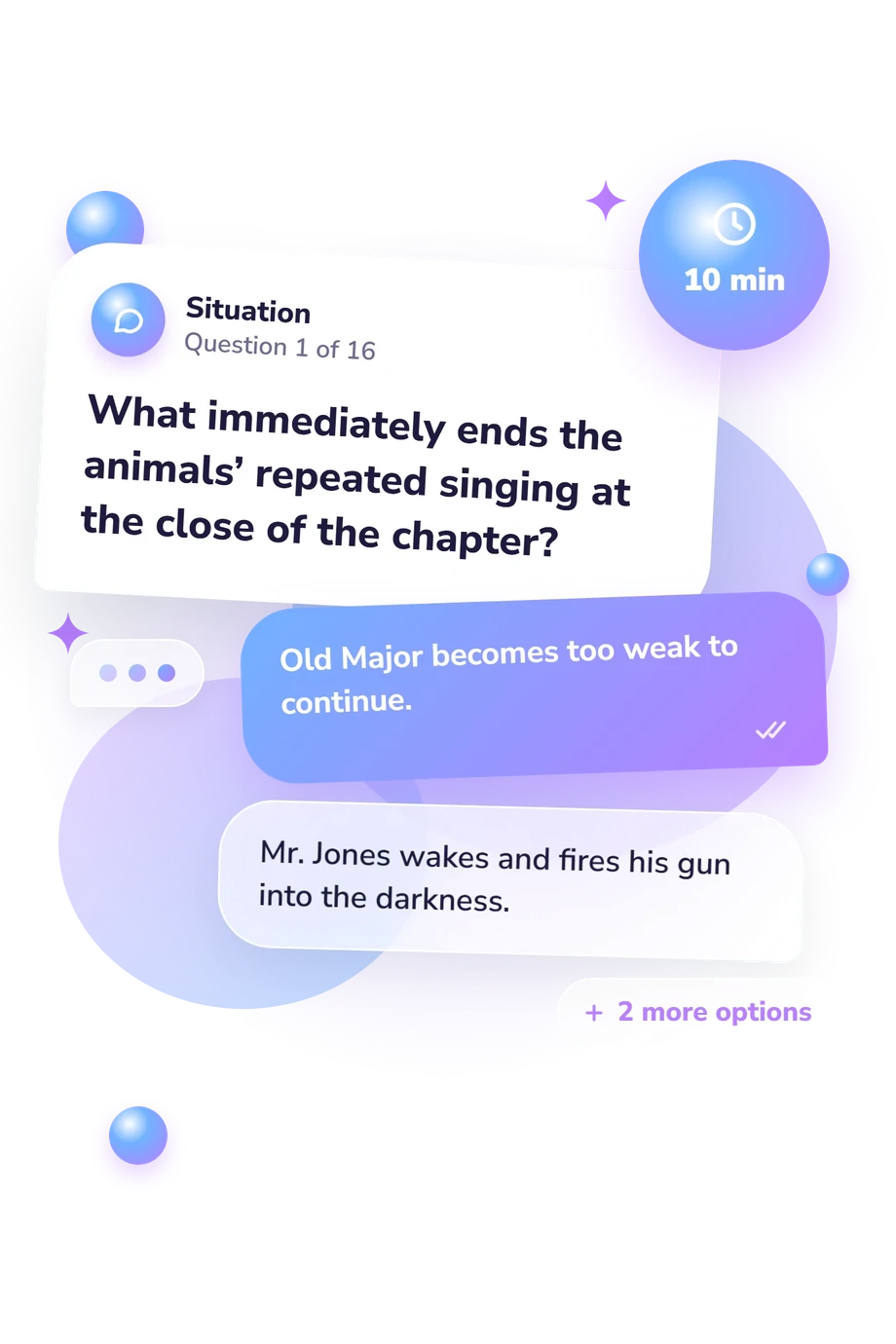
- Old Major becomes too weak to continue.
- Mr. Jones wakes and fires his gun into the darkness.
- The farmhouse bell signals the start of work.
- The dogs begin fighting near the barn door.
- Animal Farm
- Foxwood
- Pinchfield
- Manor Farm
- Moses
- Muriel
- Boxer
- Benjamin
Animal Farm Chapter 1 Quiz - Description and methodology of the test
Readers revising George Orwell’s first chapter can use the Animal Farm Chapter 1 Quiz to check whether recall extends beyond plot to the chapter’s political argument and early warnings about power. It suits students, teachers, and readers who want an Animal Farm Chapter 1 reading quiz for discussion, rereading, or written work. The result indicates the overall level of Chapter 1 knowledge and whether a rereading would be useful.
What This Assessment Measures
The quiz measures knowledge of Chapter 1, including its events, characters, arguments, and foreshadowing. The items ask whether the reader can connect details with Old Major’s argument and distinguish what Chapter 1 establishes from what it foreshadows.
The Animal Farm Chapter 1 questions examine these four areas:
- Events show whether the meeting’s sequence and ending are understood.
- Characters show whether roles, descriptions, and relationships are recognized.
- Old Major’s speech shows whether his claims about labor, ownership, comradeship, and rebellion are understood.
- Foreshadowing shows whether later developments are kept separate from events that have already happened.
Animal Farm Chapter 1 Knowledge is reported on a 0-16 scale: Foundation to revisit (0-6), Developing knowledge (7-12), or Strong knowledge (13-16). The result describes Chapter 1 knowledge, not general reading ability.
Methodology and Evidence Base
Each item uses a multiple-choice format with four answer options. Prompts ask for the best-supported answer about a character, event, argument, song, setting, or implication, so success depends on attentive reading rather than isolated vocabulary. Distractors test whether the reader can distinguish what happens in Chapter 1 from what it foreshadows.
Responses form one chapter-knowledge score, not separate psychological subscales. As an online reading check rather than a normed instrument, its bands are descriptive interpretations of Chapter 1 knowledge. The result can be read alongside an Animal Farm Chapter 1 study guide when a student chooses passages for rereading.
The literary foundation is Orwell (1945), which supplies the characters, meeting, speech, song, and closing scene. Boos and Boos (1990) discuss Old Major’s dream and its ideological resonance. The quiz is conceptually consistent with those sources, not an adaptation or reproduction of their academic analysis. Its meaning remains narrow: it reflects current recall of this chapter, shaped by memory, attention, prior study, and answer-choice wording.
- Orwell, George. Animal Farm: A Fairy Story. London: Secker & Warburg, 1945.
- Boos, Florence S., and William Boos. "Orwell's Morris and 'Old Major's' Dream." English Studies, vol. 71, no. 4, 1990, pp. 361-371. 10.1080/00138389008598703
Updated: