
Symmetry Quiz
How the Scales are Structured
Who Usually Takes This Test?
See How You Compare
Below is a preview of how scores are typically distributed across each scale.
Example Questions From the Test
- Reflection across the line pairs the two semicircles exactly.
- The line divides the circumference into four equal arcs.
- Every point in the circle lies directly on the line.
- The line makes the circle rotate by half a turn.
- Order 1
- Order 2
- Order 4
- Order 3
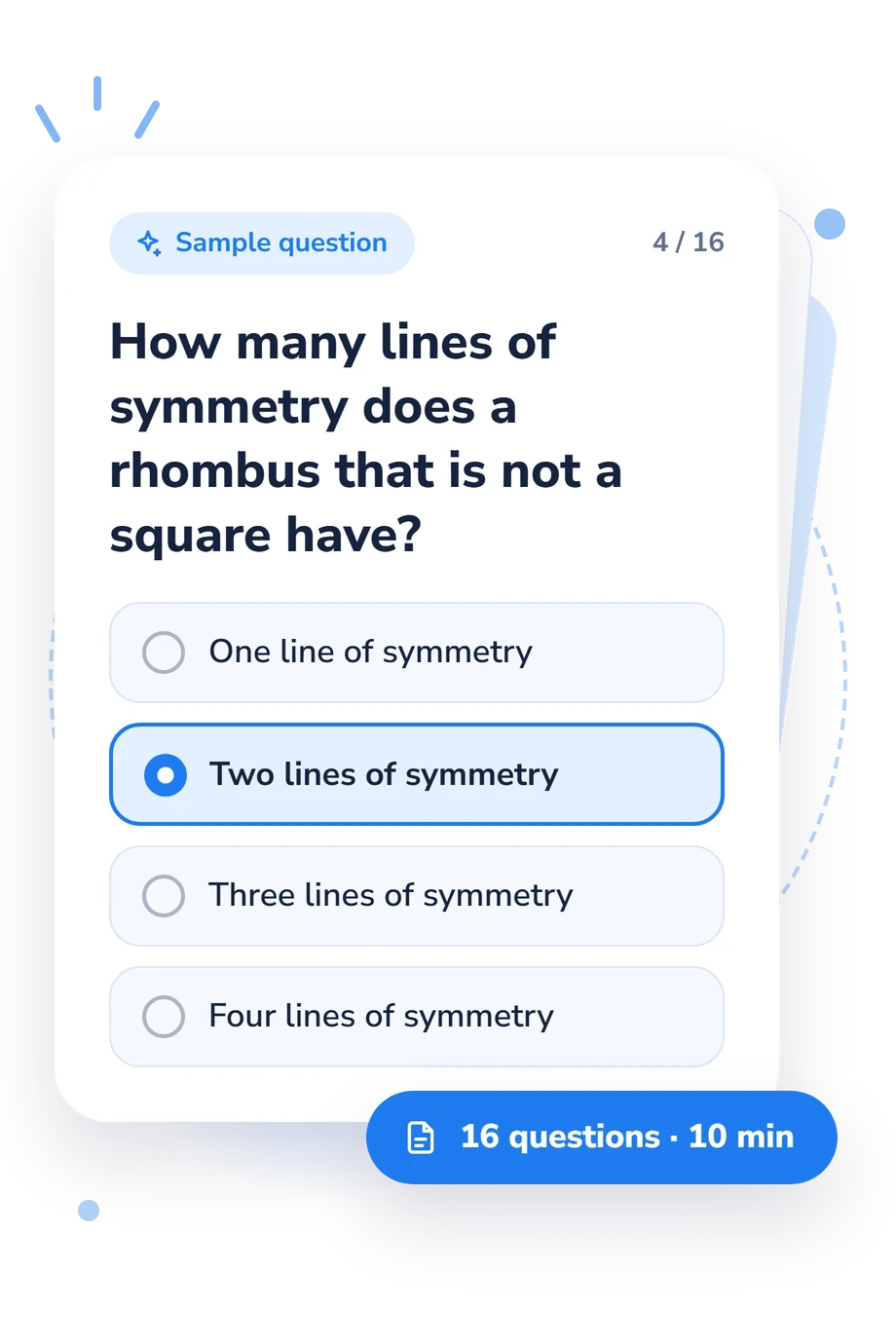
- One line of symmetry
- Two lines of symmetry
- Three lines of symmetry
- Four lines of symmetry
Symmetry Quiz - Description and methodology of the test
Students, teachers, and curious learners who want a focused check of geometric reasoning can use this Symmetry Quiz to see how confidently they apply familiar rules. It suits school-mathematics review, classroom practice, and independent study. Framed as a quiz about lines of symmetry, it connects visual recognition with exact operations, so the result identifies concepts that may need attention instead of claiming to represent overall mathematical ability.
What This Assessment Measures
The questions sample three connected areas of geometry. They ask about mirror axes in familiar figures, rotational order and smallest turning angles, and coordinate reflections across the x-axis, y-axis, or y = x. A folding-paper item checks whether the same rules transfer to a physical example.
The result is organized around these dimensions:
- Symmetry Knowledge (0-16) measures overall accuracy; Foundations to review covers 0-6, Developing knowledge covers 7-12, and Strong knowledge covers 13-16.
- Line symmetry reasoning shows whether reflection across an axis maps a figure exactly onto itself.
- Rotational and coordinate reasoning shows whether you can determine turn order and locate reflected points.
This profile helps a learner see which geometric ideas deserve review rather than treating one total as a measure of general mathematical ability.
Methodology and Evidence Base
Each item presents one geometric situation with four answer choices. You select a rule, count, angle, coordinate, or transformation, so the format tests recognition and application rather than requiring a written proof. The displayed score uses direct accuracy: one point is awarded for each correct answer, and the total is read through the stated bands rather than through an invented percentage or cutoff.
As a rotational symmetry test, the questionnaire is conceptually consistent with the Triskelion symmetry test (Winter, 2025), but it is not an adaptation of that instrument. Its coverage also corresponds to the axial and central symmetry concepts discussed by Moravcová, Robová, Hromadová, and Halas (2021), and to line-symmetry knowledge examined by Köse (2012). These sources support the mathematical domains represented by the questions; they do not establish standardization, norms, reliability, or validity for this online questionnaire.
For a symmetry knowledge test, interpret the result as a snapshot of performance on the presented concepts. Prior instruction, attention, and familiarity with coordinate notation can influence the outcome, and one score cannot capture every aspect of mathematical understanding. Use the profile to choose targeted practice: review reflection rules, compare rotational orders, or work through coordinate transformations where errors occur.
- Winter, Victor. (2025). “Triskelion-In Pursuit of Proficiency Through Immersive Gameplay.” Information, 16(1), 28. 10.3390/info16010028
- Moravcová, Vlasta, Jarmila Robová, Jana Hromadová, and Zdeněk Halas. (2021). “Students’ understanding of axial and central symmetry.” Journal on Efficiency and Responsibility in Education and Science, 14(1), 28-40. 10.7160/eriesj.2021.140103
- Köse, Nilüfer Yavuzsoy. (2012). “Primary School Students’ Knowledge of Line Symmetry.” Hacettepe University Journal of Education, 42, 274-286.
Updated: