
What Classic Book Should I Read Quiz
How the Scales are Structured
Who Usually Takes This Test?
See How You Compare
Below is a preview of how scores are typically distributed across each scale.
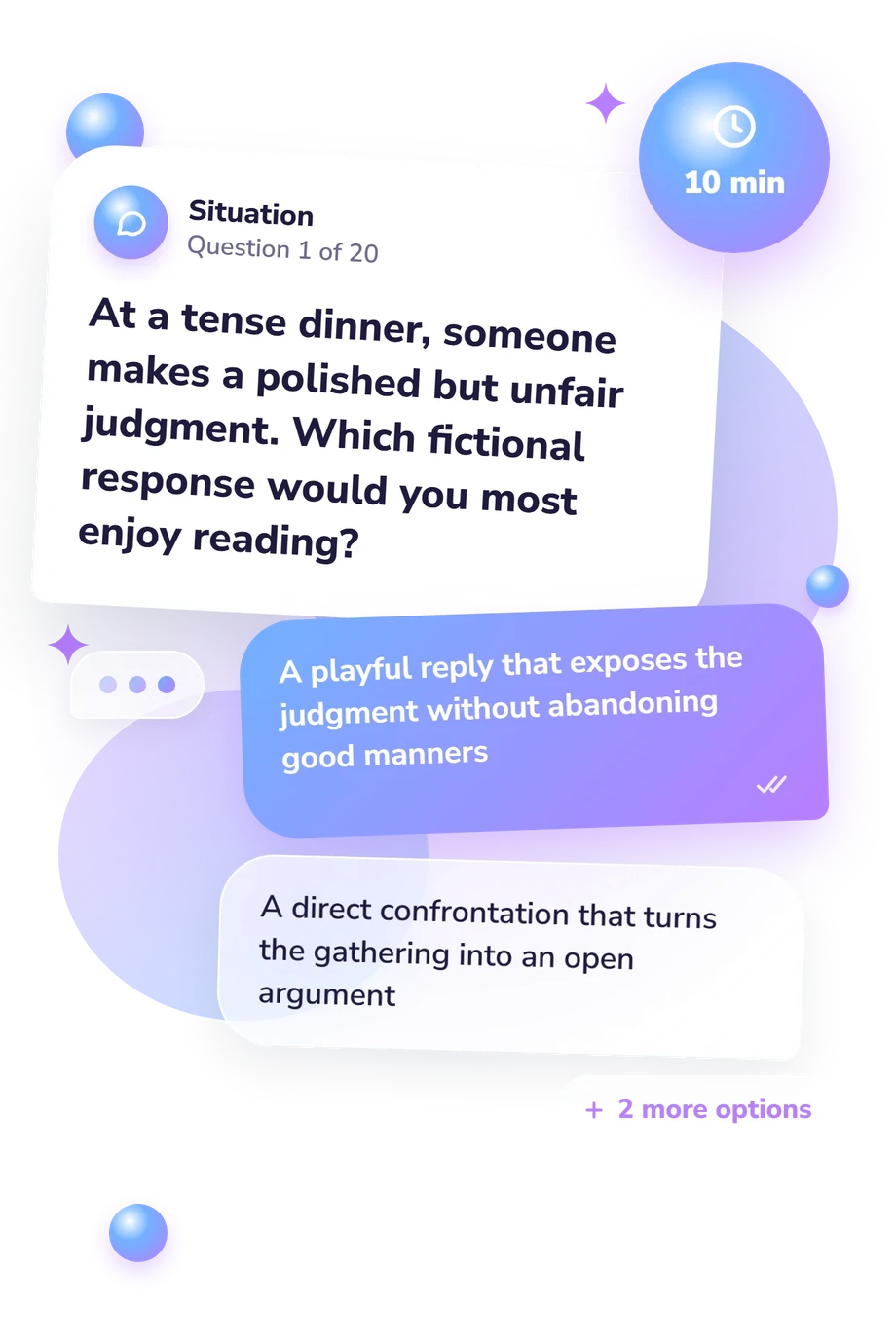
Example Questions From the Test
- A playful reply that exposes the judgment without abandoning good manners
- A direct confrontation that turns the gathering into an open argument
- A quiet retreat followed by private reflection
- A tactful change of subject that preserves the evening while signaling disagreement
- Ambition, status, reinvention, and the distance between a cherished dream and reality
- Family duty, inherited tradition, and reconciliation across generations
- Romantic hope complicated by wealth and social carelessness
- Exploration, survival, and mastery of the natural world
- Very appealing; emotional intimacy feels richer when the house itself holds secrets
- Appealing mainly if the mystery is solved quickly and the story becomes lighter
- Somewhat appealing; I would stay for the heroine more than the Gothic mood
- Unappealing; I prefer open settings without ominous uncertainty
What Classic Book Should I Read Quiz - Description and methodology of the test
Readers choosing among very different literary experiences can use the What Classic Book Should I Read Quiz to turn personal preferences into a practical starting point. It suits anyone deciding whether Gothic unease, social wit, sweeping revenge, moral independence, or lyrical disillusionment sounds most appealing. As a classic book recommendation quiz, it connects themes, relationships, atmosphere, and narrative style with a possible next read.
What This Assessment Explores
The Which Classic Book Should I Read Quiz connects five affinities with atmosphere, ethics, romance, social observation, narrative scale, and prose style. Each score describes a possible reading match:
- Frankenstein (0-12) measures creation, rejection, responsibility, and competing perspectives: Different Experiment (0-4), Curious Observer (5-8), Electrified Reader (9-12).
- Jane Eyre (0-12) measures Gothic atmosphere, moral independence, and equal romance: Another Path (0-4), Drawn to Thornfield (5-8), Kindred Spirit (9-12).
- Pride and Prejudice (0-12) measures wit, manners, social observation, and romantic growth: Different Company (0-4), Cordial Match (5-8), Excellent Acquaintance (9-12).
- The Count of Monte Cristo (0-12) measures adventure, transformation, revenge, justice, and delayed consequences: Shorter Voyage (0-4), Adventure Awaits (5-8), Grand Design (9-12).
- The Great Gatsby (0-12) measures lyrical prose, social performance, elusive dreams, and melancholy: Beyond West Egg (0-4), Invited to the Party (5-8), Green-Light Affinity (9-12).
Methodology and Evidence Base
Each item presents a fictional situation, theme, relationship, setting, or prose feature with four contrasting responses. Choosing the closest option expresses preferences through concrete examples of atmosphere, ethical tension, romance, social interaction, structure, and scale.
Selections become five affinity scores. The highest indicates the strongest match, while scores within one point form a blended recommendation; this helps a reader choose the best classic book to read when two books appeal similarly. The questionnaire is not a standardized psychometric instrument; its bands are catalogue interpretations, not independently validated cutoffs, and mood or current reading goals can shift a self-report.
Vakkari and Mikkonen (2019) offer the closest conceptual support by connecting literary preferences with fiction-selection behavior. Wyatt and Saricks (2019) provide a readers’ advisory framework based on tone, pacing, subject, and style. Miesen (2003) applies the theory of planned behavior to literary reading, while Stokmans (2003) examines psychological differences in cultural taste. The quiz is conceptually consistent with these works, not a reproduction or validated adaptation of any one source.
- Vakkari, Pertti, and Anna Mikkonen. 2019. The role of readers’ literary preferences in predicting success in fiction search. Journal of Documentation, 76(1), 317-332. 10.1108/JD-01-2019-0005
- Wyatt, Neal, and Joyce G. Saricks. 2019. The Readers’ Advisory Guide to Genre Fiction, Third Edition. Chicago: ALA Editions. ISBN 978-0-8389-1781-7
- Miesen, H.W.J.M. 2003. Predicting and explaining literary reading: an application of the theory of planned behavior. Poetics, 31(3-4), 189-212. 10.1016/S0304-422X(03)00030-5
- Stokmans, M.J.W. 2003. How heterogeneity in cultural tastes is captured by psychological factors: a study of reading fiction. Poetics, 31(5-6), 423-439. 10.1016/j.poetic.2003.09.003
Updated: