
Am I Mysterious Quiz
How the Scales are Structured
Who Usually Takes This Test?
See How You Compare
Below is a preview of how scores are typically distributed across each scale.
Example Questions From the Test
- I calmly acknowledge it and process my disappointment later.
- I say I am disappointed, but my reaction remains fairly measured.
- My disappointment is visible even if I try to be understanding.
- I openly explain how the cancellation affects me.
- It is usually obvious from my face or tone.
- People close to me can tell, but others may not notice.
- There are a few signs, although my reaction is not unmistakable.
- Most people cannot tell unless I decide to say so.
- I often bring them up naturally when introducing myself.
- I mention them once I have spent a little time with someone.
- They usually discover them gradually through shared experiences.
- They tend to find out by accident or from somebody else.
Am I Mysterious Quiz - Description and methodology of the test
People who feel that others see only part of them can use the Am I Mysterious Quiz to examine the interpersonal style behind that impression. It suits anyone who has wondered why their self-image differs from the way acquaintances perceive them and wants to use a mysterious personality quiz for structured reflection. By organizing interpersonal patterns into a profile, the questionnaire helps examine that uncertainty without assigning a fixed identity.
What This Assessment Explores
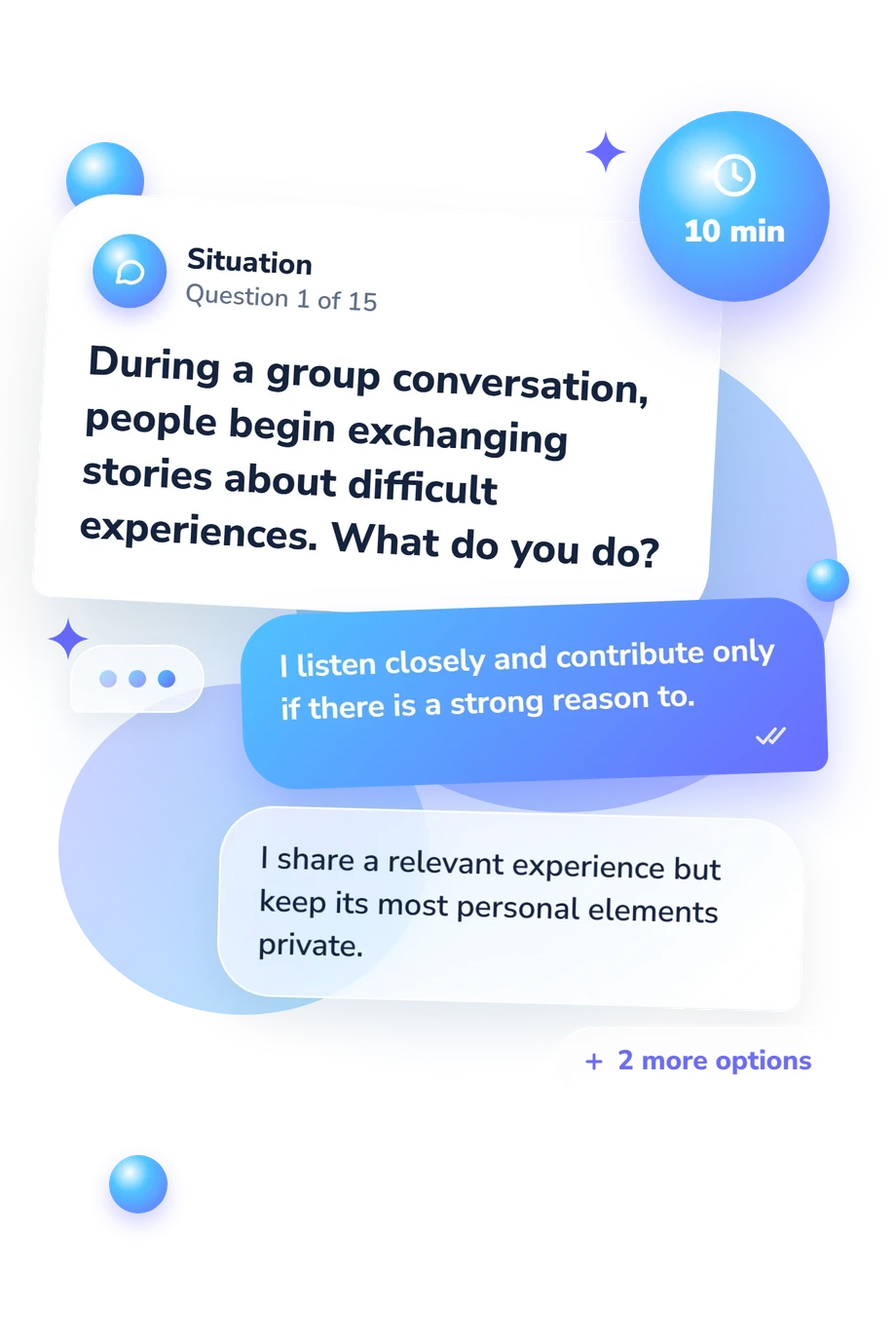
The items examine moments when other people infer your feelings, personal history, and less obvious interests. They use situations involving conversation, disagreement, disappointment, online sharing, introductions, and surprising abilities. As a quiz about how mysterious you are, the result describes social legibility across situations rather than a fixed character label.
The displayed dimensions and their bands are listed below; they describe style, not worth, honesty, intelligence, or wellbeing.
- Emotional Unreadability (0-15) shows how visible feelings, reactions, and intentions are: Expressive Signals (0-5), Contextually Reserved (6-10), or Hard to Read (11-15).
- Selective Self-Disclosure (0-15) shows how carefully personal experiences are shared: Open Book (0-5), Layered Sharer (6-10), or Guarded Presence (11-15).
- Unexpected Depth (0-15) shows how often interests, abilities, and viewpoints differ from first impressions: Readily Known (0-5), Quiet Contrasts (6-10), or Continual Surprise (11-15).
Methodology and Scientific Basis
Each question presents a social scene with four options that vary in how visible, controlled, or surprising a reaction may be. The questionnaire reports three dimensions on 0-15 scales, with each result presented in a corresponding descriptive band. These ranges describe tendencies, not a fixed identity.
The approach is conceptually consistent with Colvin (1993), which examines how personality and behavior become available to observers through everyday conduct. It also relates to Larson and Chastain’s account of self-concealment, while visible affect aligns with Kring, Smith, and Neale’s work on dispositional expressiveness. These sources give the questionnaire a traceable theoretical context; it remains a separate online self-report tool, not a reproduction of those instruments.
For someone asking whether they are hard to read, this mysterious personality test is best interpreted across the varied situations in the questions rather than in any single result. Privacy preferences, communication habits, and immediate context can all shape an answer. The bands are descriptive categories, not standardized population norms or clinical cutoffs.
- Colvin, C. Randall. “Judgable” People: Personality, Behavior, and Competing Explanations. Journal of Personality and Social Psychology, 1993, 64(5), 861-873. 10.1037/0022-3514.64.5.861
- Larson, Dale G., and Robert L. Chastain. Self-Concealment: Conceptualization, Measurement, and Health Implications. Journal of Social and Clinical Psychology, 1990, 9(4), 439-455. 10.1521/jscp.1990.9.4.439
- Kring, Ann M., David A. Smith, and John M. Neale. Individual Differences in Dispositional Expressiveness: Development and Validation of the Emotional Expressivity Scale. Journal of Personality and Social Psychology, 1994, 66(5), 934-949. 10.1037/0022-3514.66.5.934
Updated: