
Do I Have a Crush on My Teacher Quiz
How the Scales are Structured
Who Usually Takes This Test?
See How You Compare
Below is a preview of how scores are typically distributed across each scale.
Example Questions From the Test
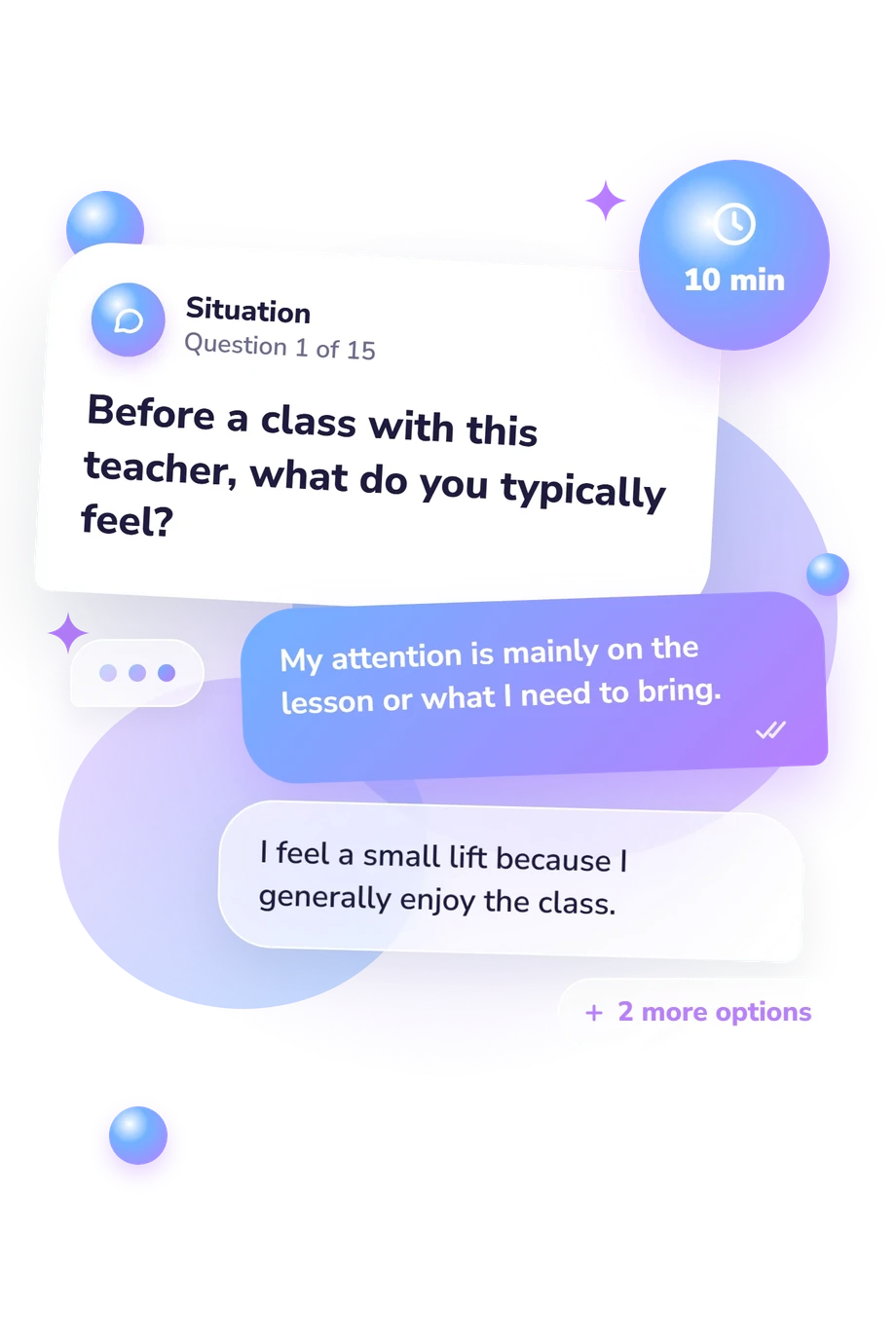
- My attention is mainly on the lesson or what I need to bring.
- I feel a small lift because I generally enjoy the class.
- I often feel noticeably excited or self-conscious about seeing them.
- I experience a strong rush of nerves, excitement, or anticipation centered on them.
- Rarely, unless something directly reminds me of the class.
- Occasionally, usually because of something interesting they taught or said.
- Often, including thoughts about their personality or appearance.
- Very often; thoughts about them repeatedly take over my attention.
- I adjust to the change and focus on the class plan.
- I notice their absence but it does not affect me much.
- I feel personally disappointed that I will not see them.
- Their absence causes a strong letdown that is difficult to shake.
Do I Have a Crush on My Teacher Quiz - Description and methodology of the test
People who feel unusually drawn to a teacher can use the Do I Have a Crush on My Teacher Quiz to separate ordinary respect from stronger personal reactions. It is intended for self-reflection about attention, excitement, fantasies, jealousy, and wishes for contact beyond class. A teacher crush may be confusing, but the result offers a structured profile rather than a verdict.
What This Assessment Explores
This assessment distinguishes role-based respect from stronger personal and romantic reactions. Items address anticipation, thoughts away from school, sensitivity to praise or absence, peer comparisons, jealousy, idealization, and wishes for contact beyond class. The profile explores persistent thoughts, idealization, and personal closeness as measured patterns; it does not determine whether they amount to an obsession.
It can help a reader organize feelings for a teacher without treating them as proof of an obsession.
The three displayed dimensions are:
- Emotional Pull (0-15) captures excitement, nervousness, disappointment, and jealousy: Mild 0-5; Noticeable 6-10; Strong 11-15.
- Mental Focus and Idealization (0-15) captures situational attention, recurring personal focus, or strong idealized focus: Situational attention 0-5; Recurring personal focus 6-10; Strong idealized focus 11-15.
- Wish for Personal Closeness (0-15) captures role-based connection, personal closeness curiosity, or strong closeness wish: Role-based connection 0-5; Personal closeness curiosity 6-10; Strong closeness wish 11-15.
Methodology and Scientific Basis
Each prompt presents a school situation with four ordered choices, moving from ordinary classroom reactions toward stronger personal, romantic, or jealous responses. Choose the option closest to your usual experience. Responses are combined into the displayed dimensions; use their ranges and labels rather than guessing how many points an answer contributes.
The questionnaire is conceptually consistent with Chaikin et al. (1978) on student reactions to teachers’ attractiveness and nonverbal behavior, Hatfield and Sprecher (1986) on passionate love, and Riley (2009) on attachment and student-teacher role context. It is not an adaptation of those published works, and it is not validated by them.
The questionnaire is an online self-reflection tool rather than a published standardized scale. Scores can shift with recent interactions, stress, admiration, or a need for approval; self-report depends on honesty and self-awareness. A crush on a teacher may feel intense, but a high pattern cannot establish mutual interest or the teacher’s intentions. If secrecy or romantic or sexual contact is encouraged, tell a trusted adult.
- Chaikin, A. L., Gillen, B., Derlega, V. J., Heinen, J. R. K., & Wilson, M. (1978). Students' reactions to teachers' physical attractiveness and nonverbal behavior: Two exploratory studies. Psychology in the Schools, 15(4), 588-595. 10.1002/1520-6807(197810)15:4<588::AID-PITS2310150425>3.0.CO;2-#
- Hatfield, E., & Sprecher, S. (1986). Measuring passionate love in intimate relationships. Journal of Adolescence, 9(4), 383-410. 10.1016/S0140-1971(86)80043-4
- Riley, P. J. (2009). An adult attachment perspective on the student-teacher relationship & classroom management difficulties. Teaching and Teacher Education, 25(5), 626-635. 10.1016/j.tate.2008.11.018
Updated: