
Natural Disasters Quiz
How the Scales are Structured
Who Usually Takes This Test?
See How You Compare
Below is a preview of how scores are typically distributed across each scale.
Example Questions From the Test
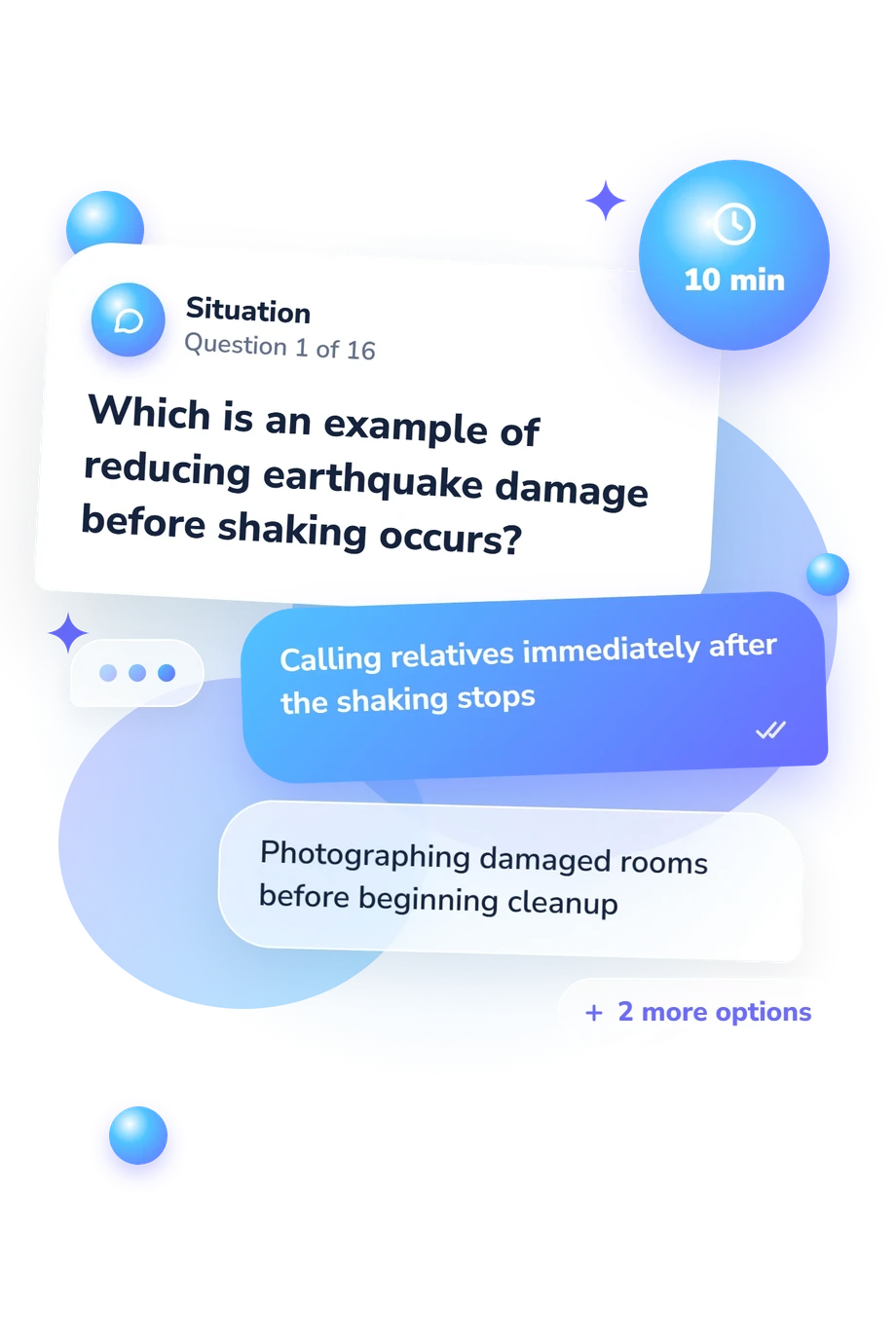
- Calling relatives immediately after the shaking stops
- Photographing damaged rooms before beginning cleanup
- Securing tall furniture and other heavy items that could fall
- Waiting outdoors until officials complete building inspections
- In a room with large windows so you can monitor the storm
- In a small interior room on the lowest floor, away from windows
- In a vehicle parked beneath an overpass
- In the largest room available, even if it has a wide roof span
- Drive through slowly if the road markings remain visible
- Follow a larger vehicle because it will reveal the road's depth
- Leave the vehicle and test the water on foot before proceeding
- Turn around and use a route that does not cross the floodwater
Natural Disasters Quiz - Description and methodology of the test
People reviewing household emergency planning can use this natural disasters quiz to examine whether their choices match practical protective guidance. It is intended for readers who want a focused check of preparedness knowledge across several hazards. The disaster quiz emphasizes decisions that can reduce exposure, improve communication, and support safer evacuation, giving the result a clear starting point for targeted review.
What This Assessment Measures
The assessment measures applied preparedness knowledge: choices made before, during, and after hazards, rather than personality or emotional reactions. Items span earthquakes, storms, floods, fires, alerts, supplies, and evacuation.
Natural Disaster Preparedness Knowledge is the displayed 0-16 scale. Its bands are Foundation to Build (0-6), Developing Knowledge (7-12), and Strong Knowledge (13-16). They show how answers align with the principles represented by the questionnaire, not guaranteed performance in an emergency.
The questions group into three practical areas:
- Structural safety shows whether the result recognizes securing heavy furniture, sheltering during shaking, and avoiding ignition sources after a gas leak.
- Communication and supplies show understanding of alerts, contact plans, documents, water, food, and medications.
- Evacuation awareness shows how answers handle routes, shelter locations, ash, generators, coastal warnings, and floodwater.
These natural disaster quiz questions highlight subjects for further study or household discussion.
Methodology and Evidence Base
Each item presents a brief scenario with four answer choices. The respondent selects the option that best matches protective guidance. The total is interpreted through the displayed band; the range does not show how individual options are weighted. This self-report format reflects selected knowledge, not observed conduct or performance under stress.
In practice, the natural-disaster quiz questions and answers turn common guidance into decisions about alerts, sheltering, evacuation, supplies, and hazard-specific protection. Disaster response knowledge (Li et al., 2019) is the closest conceptual reference for treating disaster knowledge as measurable. Su et al. (2013) supports identifying knowledge gaps and training needs, while FEMA and Citizen Corps guidance provides practical principles for alerts, water, evacuation, and generator safety. The questionnaire is conceptually consistent with these sources, not a direct adaptation or standardized reproduction.
Interpret the outcome as an educational snapshot of the item principles. The questionnaire has no stated standardized norms or clinical validation; local risks, access needs, household circumstances, current context, and honest self-report can affect results. Use the score to prioritize review and planning.
- Li, Tongtong, Qi Wang, and Zheng Xie. (2019). Disaster response knowledge and its social determinants: A cross-sectional study in Beijing, China. PLoS ONE, 14(3), e0214367. 10.1371/journal.pone.0214367
- Su, Tong, Xue Han, Fei Chen, Yan Du, Hongwei Zhang, Jianhua Yin, Xiaojie Tan, Wenjun Chang, Yibo Ding, Yifang Han, and Guangwen Cao. (2013). Knowledge Levels and Training Needs of Disaster Medicine among Health Professionals, Medical Students, and Local Residents in Shanghai, China. PLoS ONE, 8(6), e67041. 10.1371/journal.pone.0067041
- Federal Emergency Management Agency and Citizen Corps. (2004). Are You Ready?: An In-depth Guide to Citizen Preparedness. Washington, DC: FEMA.
Updated: