
Name the TV Show Picture Quiz
How the Scales are Structured
Who Usually Takes This Test?
See How You Compare
Below is a preview of how scores are typically distributed across each scale.
Example Questions From the Test
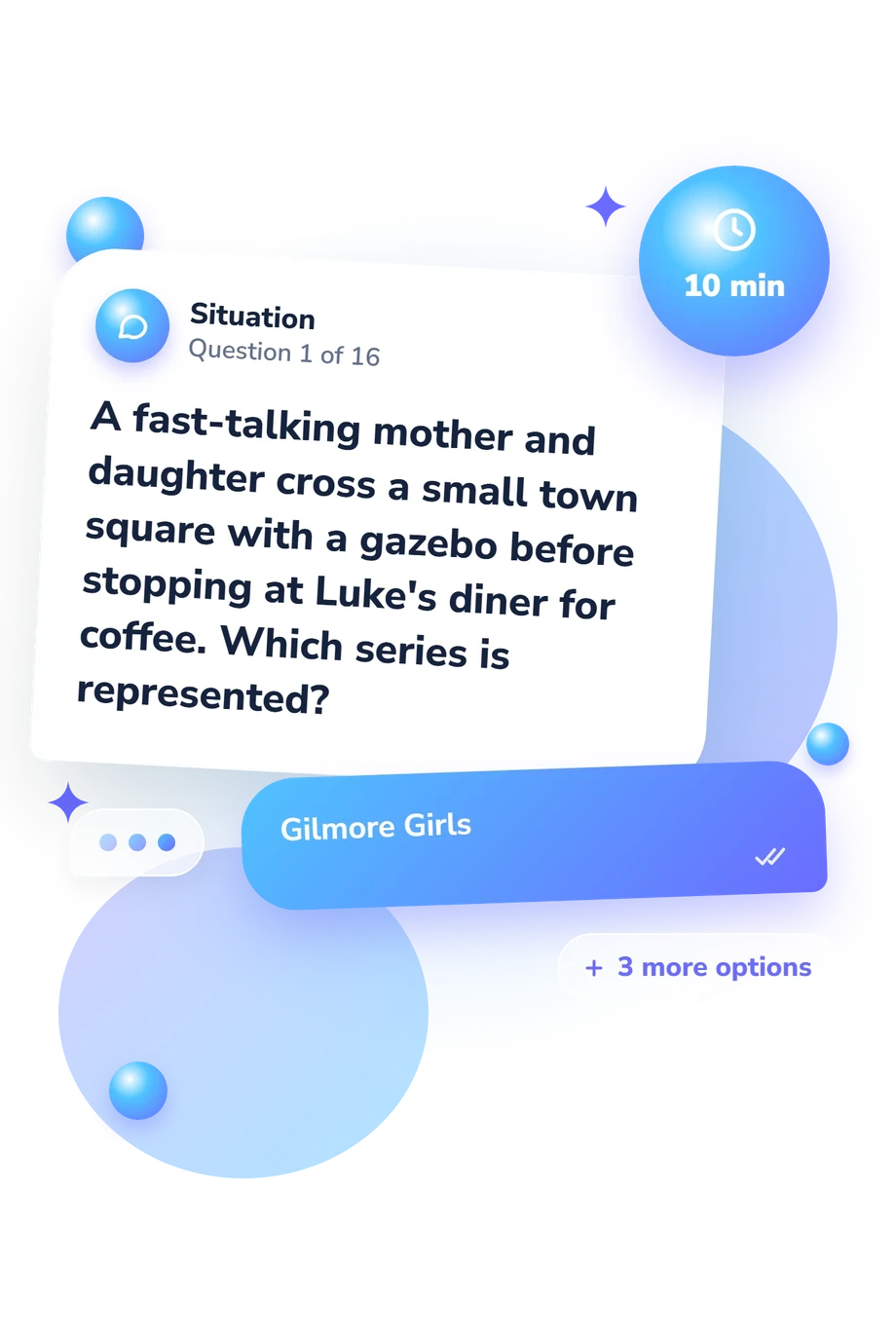
- Gilmore Girls
- Virgin River
- Kim's Convenience
- Schitt's Creek
- Seinfeld
- Friends
- How I Met Your Mother
- New Girl
- How I Met Your Mother
- Happy Endings
- Friends
- New Girl
Name the TV Show Picture Quiz - Description and methodology of the test
People who enjoy television details can use Name the TV Show Picture Quiz to test how readily familiar visual clues bring a series to mind. It suits anyone who enjoys picture quiz tv shows and wants a focused way to compare recognition across comedy, drama, fantasy, science fiction, and animation. The result summarizes performance in identifying scenes rather than judging broader media expertise.
What This Assessment Explores
The task measures recognition of distinctive television imagery: props, settings, costumes, recurring visual devices, and character situations linked with a series. It suits viewers who want to discover which kinds of screen memories they retrieve from brief scene descriptions.
Visitors identify TV shows from pictures and clues. The main themes are:
- Iconic objects and settings show whether a familiar location or prop connects a scene with its series.
- Costumes and visual signatures indicate whether styling, color, or staging triggers identification.
- Recurring scenes and character contexts reveal whether formats, ensembles, or narrative situations support recall.
The result is TV Show Picture Knowledge, scored 0-16: Scene Starter (0-6) reflects recognition of some major imagery; Channel Surfer (7-12) reflects many links between visuals and shows; Screen Spotter (13-16) reflects excellent recall across genres. It measures entertainment knowledge, not general intelligence.
Methodology and Evidence Base
Each item presents a scene through visual clues and four show titles. The respondent selects the best match, so the format tests recognition and retrieval rather than opinions or personality ratings. The displayed scoring method gives one point for each correct identification.
The design is conceptually consistent with Burns and Anderson (1993), who examined recognition memory in television viewing, and with Ferguson, Homa, and Ellis (2017) and Potter (2012), whose studies address memory for visually presented or changing scenes. These sources support using distinctive scene information as a cue; they do not make this questionnaire an adaptation of their instruments or establish norms for its online result.
A TV show identification quiz can be influenced by previous viewing, genre familiarity, cultural exposure, and the context available in one image or description. Famous props may be easier to recognize than subtler details. Interpret the outcome as a snapshot of entertainment knowledge under this format, useful for personal comparison rather than judging intelligence or universal recall.
- Burns, John J., and Daniel R. Anderson. “Attentional Inertia and Recognition Memory in Adult Television Viewing.” Communication Research, vol. 20, no. 6, 1993, pp. 777-799. 10.1177/009365093020006002
- Ferguson, Ryan, Donald Homa, and Derek Ellis. “Memory for Temporally Dynamic Scenes.” Quarterly Journal of Experimental Psychology, vol. 70, no. 7, 2017, pp. 1197-1210. 10.1080/17470218.2016.1174721
- Potter, Mary C. “Recognition and Memory for Briefly Presented Scenes.” Frontiers in Psychology, vol. 3, 2012, article 32. 10.3389/fpsyg.2012.00032
Updated: