
How to Find Your Art Style Quiz
How the Scales are Structured
Who Usually Takes This Test?
See How You Compare
Below is a preview of how scores are typically distributed across each scale.
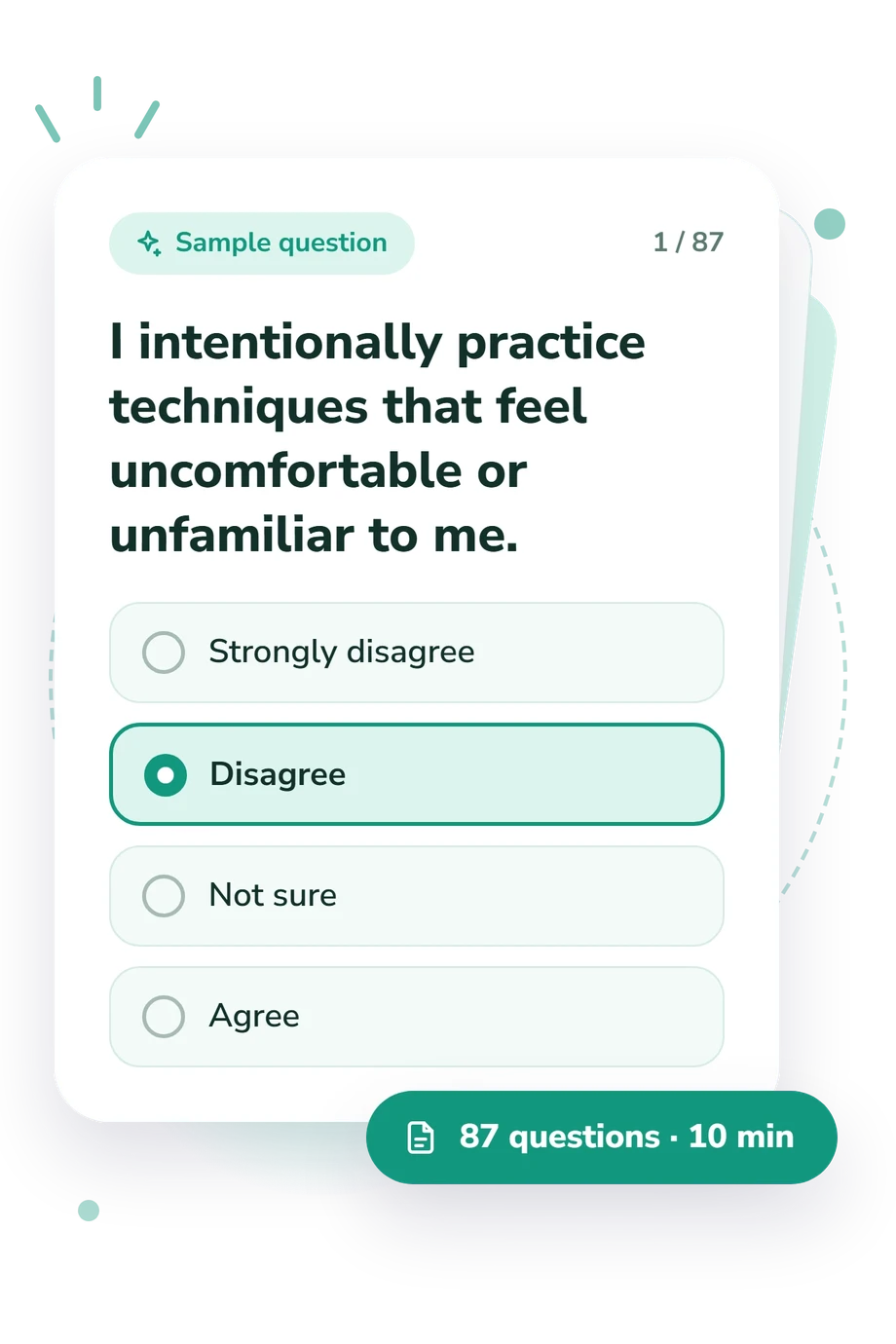
Example Questions From the Test
- Strongly disagree
- Disagree
- Not sure
- Agree
- Strongly disagree
- Disagree
- Not sure
- Agree
- Strongly disagree
- Disagree
- Not sure
- Agree
How to Find Your Art Style Quiz - Description and methodology of the test
For artists seeking recurring choices in their work, the How to Find Your Art Style Quiz offers a way to examine visual preferences, habits, and clarity in identifying and describing an emerging art style. It is useful when you are trying to discover your art style, compare work, or decide which experiments deserve attention. Its three dimensions clarify visual preferences, creative process, and style development rather than assess artistic quality.
What This Assessment Explores
This questionnaire examines visual preferences and creative self-perception. Its items touch on contrast, saturation, stylization, unfamiliar techniques, changing workflows, recurring themes, influences, and continuity across finished pieces. As an art style quiz, it suits artists seeking language for patterns already emerging in their work.
The three displayed scales are:
- Aesthetic Boldness (0-30) indicates understated or high-contrast, saturated, dramatic choices; Subtle & Minimal (0-10), Balanced Boldness (11-20), Dramatic & Stylized (21-30).
- Experimentation Tendency (0-30) indicates stable or exploratory approaches to media, technique, subject, and workflow; Steady (0-12), Balanced (13-22), Exploratory (23-30).
- Style Clarity (0-30) indicates how clearly you recognize influences, themes, and recurring visual choices; Exploring (0-12), Taking Shape (13-22), Defined (23-30).
Read together, the profile distinguishes aesthetic taste and creative process from how defined and consistent a developing style feels.
Methodology and Evidence Base
As a self-report questionnaire, each statement uses one of four options: Strongly disagree, Disagree, Not sure, or Agree. Items cover visual preferences and working habits, including bold effects, unfamiliar experiments, stable routines, and clarity in naming a personal art style. The result reports three displayed scale scores, but the point value assigned to each response is not specified.
Gabora, O'Connor, and Ranjan (2012) provide the closest conceptual link: their findings support the recognizability of an individual's creative style across works and domains. The Aesthetic Responsiveness Assessment (AReA) is relevant to individual differences in engagement with art, while Karwowski, Lebuda, Wisniewska, and Gralewski (2013) connects creative self-beliefs with creative identity. This questionnaire is conceptually consistent with those studies, not an adaptation or validation of them.
Use the bands as descriptive prompts: higher scores indicate more of the named tendency, while middle bands suggest mixed or developing patterns. Results can support reflection and choosing creative experiments, but current mood and self-report bias can influence the profile.
- Gabora, L., O'Connor, B. P., & Ranjan, A. (2012). The Recognizability of Individual Creative Styles Within and Across Domains. Psychology of Aesthetics, Creativity, and the Arts, 6(4), 351-360. 10.1037/a0030193
- Schlotz, W., Wallot, S., Omigie, D., Masucci, M. D., Hoelzmann, S. C., & Vessel, E. A. (2021). The Aesthetic Responsiveness Assessment (AReA): A Screening Tool to Assess Individual Differences in Responsiveness to Art in English and German. Psychology of Aesthetics, Creativity, and the Arts, 15(4), 682-696. 10.1037/aca0000348
- Karwowski, M., Lebuda, I., Wisniewska, E., & Gralewski, J. (2013). Big Five Personality Traits as the Predictors of Creative Self-Efficacy and Creative Personal Identity: Does Gender Matter? Journal of Creative Behavior, 47(3), 215-232. 10.1002/jocb.32
Updated: