
General Knowledge Quiz of the Week
How the Scales are Structured
Who Usually Takes This Test?
See How You Compare
Below is a preview of how scores are typically distributed across each scale.
Example Questions From the Test
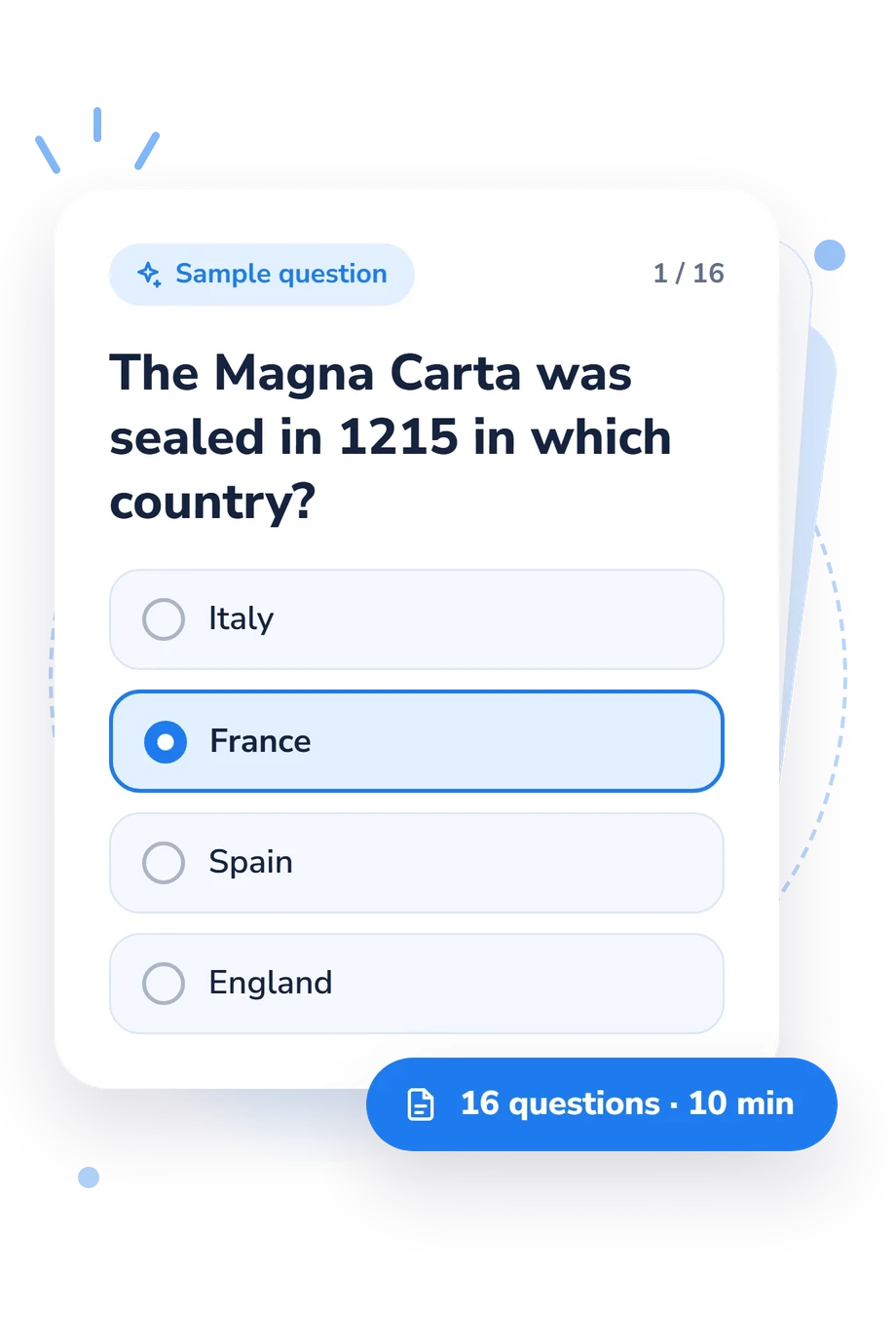
- Italy
- France
- Spain
- England
- Mammals
- Amphibians
- Reptiles
- Fish
- Asia
- Africa
- Australia
- South America
General Knowledge Quiz of the Week - Description and methodology of the test
Curious learners, trivia fans, and anyone who enjoys testing memory can use this assessment to explore familiar facts across several subjects. The general knowledge quiz of the week brings history, science, geography, culture, and basic reasoning together in one overall result. Answering its weekly quiz questions gives you a starting point for reflecting on how you approach mixed-topic questions.
What This Assessment Explores
This questionnaire samples factual knowledge and short applications of familiar concepts. It suits anyone seeking a broad, non-specialist profile. As a general knowledge test, it shows how readily you recognize information and apply simple principles across domains.
The item themes fall into three groups:
- History, geography, and culture measure recognition of places, events, languages, literature, and public facts.
- Science and nature measure understanding of core ideas in biology, chemistry, astronomy, and the physical world.
- Quantitative and spatial reasoning measure handling of calculations, directions, relationships, and proportions.
The General Knowledge scale spans 0-16. Building Foundations (0-6) indicates some key facts are recognized while topics remain to explore; Developing Range (7-12) reflects a broad base used in many contexts; Strong Command (13-16) indicates wide-ranging recall and reliable reasoning across the included subjects. The result describes this selection, not every area of knowledge.
Methodology and Evidence Base
Each item in this weekly general knowledge quiz presents a question with four answer choices. The format mixes direct recall with brief applications, including calculations, directions, percentages, and scientific processes. The respondent chooses the best option, and responses are combined into one displayed total; no subject subscores are reported. The varied topics make the score a snapshot of breadth, not a precise estimate in one field.
Its emphasis on accessible factual recall is conceptually consistent with Nelson and Narens (1980) and the expanded norms reported by Tauber and colleagues (2013). Horn and Cattell (1966) provide context for distinguishing acquired knowledge from fluid problem solving, while Schipolowski and colleagues (2013) describe a short measure of crystallized intelligence. This questionnaire is not a standardized administration or adaptation of those instruments.
Performance can vary with education, language, cultural exposure, guessing, fatigue, and current memory access. The exact online form has no established norms or reported reliability estimates, so comparisons between people should be cautious; its single total is best used to guide curiosity and study choices rather than rank performance.
- Nelson, T. O., & Narens, L. (1980). Norms of 300 general-information questions: Accuracy of recall, latency of recall, and feeling-of-knowing ratings. Journal of Verbal Learning and Verbal Behavior, 19(3), 338-368. 10.1016/S0022-5371(80)90266-2
- Tauber, S. K., Dunlosky, J., Rawson, K. A., Rhodes, M. G., & Sitzman, D. M. (2013). General knowledge norms: Updated and expanded from the Nelson and Narens (1980) norms. Behavior Research Methods, 45(4), 1115-1143. 10.3758/s13428-012-0307-9
- Schipolowski, S., Wilhelm, O., Schroeders, U., Kovaleva, A., Kemper, C. J., & Rammstedt, B. (2013). BEFKI GC-K: A Short Scale for the Measurement of Crystallized Intelligence. Methods, Data, Analyses, 7(2), 153-181. 10.12758/mda.2013.010
- Horn, J. L., & Cattell, R. B. (1966). Refinement and test of the theory of fluid and crystallized general intelligences. Journal of Educational Psychology, 57(5), 253-270. 10.1037/h0023816
Updated: