
French Food Quiz
How the Scales are Structured
Who Usually Takes This Test?
See How You Compare
Below is a preview of how scores are typically distributed across each scale.
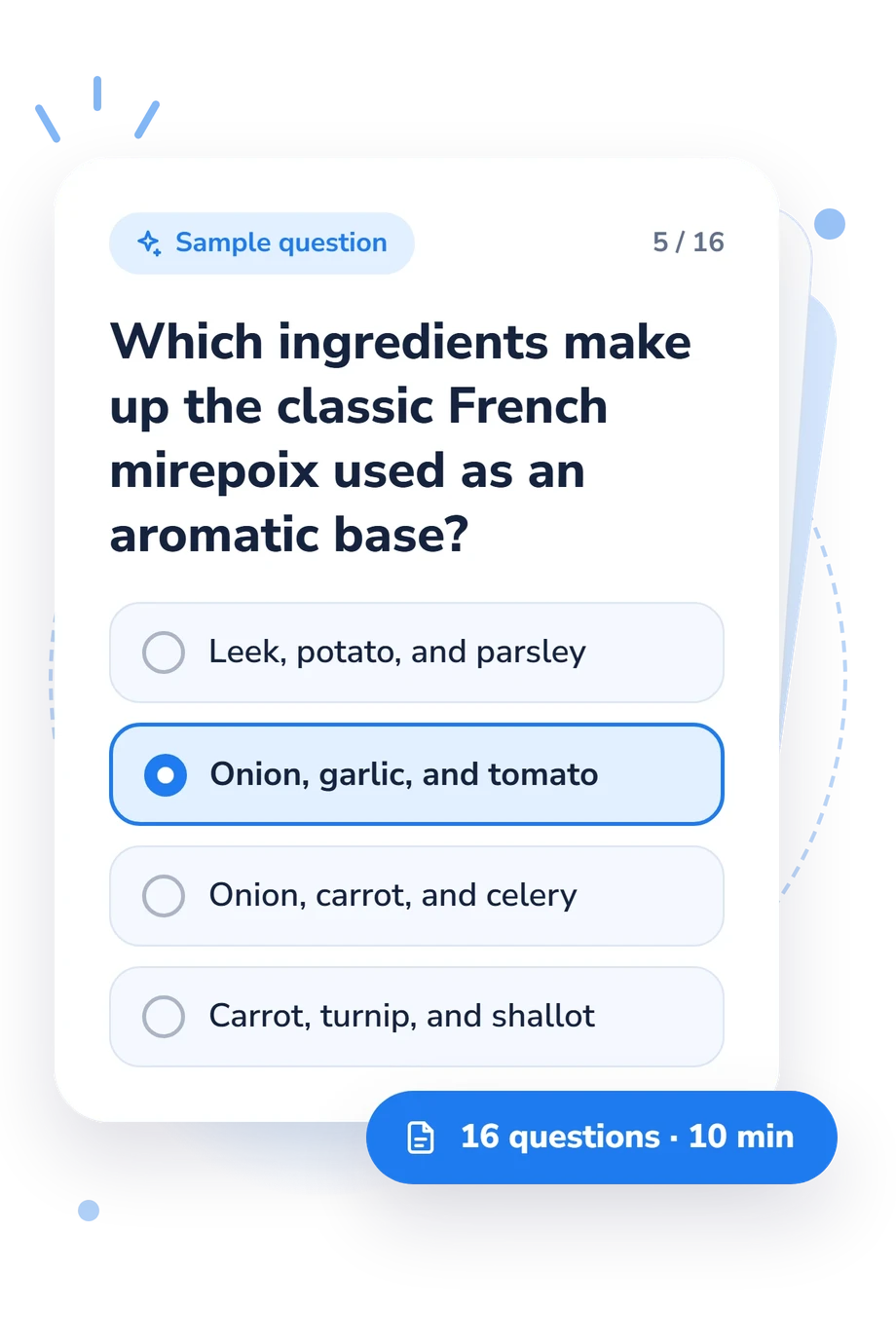
Example Questions From the Test
- Large, irregular chunks intended for long braising
- Thin, uniform matchstick-shaped strips
- Very small cubes produced from minced herbs
- Wide circular slices cut on a diagonal
- It is roasted uncovered over very high heat
- It is coated in breadcrumbs and fried until crisp
- It is simmered rapidly in wine until the liquid evaporates
- It is salted, then cooked slowly in fat at a low temperature
- To create a crisp coating on fried foods
- To thicken a sauce without using flour
- To infuse a dish with herbs that can be removed after cooking
- To garnish a finished plate with raw vegetables
French Food Quiz - Description and methodology of the test
For home cooks, culinary students, and curious diners, the French Food Quiz offers a focused way to check whether practical French techniques are understood rather than merely recognized by name. It suits anyone seeking a French cooking quiz that offers a clearer starting point for study, recipe selection, or kitchen practice. The questions connect culinary terminology with the decisions cooks make during preparation.
What This Assessment Measures
The questions examine French cooking knowledge through knife cuts, aromatic bases, cooking methods, sauces, emulsions, finishing techniques, and dish recognition. They link terms with procedures and observable results, giving the French culinary quiz a practical focus and testing terminology alongside procedural understanding. The result reflects terminology and procedural understanding.
These thematic groups define the coverage:
- Cooking methods distinguish sautéing, poaching, confiting, and braising.
- Preparation techniques cover knife cuts, blind-baking, and aromatic bases.
- Sauces and finishing show recognition of thickening, emulsions, deglazing, and gratinéing.
- Dishes and ingredient preparations connect ratatouille, mirepoix, and bouquet garni with defining features.
The sole displayed scale, French Food Knowledge (0-16), places results in Foundations to build (0-6), Developing knowledge (7-12), or Accomplished knowledge (13-16). These bands summarize the practical breadth shown by selected answers.
Methodology and Evidence Base
Each item presents a culinary prompt with four answer choices. The respondent selects the option that best matches the technique, ingredient, or decision described. Answers produce the displayed total, and that total maps to one of the displayed result bands. This is a knowledge assessment, not a measure of personality or motivation.
Michaud’s 2007 work provides a conceptual reference for culinary terms and techniques. This questionnaire is conceptually consistent with that work, not an adaptation of it. The 2011 study by Condrasky and colleagues adds related educational context, while Labensky, Hause, and Martel (2024) provide the reference framework for methods and preparations.
The result helps identify topics to review. In this French cooking test, a lower band may point to foundational terminology and methods, while a higher band indicates broader command across the sampled content. The bands are descriptive, not professional licensing standards.
Interpretation depends on familiarity with French culinary vocabulary and methods. Prior instruction, cultural familiarity, guessing, and attention can affect performance, so the score should guide learning priorities rather than prove practical competence.
- Michaud, Patricia. Development and Evaluation of Instruments to Measure the Effectiveness of a Culinary and Nutrition Education Program. Master's thesis, Clemson University, 2007.
- Condrasky, Margaret D., Joel E. Williams, Patricia Michaud Catalano, and Sara F. Griffin. Development of Psychosocial Scales for Evaluating the Impact of a Culinary Nutrition Education Program on Cooking and Healthful Eating. Journal of Nutrition Education and Behavior, 43(6), 511-516, 2011. 10.1016/j.jneb.2010.09.013
- Labensky, Sarah R., Alan M. Hause, and Priscilla A. Martel. On Cooking: A Textbook of Culinary Fundamentals. 7th ed. Pearson, 2024.
Updated: