
Flower Quiz
How the Scales are Structured
Who Usually Takes This Test?
See How You Compare
Below is a preview of how scores are typically distributed across each scale.
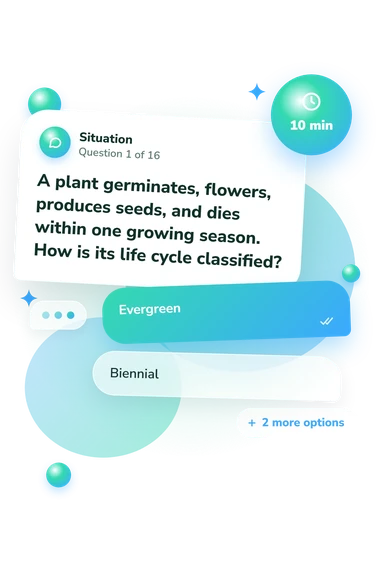
Example Questions From the Test
- Evergreen
- Biennial
- Perennial
- Annual
- Filaments
- Stigmas
- Sepals
- Ovules
- The vase water is preventing the petals from transpiring
- The flowers were not pollinated before being cut
- Blocked or dried stem vessels are limiting water uptake
- The cut stems can no longer detect gravity
Flower Quiz - Description and methodology of the test
For curious learners, gardeners, and anyone who wants to understand flowering plants, this flower quiz offers a focused check of core botanical knowledge. Rather than isolated labels, the applied questions make it a flower knowledge test focused on reproduction, pollination, and water movement across familiar garden and cut-flower situations. Its overall score places performance in a descriptive level across the tested topics.
What This Assessment Explores
Questions connect flower features with the biological processes behind them. They cover life cycles, reproductive structures, pollination, seed formation, fertilizer effects, deadheading, seasonal bloom planning, and water uptake in cut stems.
Some function as flower anatomy questions, asking how structures support reproduction. The questions go beyond naming flowers by asking about function and cause. The main themes covered by the questions are:
- Life cycles show whether you distinguish annual, biennial, perennial, and dormant growth.
- Structures show how sepals, anthers, stigmas, and pollen tubes support reproduction.
- Pollination shows how flowers attract agents, transfer pollen, and form seeds.
- Care shows how biology guides flowering, planting, deadheading, and vase life.
Together, these themes sample botanical knowledge for the overall score rather than functioning as separate result categories.
Methodology and Scientific Basis
Each item presents a botanical situation or definition with four answer choices. The alternatives distinguish related terms or plausible explanations, so the task tests applied recognition rather than an open-ended account. Some items use familiar flower names, but the names serve questions about anatomy, reproduction, or care. The pollination knowledge questions connect floral traits with pollen transfer and seed formation.
The result is reported on the Flower Knowledge scale, 0-16. Budding Basics (0-6) reflects recognition of some flower concepts, with fundamentals still worth reviewing. Growing Knowledge (7-12) reflects a solid foundation with room to strengthen some areas. Flourishing Knowledge (13-16) reflects strong, well-rounded understanding across the topics tested. The score reflects these 16 questions, not professional horticultural ability.
Conceptually, the content is consistent with plant structure and life-process principles described by Raven, Evert, and Eichhorn (2013), while floral function and animal pollination align with Lloyd and Barrett (1996). Cut-flower water movement is consistent with van Doorn (2012). These sources support the subject matter, not authorship, validation, or norms for this questionnaire.
Guessing, prior exposure, and the topics selected here can affect results.
- Evert, Ray Franklin, and Susan E. Eichhorn. Raven Biology of Plants. 8th ed., W.H. Freeman and Company, 2013.
- Lloyd, David G., and Spencer C. H. Barrett, eds. Floral Biology: Studies on Floral Evolution in Animal-Pollinated Plants. Chapman & Hall, 1996. 10.1007/978-1-4613-1165-2
- van Doorn, Wouter G. "Water Relations of Cut Flowers: An Update." Horticultural Reviews, vol. 40, 2012, pp. 55-106. 10.1002/9781118351871.ch2