
Engine Parts Quiz
How the Scales are Structured
Who Usually Takes This Test?
See How You Compare
Below is a preview of how scores are typically distributed across each scale.
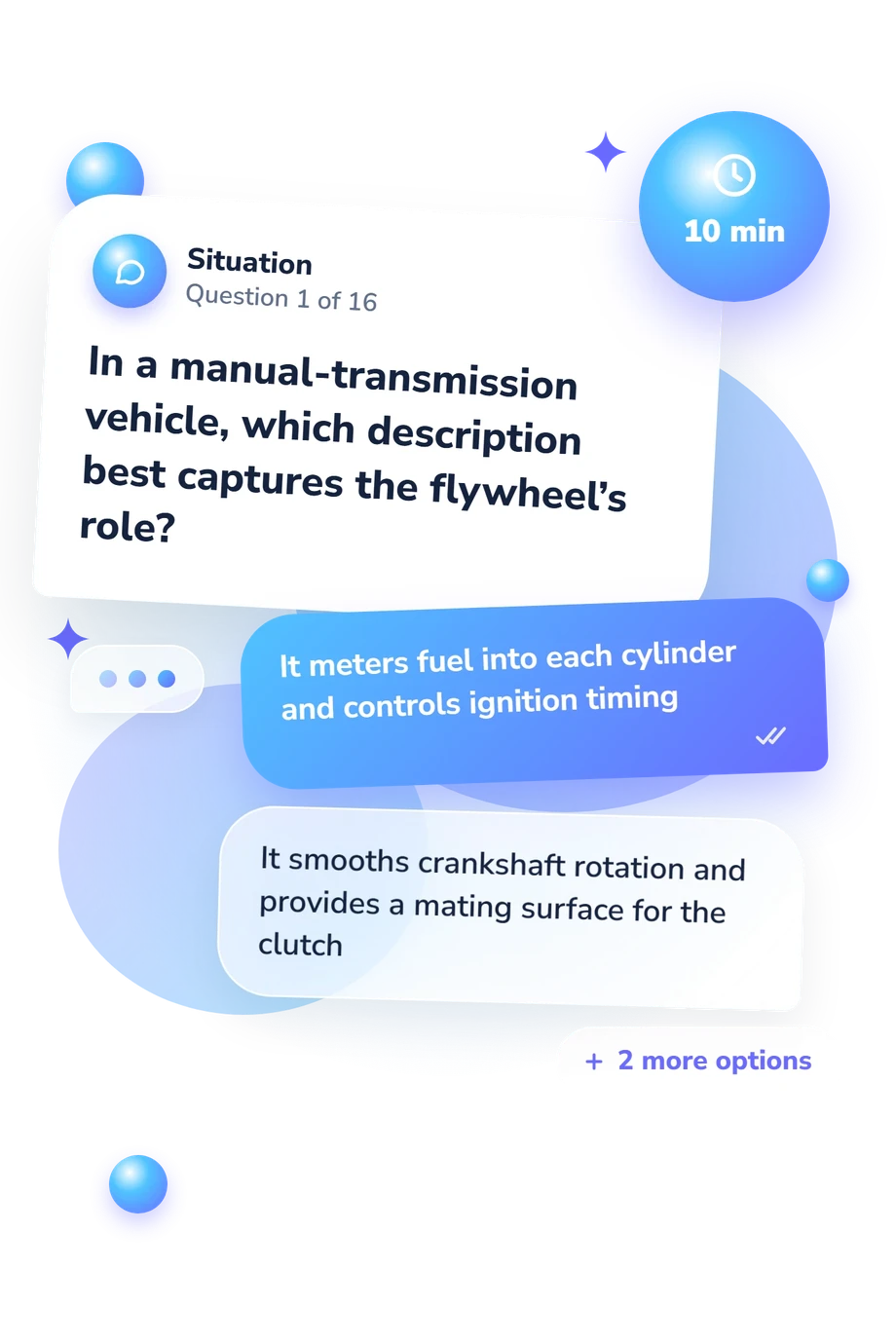
Example Questions From the Test
- Throttle position sensor
- Oxygen sensor
- Crankshaft position sensor
- Mass airflow sensor
- Intake manifold gasket
- Crankshaft seal
- Valve cover gasket
- Head gasket
- The exhaust-driven turbine turns it through a shared shaft
- Intake vacuum pulls it around its housing
- The oil pump turns it through pressurized oil flow
- The crankshaft drives it through the timing belt
Engine Parts Quiz - Description and methodology of the test
Drivers, students, and curious vehicle owners can use this engine component assessment to decide whether their current knowledge is sufficient for coursework, study planning, or practical learning. The engine parts quiz helps a learner choose topics for closer study, while its result identifies areas that may need more reading or supervised practice.
What This Assessment Explores
Questions test recognition and application: identifying a part, matching it to its role, or predicting an effect when a system changes. As a quiz about parts of an engine, it groups the questions into four areas:
- Core mechanics shows how pistons, rings, crankshafts, camshafts, flywheels, and gaskets support motion and sealing, while valves control gas exchange.
- Airflow systems track air measurement, routing, compression, cooling, and delivery to cylinders.
- Turbocharger systems explain how the turbine, compressor, wastegate, intercooler, and relief valves manage boost.
- Thermal and lubrication systems show how thermostats, coolant flow, oil pressure, and bearings support safe operation.
The result reports Engine Parts Knowledge on a 0-16 scale. Foundations to Build (0-6) indicates concepts need review; Developing Knowledge (7-12) reflects gaps in applied operation or turbo systems; Strong Knowledge (13-16) indicates reliable understanding. These bands describe this educational snapshot, not certification of mechanical competence.
Methodology and Scientific Basis
Each item presents a mechanical situation or identification problem with four choices. The questions require recognizing a component’s function or tracing relationships, such as turbocharger shaft rotation, intake-air routing, or a closed thermostat.
Its format is best understood as an automotive engine knowledge test: it samples recognition and basic application, with questions about component roles, system sequences, and immediate effects of changes.
The questionnaire displays an Engine Parts Knowledge result from 0 to 16 within one of three descriptive bands; this result reflects performance on these items, not a broad measure of mechanical ability.
The content is conceptually consistent with engine-system coverage in Hadfield and Nussler (2017) and Halderman and Ward (2024). Woollenweber (1970) is especially relevant to turbine-compressor rotation, boost control, and charge cooling. These sources support the mechanical relationships represented by the items, but do not establish psychometric properties for this questionnaire.
Performance can vary with guessing, prior training, attention, and current context. A multiple-choice result cannot establish hands-on competence or diagnose a mechanical fault, so it is best used to target further study and supervised practice.
- Hadfield, Chris, and Randy Nussler. Today's Technician: Automotive Engine Repair & Rebuilding, Classroom Manual and Shop Manual, Spiral bound Version. 6th ed., Cengage Learning, 2017. ISBN 9781305958135.
- Halderman, James D., and Curt Ward. Automotive Technology: Principles, Diagnosis, and Service. 7th ed., Pearson, 2024. ISBN 9780137871797.
- Woollenweber, W. E. "The Turbocharger - A Vital Part of the Engine Intake and Exhaust Systems." SAE Technical Paper 700534, SAE International, 1970. DOI 10.4271/700534.
Updated: