
Does My Coworker Like Me Quiz
How the Scales are Structured
Who Usually Takes This Test?
See How You Compare
Below is a preview of how scores are typically distributed across each scale.
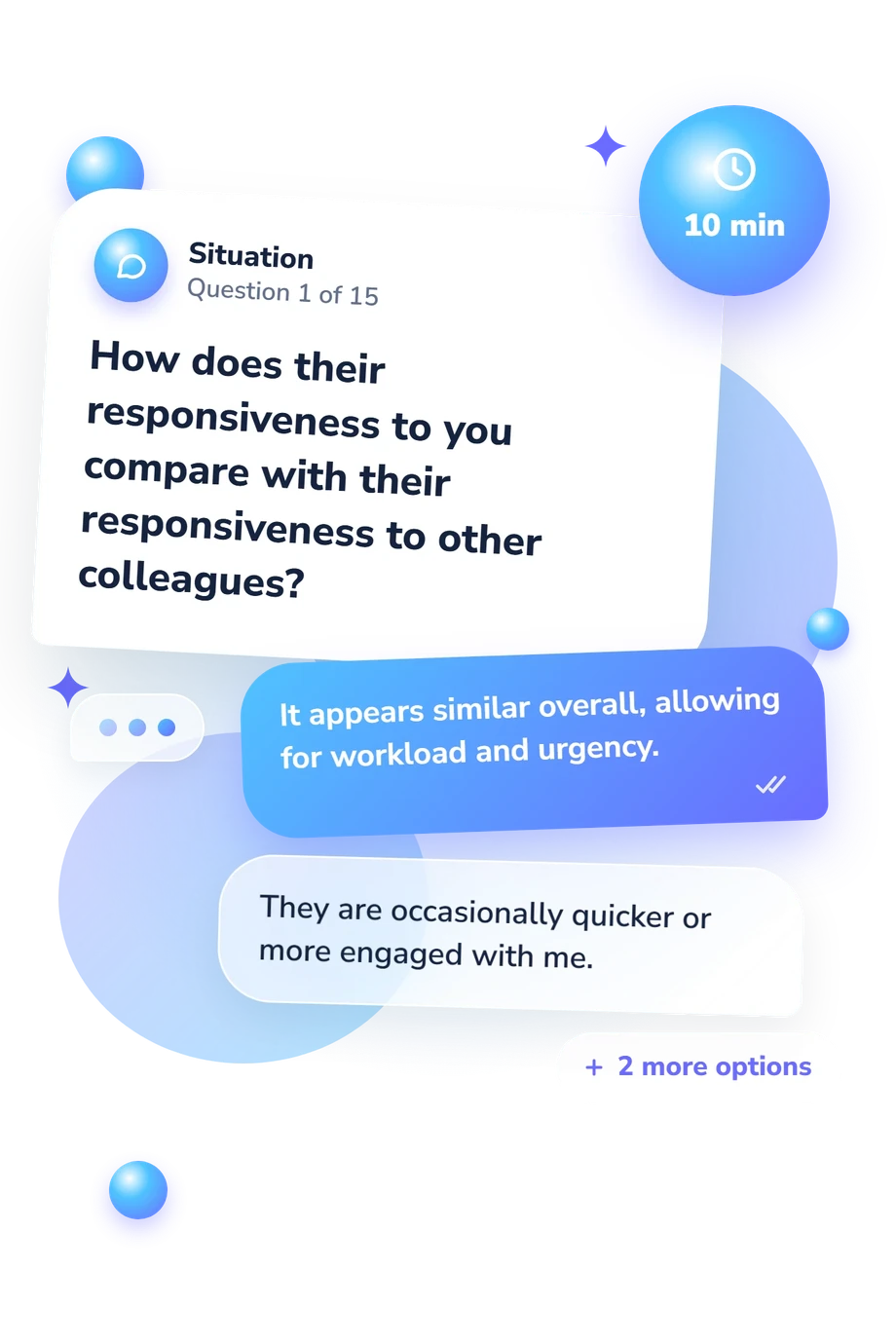
Example Questions From the Test
- It appears similar overall, allowing for workload and urgency.
- They are occasionally quicker or more engaged with me.
- They often give my messages or comments noticeably focused attention.
- Their speed, tone, or effort with me consistently stands out from their usual pattern.
- They rarely refer to it again, which fits our mostly work-focused contact.
- They remember major details if the topic comes up naturally.
- They often ask how it went without needing a reminder.
- They sometimes remember and ask a relevant follow-up question.
- They might share a light anecdote that they would comfortably tell many coworkers.
- They sometimes discuss meaningful experiences or feelings with me.
- They generally keep the conversation practical and professionally neutral.
- They often trust me with personal thoughts and invite a more mutual conversation.
Does My Coworker Like Me Quiz - Description and methodology of the test
People who feel uncertain about a colleague’s attention can use the Does My Coworker Like Me Quiz to organize observations without forcing an answer. It is suited to anyone asking whether workplace warmth reflects friendship, trust, mentoring, teamwork, or attraction. The does my coworker have a crush on me quiz question may feel compelling, yet the profile keeps several explanations open and focuses on patterns rather than private motives.
What This Assessment Explores
Rather than isolating flirtation, the questionnaire compares a colleague’s attention with their style. It covers responsiveness, remembered details, follow-up, group attention, optional contact, and reconnection. For readers using a does my male coworker like me quiz to frame the issue, warmth may reflect friendship, comfort, mentorship, or attraction.
The result is organized into three dimensions:
- Distinctive Warmth and Rapport (0-15) shows whether warmth differs from a colleague’s norm: Broadly consistent (0-5), Occasionally distinctive (6-10), or Clearly distinctive (11-15).
- Personal Curiosity and Openness (0-15) reflects remembered details, follow-up, and sharing: Professional focus (0-5), Growing familiarity (6-10), or Strong personal engagement (11-15).
- Voluntary Connection (0-15) measures optional contact beyond work requirements: Mostly task-based (0-5), Some extra effort (6-10), or Consistent initiative (11-15).
The does my co worker like me quiz question is handled through several patterns, not proof of romantic interest.
Methodology and Evidence Base
Each item offers four response descriptions about messages, sharing, group interaction, optional contact, and reconnection. Choose the option that best matches a recurring pattern rather than an isolated exchange. This comparative self-report format means memory and context can influence the profile.
Responses contribute to the displayed dimensions, but no standardized norm group or universal points-per-answer rule is stated. A higher result within one dimension indicates more distinctive behavior there; it does not identify another person’s motive.
Readers interested in the subtle signs a male coworker likes you quiz can use the profile to organize observations. Malloy (2018) offers a framework in which attraction reflects the perceiver, the other person, and interaction context. This questionnaire is conceptually consistent with that work, not an adaptation of it.
Sias and Cahill (1998) connect workplace friendship with contact, communication, shared ground, and socializing, while Nielsen, Jex, and Adams (2000) distinguish friendship opportunities from perceived friendship. These sources support the questionnaire’s themes, not the validity of its scores. Wishful or anxious interpretation can shape self-report, leaving friendship, mentoring, teamwork, and social style as explanations.
- Malloy, Thomas E. (2018). Interpersonal attraction in dyads and groups: Effects of the hearts of the beholder and the beheld. European Journal of Social Psychology, 48(3), 285-302. 10.1002/ejsp.2324
- Sias, Patricia M., & Cahill, Daniel J. (1998). From coworkers to friends: The development of peer friendships in the workplace. Western Journal of Communication, 62(3), 273-299. 10.1080/10570319809374611
- Nielsen, Ivy K., Jex, Steve M., & Adams, Gary A. (2000). Development and validation of scores on a two-dimensional workplace friendship scale. Educational and Psychological Measurement, 60(4), 628-643. 10.1177/00131640021970655
Updated: