
Do I Have HPV Quiz
How the Scales are Structured
Who Usually Takes This Test?
See How You Compare
Below is a preview of how scores are typically distributed across each scale.
Example Questions From the Test
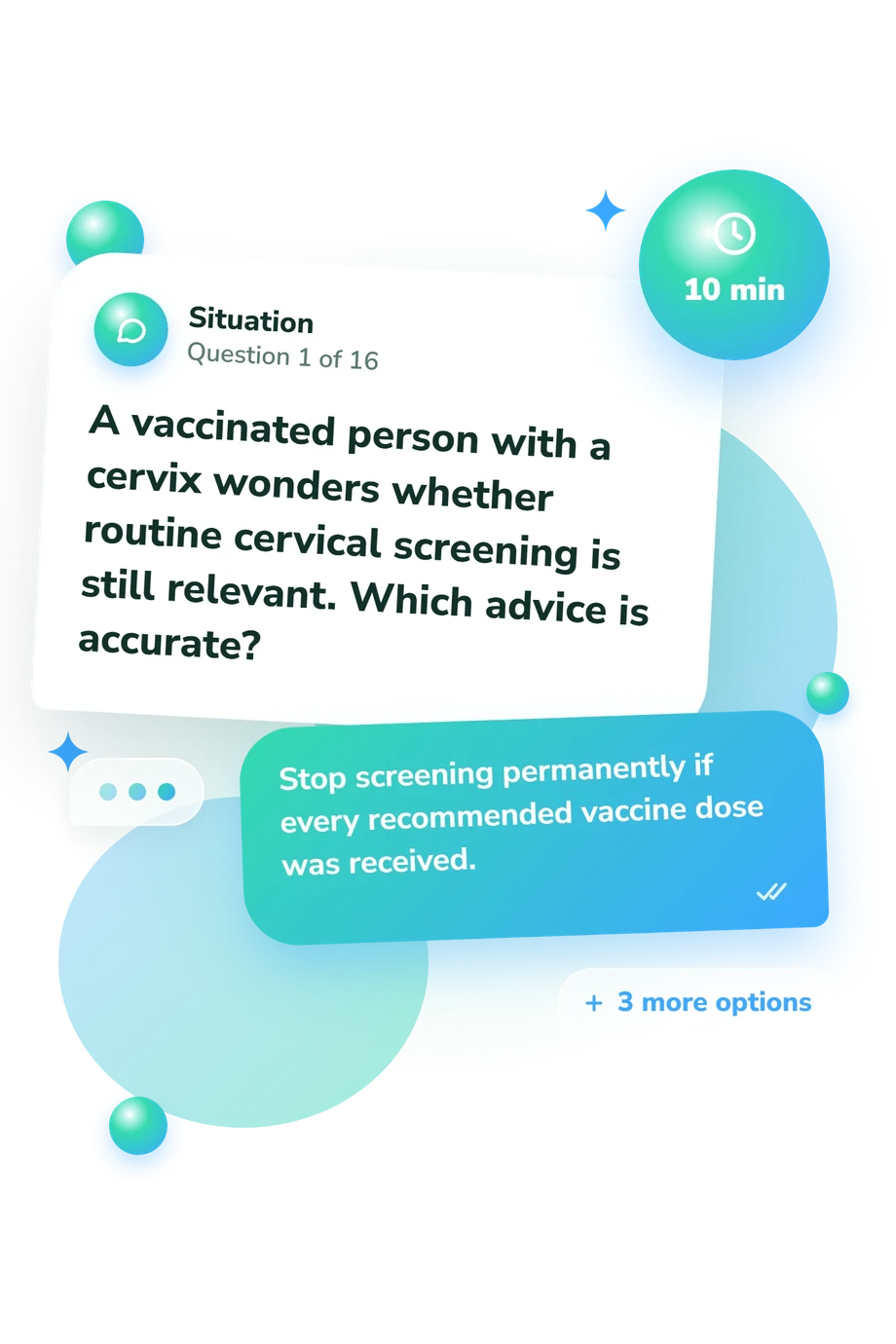
- Stop screening permanently if every recommended vaccine dose was received.
- Follow applicable screening guidance because vaccination does not prevent every cancer-associated HPV type.
- Screen only if genital warts become visible.
- Replace cervical screening with an annual HPV blood test.
- A positive result always identifies transmission within the previous month.
- The result proves the partner with no symptoms transmitted it recently.
- HPV can be detected long after exposure, so the result generally cannot show when or from whom it came.
- Infidelity is ruled out only if both partners previously had negative blood tests.
- Many HPV infections cause no noticeable symptoms.
- High-risk HPV usually causes pain soon after transmission.
- Every infection eventually causes visible genital warts.
- An infection is symptom-free only during its first few days.
Do I Have HPV Quiz - Description and methodology of the test
People who want a clearer grasp of HPV, screening, vaccination, or a new symptom can use the Do I Have HPV Quiz as a structured knowledge check. It is suited to readers who want to identify misunderstandings before discussing personal concerns with a clinician. An HPV knowledge test can make the difference between recognizing a knowledge gap and mistaking general information for evidence of infection.
What This Assessment Explores
Rather than diagnosing HPV, the questionnaire checks understanding of transmission, symptoms, screening, vaccination, prevention, and follow-up. Its scenarios counter common overinterpretations: a positive test does not date exposure, normal cervical screening does not rule out every infection, and a genital growth may have other causes.
The displayed result uses one scale with three interpretation bands:
- HPV Knowledge (0-16) reflects understanding of core HPV facts and appropriate care.
- Foundations to build (0-6) marks several important facts for review.
- Developing knowledge (7-12) shows many essentials understood, with possible gaps in testing, screening, or prevention.
- Strong knowledge (13-16) indicates sound understanding, but remains an unvalidated educational result.
An HPV facts quiz can therefore show which explanations to revisit before discussing personal questions with a clinician.
Methodology and Evidence Base
Each item presents a health scenario followed by answer choices. The topics include transmission, symptoms and genital warts, screening and test interpretation, vaccination, prevention, and responses to concerning symptoms or results. The respondent selects the most accurate statement, and the total score reflects performance across the items; higher performance means more accurate understanding, not a probability or clinical threshold.
The structure is conceptually consistent with the HPV Knowledge Scale (Waller et al., 2013), which examined HPV knowledge using item-response theory and classical test theory. This Freudly questionnaire is not presented as a direct adaptation or validated administration of that scale. Dodd et al. (2014) supports careful distinctions about what HPV testing can show, while Marlow et al. (2009) addresses how information needs shape understanding.
Its HPV screening quiz content is educational rather than a screening result, and the score has no stated norms or clinical validation. Answers can reflect guessing, prior education, or current context, and self-report cannot establish infection or explain a symptom. Personal concerns therefore require site-specific medical assessment.
- Jo Waller, Remo Ostini, Laura A. V. Marlow, Kirsten McCaffery, Gregory Zimet. Validation of a measure of knowledge about human papillomavirus (HPV) using item response theory and classical test theory. Preventive Medicine. 2013;56(1):35-40. 10.1016/j.ypmed.2012.10.028
- Rachael H. Dodd, Kirsten J. McCaffery, Laura A. V. Marlow, Remo Ostini, Gregory D. Zimet, Jo Waller. Knowledge of human papillomavirus (HPV) testing in the USA, the UK and Australia: an international survey. Sexually Transmitted Infections. 2014;90(3):201-207. 10.1136/sextrans-2013-051402
- Laura A. V. Marlow, Jane Wardle, Nina Grant, Jo Waller. Human papillomavirus (HPV) information needs: a theoretical framework. Journal of Family Planning and Reproductive Health Care. 2009;35(1):29-33. 10.1783/147118909787072432
Updated: