
Asimov Quiz
How the Scales are Structured
Who Usually Takes This Test?
See How You Compare
Below is a preview of how scores are typically distributed across each scale.
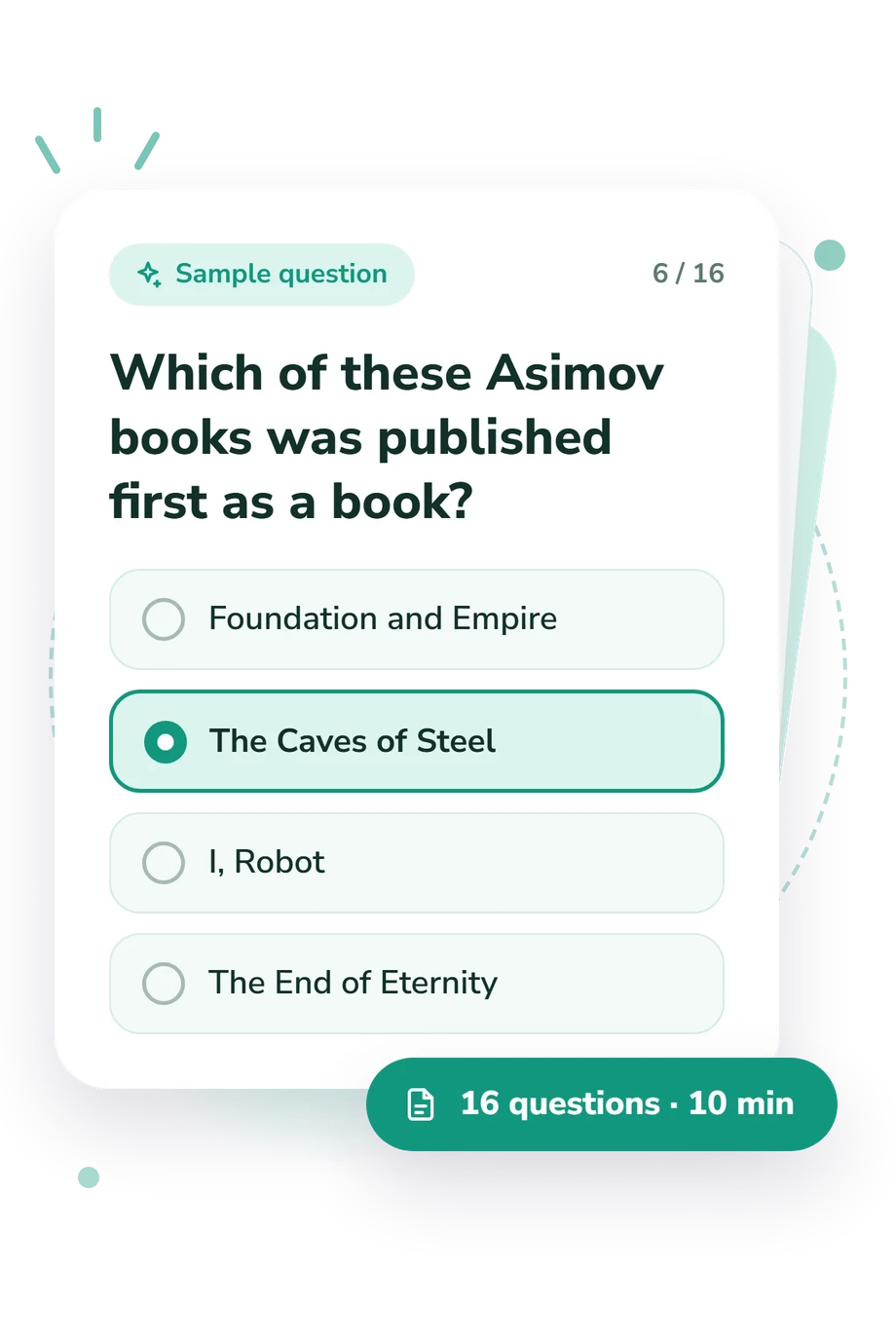
Example Questions From the Test
- Elijah Baley and R. Daneel Olivaw
- Susan Calvin and Andrew Martin
- Hari Seldon and Salvor Hardin
- Golan Trevize and Hober Mallow
- Gaining recognition as a human being
- Recovering the secret mathematical basis of psychohistory
- Becoming the ruler of a robot-only society
- Removing the First Law from every robot
- Prevent the Galactic Empire from ever collapsing
- Replace human government with rule by robots
- Preserve the Empire’s capital as an untouched museum
- Shorten the predicted age of disorder after the Empire falls
Asimov Quiz - Description and methodology of the test
Fans, students, and curious readers can use the Asimov Quiz when deciding whether to revisit his fiction. A quiz about Isaac Asimov suits anyone who enjoys connecting individual facts with larger patterns across his worlds. The exercise offers a structured reason to recall characters, ideas, chronology, and recurring concerns without treating literary taste as a score.
What This Assessment Explores
The questions combine factual recall with interpretation. They cover characters, publication order, scientific training, story premises, the Three Laws, the Zeroth Law, and psychohistory, so the assessment checks both memory and connections across Asimov’s fictional worlds.
A higher score on a quiz about Asimov reflects broader and more accurate recognition of these references, not superior taste. The result brings together four areas:
- The Asimov Knowledge scale runs from 0-16 and reports Building the Foundation (0-6), Developing Encyclopedist (7-12), or Strong Command (13-16), reflecting increasing breadth and accuracy.
- Robot fiction and ethics measure recognition of Baley, Daneel, Susan Calvin, and Andrew Martin alongside conflicts among duties.
- The Foundation strand tests psychohistory, the Seldon Plan, the Mule, and links between the Robot and Foundation settings.
- Stories, themes, and biography cover major premises, scientific ideas, chronology, education, and career.
Methodology and Scientific Basis
Each item presents four answer choices with one best answer. The displayed total awards one point for each correct response, producing a descriptive performance result rather than a norm-based classification.
The quiz’s literary and biographical prompts align with Green’s bibliographic work on Asimov, including publication order, characters, dates, and biographical facts. I, Robot and Foundation and Empire, a Foundation novel, supply literary context for questions about the Laws, robot society, psychohistory, and the later connection involving R. Daneel Olivaw; Foundation and Earth is especially relevant to that link.
Schild and Zeleznikow’s 2008 analysis of the Three Laws supports reading the ethical items as conflicts among duties rather than isolated commands. The quiz is conceptually consistent with these works, but it is not an adaptation of their publications.
The displayed bands are descriptive performance categories, so a result marks performance on this questionnaire rather than a norm-based standing. Performance on this questionnaire should be read as performance on a curated literary quiz about Asimov. Scores may shift with recent reading, guessing, familiarity with editions, and wording. They do not establish complete literary expertise or measure the quality of a reader’s engagement.
- Green, Scott E. Isaac Asimov: An Annotated Bibliography of the Asimov Collection at Boston University. Greenwood, 1995.
- Asimov, Isaac. I, Robot. New York: Gnome Press, 1950.
- Asimov, Isaac. Foundation and Empire. New York: Gnome Press, 1952.
- Schild, Uri J., and John Zeleznikow. “The Three Laws of Robotics Revisited.” International Journal of Intelligent Systems Technologies and Applications, vol. 4, nos. 3-4, 2008, pp. 254-270. doi 10.1504/ijista.2008.017271
Updated: