
Am I White or Black Quiz
How the Scales are Structured
Who Usually Takes This Test?
See How You Compare
Below is a preview of how scores are typically distributed across each scale.
Example Questions From the Test
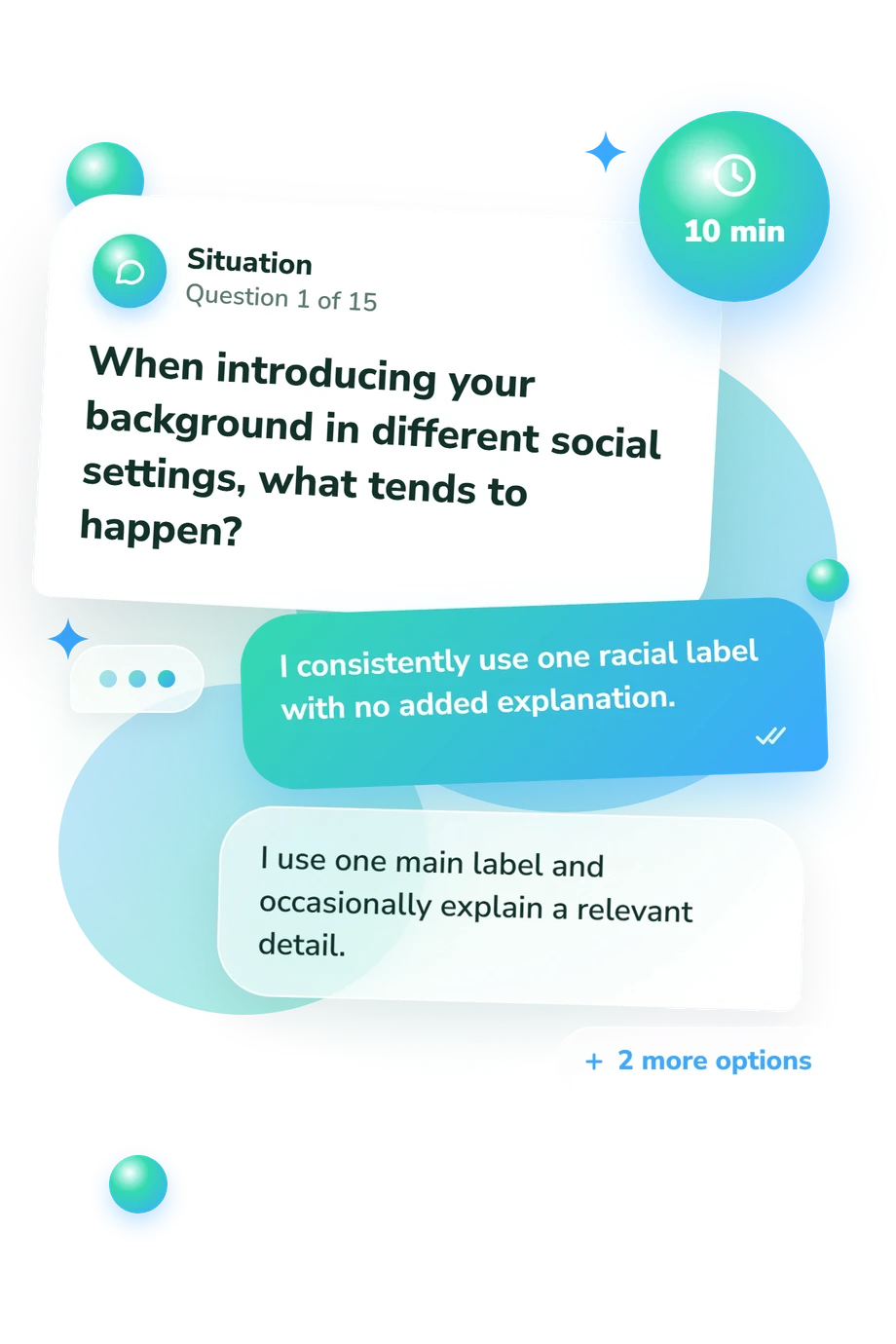
- I consistently use one racial label with no added explanation.
- I use one main label and occasionally explain a relevant detail.
- I usually combine labels so important parts are not omitted.
- I intentionally use multiple or context-dependent labels because no single one is sufficient.
- It describes part of my background, although I rarely use it for myself.
- It is a primary part of how I identify.
- It is not a racial identity I claim.
- I identify as Black alongside another racial or ethnic identity.
- I select Black along with another category.
- I do not select Black.
- I select Black only when its definition matches a particular part of my background.
- I select Black as my sole racial category.
Am I White or Black Quiz - Description and methodology of the test
People questioning how family history, social recognition, and multiple affiliations shape racial identity may find the Am I White or Black Quiz useful for reflection. It is for anyone who wants to examine whether labels fit comfortably, fit only in certain contexts, or leave out something important. Someone approaching this as an are you Black or White quiz can use the result to keep that question open to nuance.
What This Assessment Explores
The questions examine self-labels, family narratives, official forms, social recognition, and the difficulty of fitting a complex background into one category. They consider whether Black or White feels central, partial, contextual, or inaccurate, while allowing for mixed and beyond-binary identities. The result is a profile of relative affinity, not a fixed racial assignment. The Black or White quiz framing therefore remains open to qualification.
The displayed scales describe these result dimensions:
- Black Identity Affinity (0-15) shows how personally meaningful Black identity is: Limited fit (0-5), Contextual fit (6-10), or Strong affinity (11-15).
- Multiracial or Beyond-Binary Affinity (0-15) shows whether one category feels sufficient: Single-category fit (0-5), Layered identity (6-10), or Strong complex affinity (11-15).
- White Identity Affinity (0-15) shows how personally meaningful White identity is: Limited fit (0-5), Contextual fit (6-10), or Strong affinity (11-15).
Methodology and Evidence Base
Each item offers four answer choices about labels, family narratives, demographic forms, social recognition, and binary or multiple-category decisions. Responses feed three scores, but the questionnaire does not state how many points each option contributes, so no finer scoring rule should be inferred. The highest score across the profiles indicates strongest affinity; scores within one point indicate a blended result rather than a definitive classification.
The framework is conceptually consistent with the Rockquemore-Brunsma biracial identity taxonomy, which distinguishes single-category, multiple, and context-dependent positions. Cheng and Lee (2009) are relevant to perceived conflict or distance in multiracial identity, while Townsend and colleagues (2012) address why people claim or reject a biracial identity. These sources support the themes; this questionnaire is not an adaptation of them and has no stated norms.
It is an online self-report tool rather than a normed diagnostic instrument, so results may shift with context, social setting, family language, and self-awareness. Its four-choice format makes this White or Black identity quiz more nuanced than a forced yes-or-no prompt. Read the profile as personal fit, not proof of ancestry or legal classification.
- Rockquemore, Kerry Ann, and David L. Brunsma. Beyond Black: Biracial Identity in America. 2nd ed., Rowman & Littlefield Publishers, 2007. ISBN 9780742560550.
- Cheng, Chi-Ying, and Fiona Lee. "Multiracial Identity Integration: Perceptions of Conflict and Distance among Multiracial Individuals." Journal of Social Issues, vol. 65, no. 1, 2009, pp. 51-68. 10.1111/j.1540-4560.2008.01587.x
- Townsend, Sarah S. M., Stephanie A. Fryberg, Clara L. Wilkins, and Hazel Rose Markus. "Being Mixed: Who Claims a Biracial Identity?" Cultural Diversity and Ethnic Minority Psychology, vol. 18, no. 1, 2012, pp. 91-96. 10.1037/a0026845
Updated: