
Am I Musically Gifted Quiz
How the Scales are Structured
Who Usually Takes This Test?
See How You Compare
Below is a preview of how scores are typically distributed across each scale.
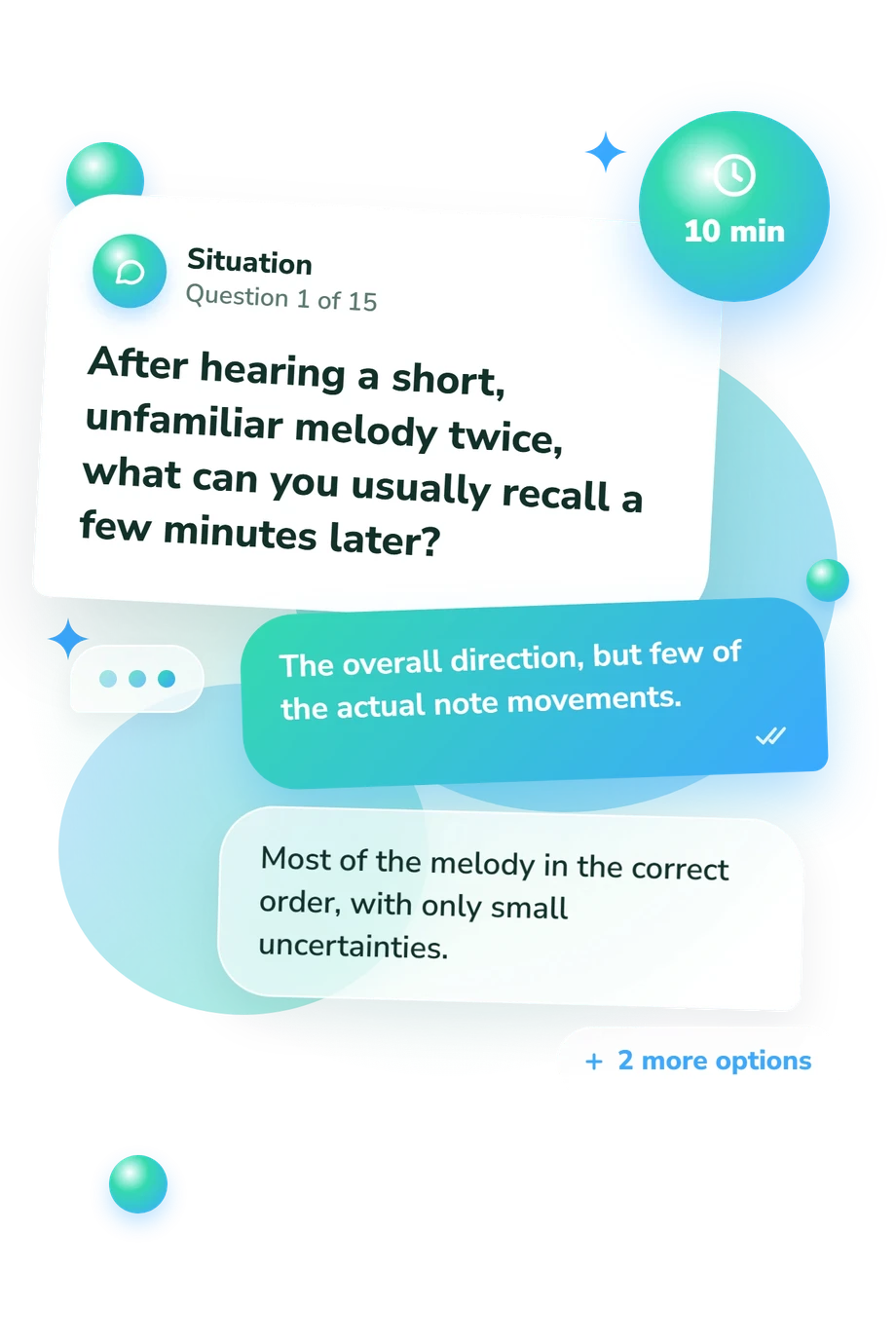
Example Questions From the Test
- The overall direction, but few of the actual note movements.
- Most of the melody in the correct order, with only small uncertainties.
- Little beyond the fact that I heard a melody.
- A recognizable section, though some notes or intervals change.
- I can usually predict the return point accurately, even through a longer gap.
- I keep a rough pulse but may be slightly early or late when the music returns.
- I need to tap or count deliberately to have a reasonable chance of staying aligned.
- I generally lose the pulse once the sound stops.
- I usually retain the beat count but simplify the pattern.
- I can usually reproduce the spacing and accents accurately.
- I remember most of it, with an occasional altered gap or accent.
- The sequence tends to blur before I can repeat it.
Am I Musically Gifted Quiz - Description and methodology of the test
People who want a picture of how they respond to melody, pitch, and beat can use the Am I Musically Gifted Quiz as a structured self-reflection exercise. The result gives a practical response to the question behind a do i have musical talent quiz by separating several parts of musical functioning. It highlights reported strengths and developing areas rather than offering one global label.
What This Assessment Explores
The questionnaire examines reported handling of melody, pitch, and rhythm in listening or performance. Items address recalling a tune, recognizing a changed theme, noticing an out-of-tune note, matching a tone, keeping a pulse through silence, reproducing a rhythm, and recovering after an early or late entry. The situations suit people with varied musical experience.
Viewed as a musical intelligence quiz, it describes separate abilities rather than one global rank. The displayed dimensions are:
- Musical Memory and Pattern Learning (0-15) describes melody and pattern recall: Emerging recall (0-5), Developing memory (6-10), or Established memory (11-15).
- Pitch Perception and Matching (0-15) describes pitch detection and tone matching: Emerging (0-5), Developing (6-10), or Established (11-15).
- Rhythm and Timing (0-15) describes beat, syncopation, and timing control: Emerging time sense (0-5), Developing rhythmic control (6-10), or Established rhythmic control (11-15).
Methodology and Scientific Basis
Each question presents a concrete musical situation and four self-report choices. The options describe degrees of recall, accuracy, stability, or need for deliberate support. Answers are grouped into three domain scores; the questionnaire does not specify point values for individual options, so the ranges should not be used to infer a hidden scoring rule.
The structure is conceptually consistent with PROMS, which distinguishes perceptual abilities involving melody, pitch, and rhythm. It also relates to the Musical Ear Test’s separate attention to melodic and rhythmic competence and to the Goldsmiths Musical Sophistication Index (Gold-MSI), which uses self-report to examine musical engagement and ability. This questionnaire is not presented as an adaptation or validation of those published instruments.
As a musical giftedness assessment, it offers reflective categories rather than standardized norms or an aptitude classification. Scores can be influenced by musical training, listening habits, hearing conditions, attention, confidence, and the situation a respondent recalls. Read the bands as descriptions of reported functioning at the time of answering; actual performance and broader assessment may provide context.
- Law LNC, Zentner M. (2012). Assessing Musical Abilities Objectively: Construction and Validation of the Profile of Music Perception Skills. PLoS ONE, 7(12), e52508. 10.1371/journal.pone.0052508
- Wallentin M, Nielsen AH, Friis-Olivarius M, Vuust C, Vuust P. (2010). The Musical Ear Test, a New Reliable Test for Measuring Musical Competence. Learning and Individual Differences, 20(3), 188-196. 10.1016/j.lindif.2010.02.004
- Müllensiefen D, Gingras B, Musil J, Stewart L. (2014). The Musicality of Non-Musicians: An Index for Assessing Musical Sophistication in the General Population. PLoS ONE, 9(2), e89642. 10.1371/journal.pone.0089642
Updated: