
Which Batman Are You Quiz
How the Scales are Structured
Who Usually Takes This Test?
See How You Compare
Below is a preview of how scores are typically distributed across each scale.
Example Questions From the Test
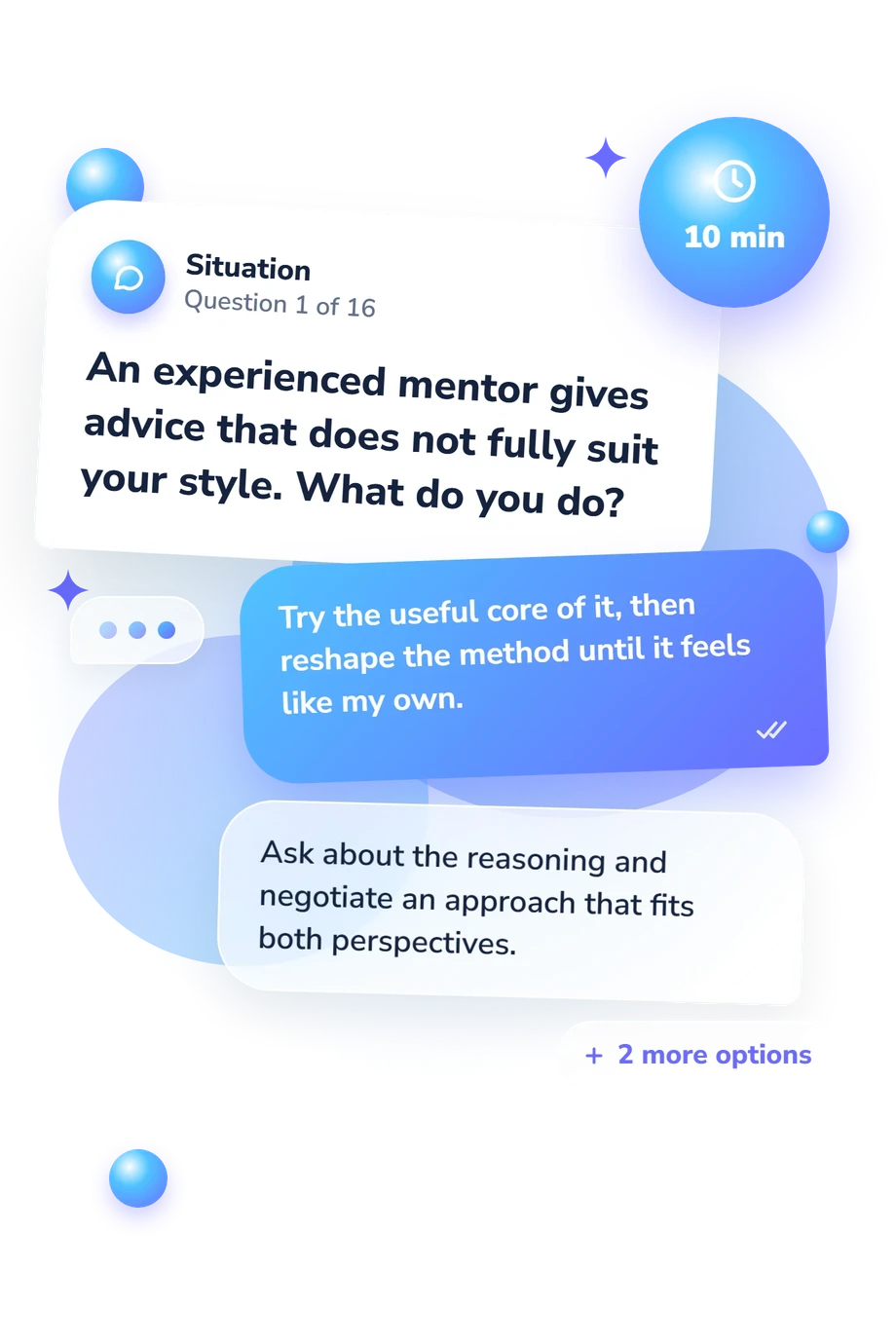
- Try the useful core of it, then reshape the method until it feels like my own.
- Ask about the reasoning and negotiate an approach that fits both perspectives.
- Use the advice as given before deciding whether it needs adjustment.
- Set it aside and rely on methods that have already worked for me.
- Test a workable alternative and accept responsibility for the consequences.
- Argue for an exception, but comply if the decision goes against me.
- Follow it for now and make the case for changing it afterward.
- Preserve consistency because changing rules during a situation can create confusion.
- Bypass it and impose a direct solution that produces immediate results.
- Expose the failures and apply enough pressure to force action.
- Build an alternative support network outside the institution.
- Work toward incremental reform that can survive leadership changes.
Which Batman Are You Quiz - Description and methodology of the test
For readers who enjoy superhero stories and want a playful way to examine their own instincts, the Which Batman Are You Quiz compares everyday choices with four fictional models. It focuses on pressure, authority, loyalty, responsibility, and change, then shows which style most closely matches the response pattern. As a batman character quiz, it supports self-reflection and conversation about how you act when circumstances become difficult.
What This Assessment Explores
Advice, rules, teamwork, grief, threats, and crisis reveal balances among preparation, improvisation, cooperation, personal control, and moral responsibility. The result identifies the fictional style most evident in your choices.
The format works as an am i batman quiz, keeping this comparison playful and reflective.
The four displayed scales describe these patterns:
- Bruce Wayne (0-12) measures preparation and guarded responsibility: Flexible Operator (0-4), Strategic Resemblance (5-8), or Dark Knight Affinity (9-12).
- Dick Grayson (0-12) measures warmth and relational leadership: Independent Presence (0-4), Trusted Teammate (5-8), or Nightwing Affinity (9-12).
- Terry McGinnis (0-12) measures adaptation and resourcefulness: Deliberate Traditionalist (0-4), Adaptive Successor (5-8), or Batman Beyond Affinity (9-12).
- Thomas Wayne (0-12) measures urgent protection and moral risk: Measured Responder (0-4), Hard-Line Protector (5-8), or Flashpoint Batman Affinity (9-12).
Scores within one point suggest a blended result across the profiles.
Methodology and Scientific Basis
Each item presents a dilemma with four response choices about leadership, advice, rules, teamwork, grief, justice, protection, and crisis adaptation. This comparative self-report sorts answers into character scores; the displayed bands turn each range into a profile. Because point assignments are not specified, numbers indicate relative resemblance rather than exact trait quantities.
Eden et al. (2015) is the closest empirical reference, connecting fictional-hero perceptions with moral judgments and personality traits. This questionnaire is conceptually consistent with that work, not an adaptation. Hoorn and Konijn (2003) addresses psychological engagement with fictional characters, while White and Arp (2008) and Manning et al. (2021) add context for Batman’s identities.
No population norms, reliability estimates, or clinical cutoffs are established for this profile. Mood, circumstances, self-awareness, and answer appeal can influence self-report. In an are you batman quiz, a close result may suggest a blended fictional style rather than a fixed identity.
- Eden, Allison, Mary Beth Oliver, Ron Tamborini, Anthony Limperos, and Julia Woolley. 2015. “Perceptions of Moral Violations and Personality Traits Among Heroes and Villains.” Mass Communication and Society 18(2): 186-208. 10.1080/15205436.2014.923462
- Hoorn, Johan F., and Elly A. Konijn. 2003. “Perceiving and Experiencing Fictional Characters: An Integrative Account.” Japanese Psychological Research 45(4): 250-268. 10.1111/1468-5884.00225
- White, Mark D., and Robert Arp, eds. 2008. Batman and Philosophy: The Dark Knight of the Soul. Hoboken, NJ: John Wiley & Sons.
- Manning, Matthew K., Stephen Wiacek, Melanie Scott, Nick Jones, and Landry Q. Walker. 2021. The DC Comics Encyclopedia New Edition. New York, NY: DK Publishing.
Updated: