
The Outsiders Comprehension Quiz
How the Scales are Structured
Who Usually Takes This Test?
See How You Compare
Below is a preview of how scores are typically distributed across each scale.
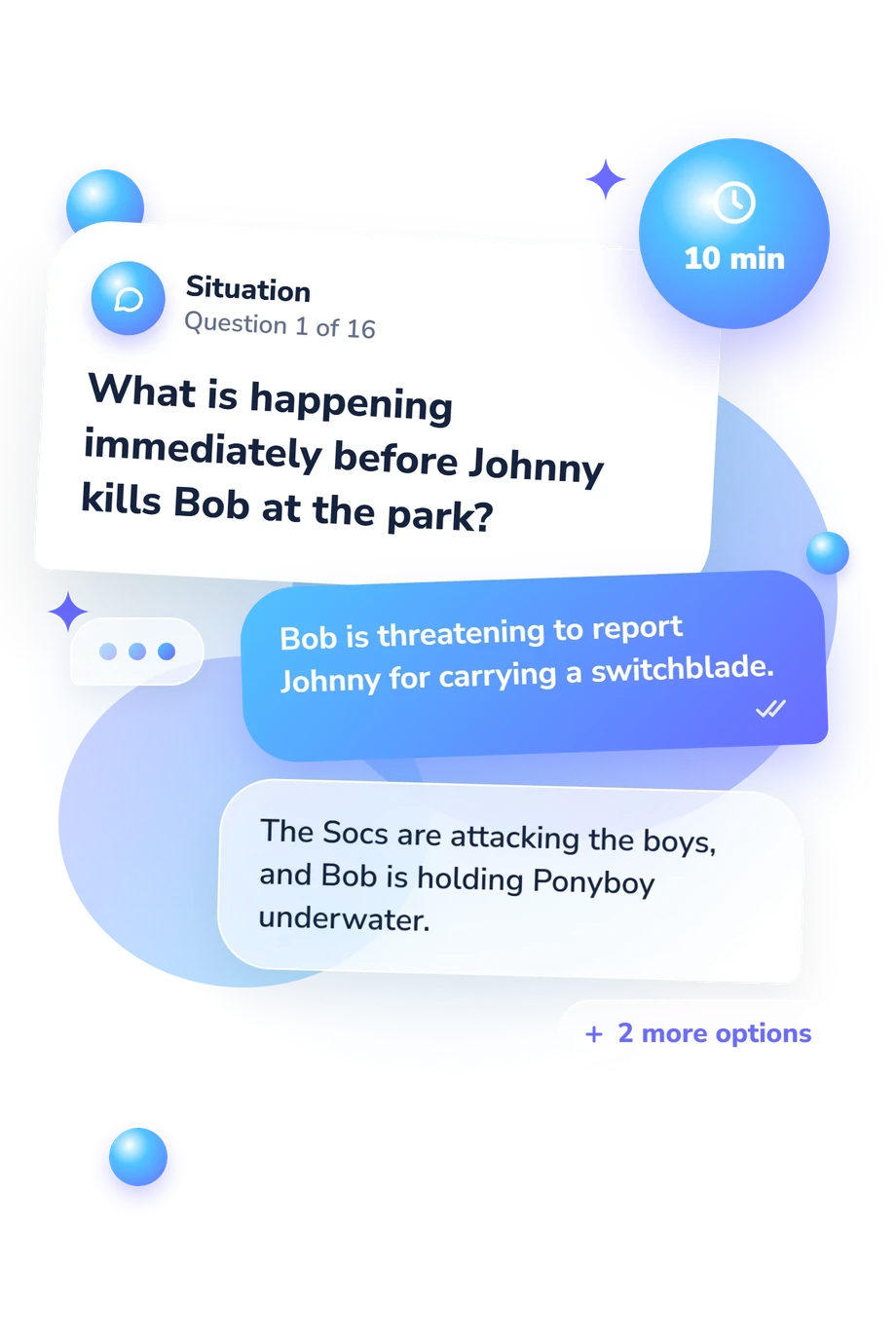
Example Questions From the Test
- Prove that the Greasers can defeat the Socs without help.
- Forget painful events by leaving Tulsa permanently.
- Accept that toughness matters more than emotion.
- Preserve his sensitivity and ability to value beauty.
- They attend schools with competing academic programs.
- They occupy different social and economic positions.
- They disagree over which Curtis brother should lead the Greasers.
- They belong to rival groups from neighboring towns.
- She gives Ponyboy money to hire a lawyer for Johnny.
- She passes along information about the Socs' plans.
- She hides Dally from the police at her family's home.
- She persuades the Socs to cancel the rumble completely.
The Outsiders Comprehension Quiz - Description and methodology of the test
Students and independent readers who want to connect recalled events with motives, conflicts, and themes can use The Outsiders Comprehension Quiz for discussion preparation or focused rereading. This Outsiders book quiz provides a structured way to revisit the novel rather than relying on a general impression. The result summarizes how securely the story’s events, characters, conflicts, symbols, and themes are understood.
What This Assessment Explores
The questions link events with motives, relationships, symbols, social class, and violence. This Outsiders reading quiz suits students, class discussion, and rereading.
The result uses The Outsiders Knowledge, with a 0-16 range. Its bands are Foundation to revisit (0-6), Developing comprehension (7-12), and Strong comprehension (13-16). The scale describes understanding of events, character choices, symbols, and themes. These bands can show how securely the respondent understands the novel and which details may merit review.
The main thematic groups are:
- Plot and sequence connect key events, locations, rescues, deaths, and the rumble’s outcome.
- Character understanding captures narration, motives, changing relationships, and difficult choices.
- Themes and symbols link “stay gold,” the title, class division, and identity.
- Interpretation asks readers to connect a decision, message, or assignment with the ending.
Together, these areas show whether recall supports a coherent reading.
Methodology and Evidence Base
Each item asks about the novel and offers four answer choices. The set combines recall with sequence tracking, causal reasoning, character interpretation, and thematic reading. For readers using it as an Outsiders comprehension test, the format rewards answers grounded in the novel rather than personal opinion.
The questionnaire presents one displayed result for this knowledge scale. It summarizes recall and interpretation of events, character choices, symbols, and themes, giving the respondent a focused check on this novel at completion. The result is an educational summary, not an official assessment.
The literary reference is Hinton (1967), and the questions assess literary-text comprehension through recall, sequencing, causal links, and interpretation. Fecteau (1999) addresses literary understanding, while Palincsar (2003) and Palincsar and Brown (1984) discuss questioning, clarifying, and connecting ideas. These studies provide broad conceptual context; they did not create, standardize, or validate this online questionnaire or its four-choice format.
Memory, rereading, discussion, and concentration can affect the result, so use it to guide review rather than measure literary skill in full.
- Hinton, S. E. (1967). The Outsiders. New York: Viking Press.
- Fecteau, Monique L. (1999). First- and Second-Language Reading Comprehension of Literary Texts. The Modern Language Journal, 83(4), 475-493. 10.1111/0026-7902.00036.
- Palincsar, Annemarie Sullivan. (2003). Collaborative Approaches to Comprehension Instruction. In Anne Polselli Sweet and Catherine E. Snow (Eds.), Rethinking Reading Comprehension (pp. 99-114). New York: Guilford Press.
- Palincsar, Annemarie Sullivan, and Ann L. Brown. (1984). Reciprocal Teaching of Comprehension-Fostering and Comprehension-Monitoring Activities. Cognition and Instruction, 1(2), 117-175. 10.1207/s1532690xci0102_1.
Updated: