
South America Capitals Quiz
How the Scales are Structured
Who Usually Takes This Test?
See How You Compare
Below is a preview of how scores are typically distributed across each scale.
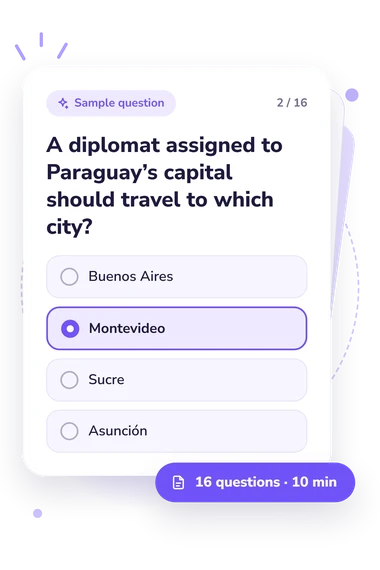
Example Questions From the Test
- Buenos Aires
- Montevideo
- Sucre
- Asunción
- Asunción
- Montevideo
- Santiago
- Buenos Aires
- Buenos Aires, Montevideo, Asunción
- Buenos Aires, Asunción, Montevideo
- Santiago, Montevideo, Asunción
- Montevideo, Buenos Aires, Asunción
South America Capitals Quiz - Description and methodology of the test
Anyone preparing for travel, studying regional geography, or checking personal recall can use South America Capitals Quiz to assess national capitals, country-city pairings, and geographic memory. The questions focus on named cities and show an overall level of demonstrated knowledge, making this a South America countries and capitals quiz with an applied geography focus.
What This Assessment Explores
This assessment checks recall of South American national capitals, from familiar pairings to less commonly tested countries. It also asks whether a respondent can follow a capital route, spot a mismatched country-city pair, and distinguish Bolivia’s constitutional capital from its seat of government. For learners reviewing country-city links, this capitals of South America quiz gives a practical check of country-capital knowledge with an applied geography focus.
The result is reported on the South America Capitals Knowledge scale, scored from 0-16 with one point for each correct answer. It is shown in three bands:
- Foundations 0-6 indicates partial recall and likely confusion among neighboring countries.
- Developing 7-12 shows that many pairings are secure, while some geographic gaps remain.
- Strong 13-16 reflects broad, accurate knowledge, including less familiar capitals and Bolivia’s constitutional distinction.
Methodology and Evidence Base
Each item presents a geographic prompt with four answer choices. The set combines direct recall with travel sequences, correction tasks, country-capital matching, and Bolivia’s special constitutional case. One selected response is scored against the keyed answer: each correct answer adds one point. The total is interpreted through the displayed bands, which describe levels of answer accuracy.
The questions test established South American capitals, including the distinction between Sucre as Bolivia’s constitutional capital and La Paz as its seat of government. UN Geospatial provides a geographic reference for national capitals, and Bolivia’s constitution supports that distinction. These sources support the factual content; they do not validate or standardize this online questionnaire.
As a South American capitals quiz, it is a fixed-answer knowledge check with displayed score bands rather than a norm-referenced psychological measure. Performance may vary with education, travel experience, language familiarity, and attention, so a lower band suggests that broader country-capital review may be useful rather than setting a fixed limit on ability.
- UN Geospatial. South America. United Nations, 20 May 2020.
- Roman Adrian Cybriwsky. Capital Cities around the World: An Encyclopedia of Geography, History, and Culture. ABC-CLIO, 2013. DOI 10.5040/9798400623233.
- Plurinational State of Bolivia. Political Constitution of the Plurinational State of Bolivia. 2009.
- H. Micheal Tarver and Carlos E. Márquez Petit, eds. South America: From European Contact to Independence. Bloomsbury Academic, 2025. DOI 10.5040/9798765118214.
Updated: